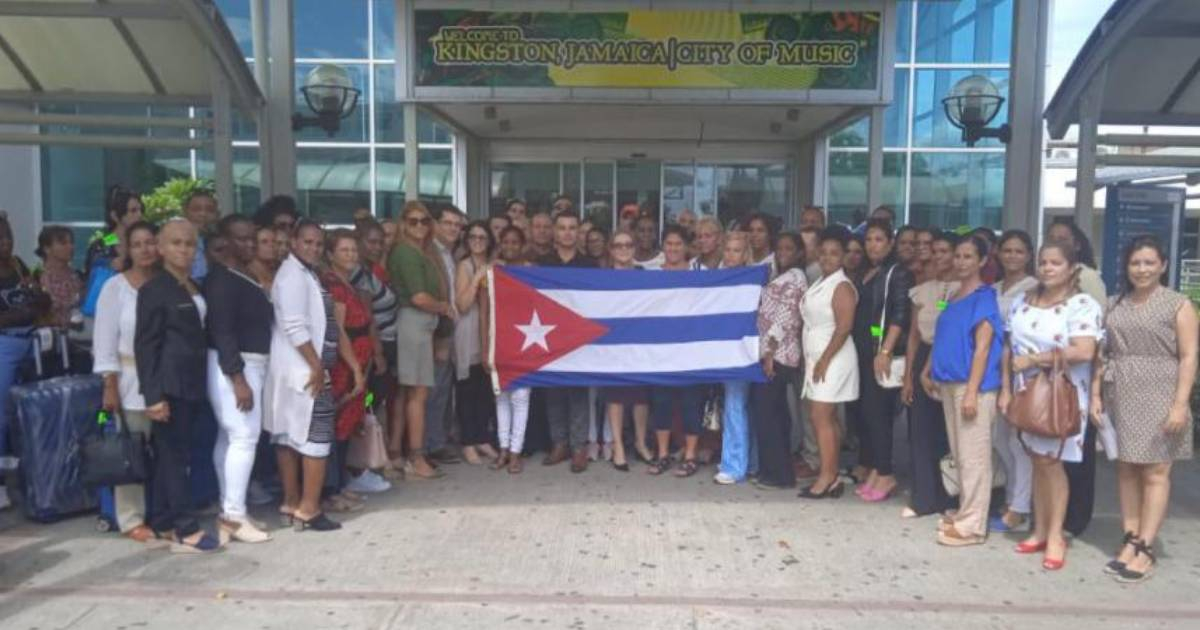
The Jamaican government has unveiled further insights into the reasons behind the conclusion of its longstanding medical collaboration with Cuba, a partnership that, for nearly fifty years, brought numerous Cuban healthcare professionals to the Caribbean nation's health system.
In an official statement echoed by local media, the Ministry of Foreign Affairs and Foreign Trade elaborated on its review of the agreement following international apprehensions about Cuban medical programs. Jamaican authorities emphasized the need to ensure compliance with both local legislation and international labor standards.
While the review found no issues regarding labor treatment, housing, licensing, or the freedom of movement for Cuban professionals in Jamaica, it also identified several concerning issues necessitating immediate correction, according to the government.
One major issue was that many Cuban professionals did not possess their own passports. Upon discovering this, the Jamaican government took steps to ensure workers retained their travel documents.
Additionally, the investigation revealed that although Cuban doctors' salaries were aligned with those of their Jamaican counterparts, payments were not made directly to the professionals. Instead, Jamaica transferred payments in U.S. dollars to the Cuban government, while the doctors received only overtime pay directly from the Jamaican government.
Authorities also noted the absence of a clause in the agreement specifying how much of these salaries should ultimately reach the workers, raising concerns about labor and tax legislation compliance, as well as international agreements.
In light of these issues, Jamaica sought to renegotiate the agreement with Havana over several months to align with domestic laws. Formal discussions commenced in July of the previous year, followed by official proposals in October and December.
"For absolute clarity, the Government of Jamaica proposed the continuation of the program with adjustments," the document states. Nonetheless, despite attempts to engage with Cuban diplomatic representatives, the government reported receiving no substantive response from the island's authorities.
Jamaica concluded that the lack of response perpetuated an arrangement that could no longer be legally justified, ultimately deeming the continuation of the program in its current form unsustainable.
This announcement follows Jamaica's March 5 declaration that it would cease renewing the medical collaboration agreement with Cuba, effective since 1976. Jamaican authorities indicated that existing contracts would be honored and the Ministry of Health could individually hire professionals under local labor laws.
Following this decision, the Cuban government announced the withdrawal of its medical brigade from Jamaica, attributing the move to U.S. pressure against the island's medical programs.
Official data from Havana revealed that at the time of the agreement's termination, 277 Cuban health professionals were serving in Jamaica. The Cuban government asserted that over the decades, thousands of its doctors cared for millions of patients in the Caribbean nation and contributed to public health initiatives, disease control, and ophthalmological care.
The program's end also sparked reactions within Jamaica. Opposition health spokesperson Dr. Alfred Dawes described the decision as “deeply unfortunate,” while Senator Donna Scott-Mottley, the opposition's foreign affairs spokesperson, urged the government to provide a comprehensive explanation for the agreement's termination and clarify plans to ensure the continuity of health services in facilities staffed by Cuban doctors.
The issue has also fueled public debate. Jamaican-American actress Sheryl Lee Ralph took to social media to question whether the United States would dispatch physicians to meet the island's healthcare needs following the Cuban brigade's departure.
The cancellation of the agreement in Jamaica occurs amid increasing international scrutiny of Cuban medical missions, a significant source of foreign currency for the Havana government. Washington has criticized these missions as involving labor exploitation, accusations that Cuba denies while defending its healthcare cooperation programs in numerous countries.
Understanding Jamaica's Termination of the Cuban Medical Program
What led Jamaica to end the medical program with Cuba?
Jamaica ended the program due to concerns over compliance with local laws and international labor standards, particularly regarding salary payments and the possession of travel documents by Cuban professionals.
How did the payment structure for Cuban doctors in Jamaica work?
Cuban doctors' salaries were aligned with Jamaican counterparts, but payments were made to the Cuban government, with doctors receiving only overtime pay directly from Jamaica.
What was the response from the Cuban government?
The Cuban government decided to withdraw its medical brigade from Jamaica, citing U.S. pressures against its medical initiatives as the reason for Jamaica's decision.