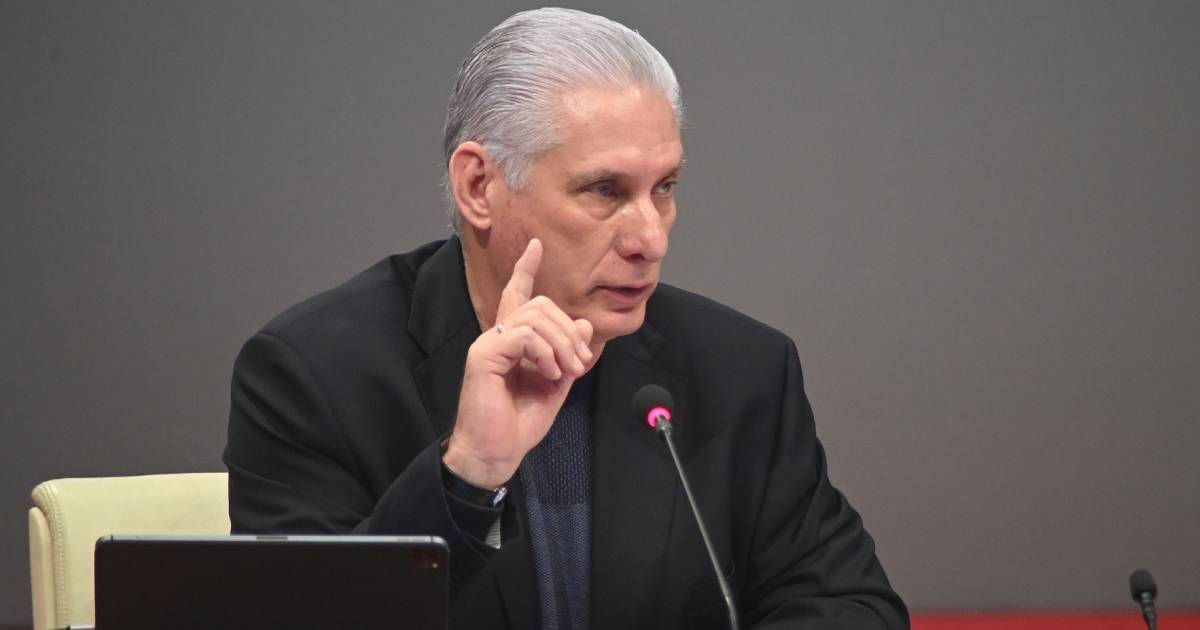
Ricardo Pascoe, a political analyst and former Mexican ambassador to Cuba, has stated that the potential exit of Miguel Díaz-Canel from power would not lead to the downfall of the Cuban regime, despite recent speculations about a possible leadership change on the island.
In an interview with Univisión, Pascoe argued that the Cuban political system possesses a more cohesive structure compared to other authoritarian regimes in the region. Therefore, removing the current leader wouldn't necessarily result in a significant shift in power control.
"The Cuban situation is not the same as Venezuela," the analyst remarked, warning that the United States would err by attempting to implement a strategy similar to its actions in Venezuela, which led to the capture of Nicolás Maduro. According to Pascoe, the Cuban regime could easily replace Díaz-Canel with another leader from the same political elite.
These comments emerge amid escalating international pressure on Havana and rumors of potential leadership changes at the top echelons of power.
Recently, media reports indicated that President Donald Trump's administration had floated the idea of Díaz-Canel's removal as part of discreet contacts with figures close to Cuba's ruling circle. These reports suggest that Washington views Díaz-Canel as a hindrance to economic and political reforms within the context of broader negotiations with the regime.
The discussions reportedly occurred outside official diplomatic channels, involving advisors to Secretary of State Marco Rubio and Raúl Guillermo Rodríguez Castro, the grandson of General Raúl Castro and a notable figure linked to GAESA, the military conglomerate that dominates much of the island's dollarized economy.
In this scenario, several analysts have pointed out that true power in Cuba remains concentrated around Raúl Castro and the military, downplaying Díaz-Canel's political influence within the regime's structure.
The debate over the leader's future coincides with significant economic and political pressure on Havana. During the recent Shield of the Americas Summit in Miami, President Trump stated that Cuba is experiencing "its final moments" under the current political system and suggested that the country could undergo profound change in the near future.
"Cuba is at the end of the line. They have no money. They have no oil. They have a bad philosophy and a bad regime," the U.S. President declared before regional leaders at the summit.
Trump also confirmed that his administration is engaged in discussions with Cuban power representatives and hinted that an agreement with Havana could be reached relatively easily.
Despite these expectations for change, Pascoe emphasized that Díaz-Canel's potential departure alone wouldn't trigger a structural transformation of the Cuban political system.
According to the analyst, the regime has shown over decades a strong internal adaptability, allowing it to replace visible figures without disrupting the actual mechanisms of power control.
In this context, the debate over Cuba's future remains open, as external pressures mount and uncertainty grows about how the ruling elite might act to preserve the political system amid one of the deepest economic and social crises the island has faced in decades.
Insights on Cuba's Political Future
Why wouldn't Díaz-Canel's departure lead to a regime collapse?
The Cuban political system is tightly structured, allowing it to replace leaders without fundamental changes to its control mechanisms.
What role does Raúl Castro's circle play in Cuba's power dynamics?
Raúl Castro's circle, including the military, retains significant influence, overshadowing Díaz-Canel's political power within the regime.
How is the U.S. involved in potential leadership changes in Cuba?
The Trump administration reportedly engaged in discussions with figures close to Cuba's leadership, exploring Díaz-Canel's removal as part of broader negotiations.