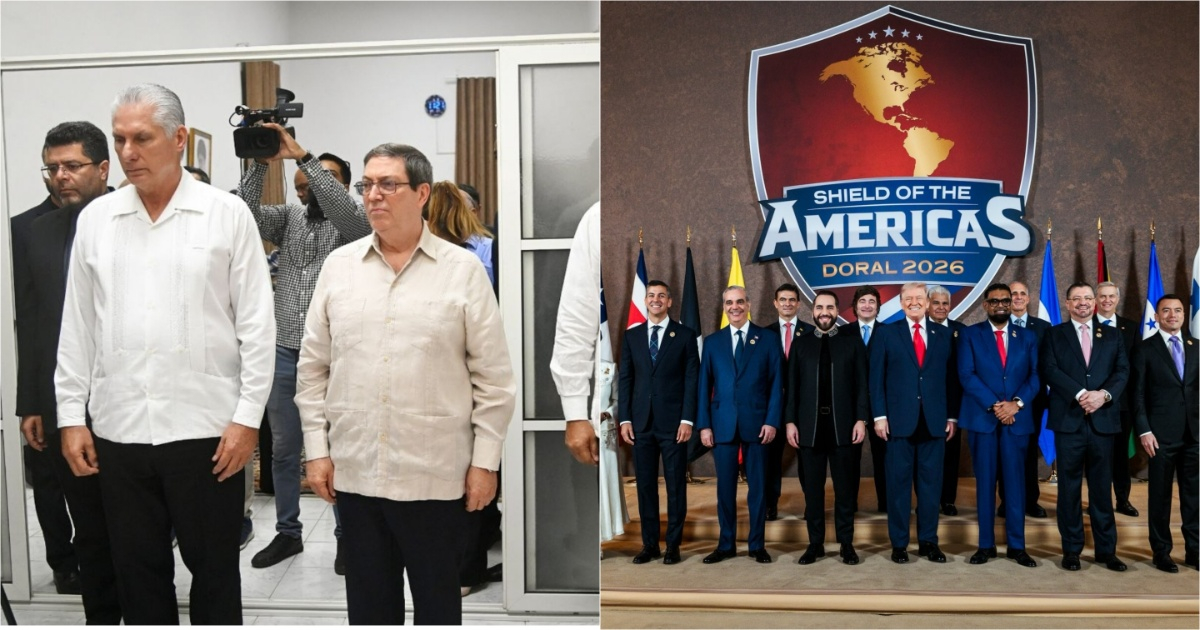
The Cuban regime's Foreign Minister, Bruno Rodríguez Parilla, voiced his disapproval on Saturday of a gathering dubbed 'Shield of the Americas,' which brought together leaders from 12 Latin American nations in Miami with Trump and Marco Rubio.
Rodríguez criticized the event, describing it as a "mini-summit" organized by the U.S. in Florida with "reactionary" regional governments. He claimed it aimed to pressure these nations into accepting a renewed form of dominance through the Monroe Doctrine and its corollaries, effectively demanding greater subordination to the northern power.
He further condemned the summit, stating the only disclosed outcome was the signing of a "servile and disgraceful document" by the attendees, advocating for the use of military force, particularly by the U.S., as a tool to repress criminal cartels and address internal and border issues.
Rodríguez Parilla views the summit as a "clear and dangerous setback in the long, arduous journey towards independence for Latin American and Caribbean peoples," as well as a significant threat to regional peace, security, stability, and integrity, violating the Proclamation of Latin America and the Caribbean as a Zone of Peace.
Cuban Leadership's Condemnation
Alongside Rodríguez, Cuban leader Miguel Díaz-Canel also criticized the Shield of the Americas summit. In a message on X, Díaz-Canel labeled the gathering as "small," "reactionary," and "neocolonial," accusing the United States of coercing right-wing regional governments into endorsing the lethal use of U.S. military force to manage internal challenges within their countries.
Díaz-Canel asserted that the event, convened by the U.S. with participation from right-leaning governments, compelled these nations to accept the lethal use of American military power for handling internal order and tranquility issues.
He portrayed this interpretation as a broader regional threat, stating that it constituted "an assault on the Proclamation of Latin America and the Caribbean as a Zone of Peace." He added that the summit was also "an attack on regional integration aspirations" and demonstrated a willingness to submit to the interests of the powerful northern neighbor under the Monroe Doctrine's principles.
The Summit's Context
On Saturday, President Donald Trump organized a summit called 'Shield of the Americas' at the Trump National Doral resort in Miami, assembling leaders from 12 Latin American and Caribbean nations to establish a regional coalition against drug trafficking, cartels, illegal immigration, and transnational organized crime.
White House spokesperson Karoline Leavitt announced the event last Thursday, describing it as a historic initiative. "The president will engage in discussions with these countries' leaders, who have formed a historic coalition to collaborate on addressing illegal and mass migration, as well as the threat posed by criminal gangs, drug traffickers, and terrorists," Leavitt stated.
The summit included leaders such as Javier Milei (Argentina), Nayib Bukele (El Salvador), Daniel Noboa (Ecuador), Santiago Peña (Paraguay), Luis Abinader (Dominican Republic), José Raúl Mulino (Panama), Rodrigo Chaves (Costa Rica), and Nasry Asfura (Honduras), alongside representatives from Trinidad and Tobago and Bolivia. Also present was José Antonio Kast, the president-elect of Chile, who will take office on March 11, becoming the first far-right leader in Chile since the return to democracy.
Cuba's Role in the Summit
During his address at the summit, Trump mentioned that Cuba "wants to negotiate" with his administration. He stated that these discussions involve Secretary of State Marco Rubio and himself, suggesting that an agreement with Havana could be reached "very easily."
"And they want to negotiate. They're negotiating with Marco and me, and some others. I believe a deal with Cuba could be achieved very easily," Trump asserted.
Trump depicted Cuba as a nation teetering on the brink of economic and political collapse. He claimed the island is "at the end of the road," lacking money and oil, attributing this situation to what he described as "a bad philosophy" and "a bad regime that has been bad for a long time."
He also noted that, historically, Cuba received support from Venezuela, but suggested that this backing has vanished. As an example of the crisis, Trump highlighted the shortage of fuel in Cuba, stating there isn't enough even for air operations.
Understanding the Implications of the Summit
What was the main purpose of the 'Shield of the Americas' summit?
The summit aimed to formalize a regional coalition against drug trafficking, illegal immigration, and transnational organized crime, bringing together leaders from 12 Latin American and Caribbean nations.
How did Cuban leaders respond to the summit?
Cuban leaders, including Bruno Rodríguez Parilla and Miguel Díaz-Canel, criticized the summit as reactionary and neocolonial, accusing the U.S. of coercing regional governments into accepting military force as a solution to internal problems.
What were President Trump's remarks about Cuba at the summit?
Trump claimed that Cuba is eager to negotiate with his administration, portraying the country as economically and politically unstable, and suggested that an agreement with Cuba could be easily achieved.