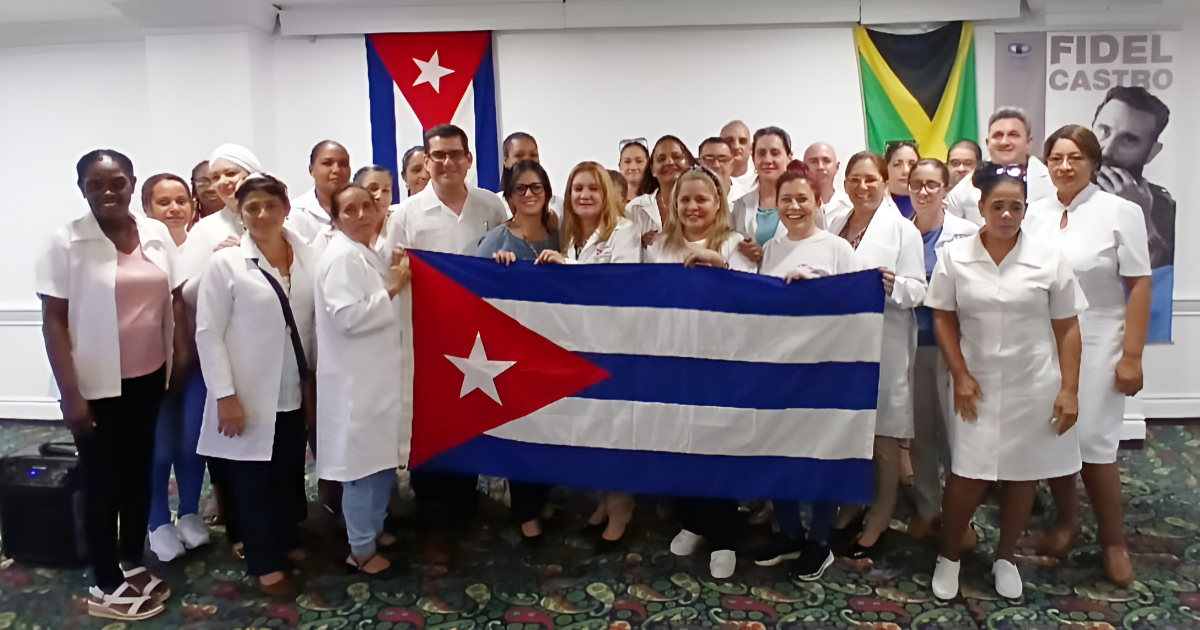
The U.S. Embassy in Havana has publicly praised Jamaica's decision to terminate its state-run program with Cuban medical brigades, marking another chapter in the growing international pressure against one of the Cuban regime's main revenue-generating initiatives.
This statement was shared on the social media platform X by the U.S. diplomatic mission in Cuba, quoting Jeremy Lewin, a Senior Official from the State Department associated with the financial affairs subsecretariat.
"We commend Jamaica, a close partner, for halting the use of Cuban medical brigades. These brigades are a significant source of cash for the Cuban regime and one of the most egregious examples of modern slavery. They must end everywhere," Lewin declared.
The U.S. response follows the Jamaican government's announcement that it will cease to renew its medical collaboration program with Cuba, which had allowed the island's healthcare professionals to work in the Caribbean nation for years.
Jamaica clarified that this shift does not close the door to Cuban doctors, but it does signify the end of the state agreement with Havana. Moving forward, professionals can work in Jamaica through individual contracts under local labor laws, eliminating direct Cuban government mediation.
The medical missions program is a major source of foreign currency for the Cuban regime. Investigations and testimonies from participating doctors indicate that the state retains most of the salaries paid by host countries, leaving professionals with only a fraction of the compensation.
Washington has consistently criticized this system as a form of labor exploitation. In recent years, U.S. authorities have labeled these medical brigades as potential forced labor schemes and have engaged in diplomatic efforts to pressure governments maintaining agreements with Cuba.
Within this context, Lewin's remarks highlighted the economic significance of these missions for Havana, emphasizing that the model "must end everywhere."
Regional Shift in Medical Collaborations
Jamaica's decision is part of a broader regional trend in Latin America and the Caribbean, where several governments are re-evaluating or ending their agreements with Cuban medical brigades amid U.S. diplomatic pressure and increasing criticism over the working conditions of the professionals sent by Havana.
Recently, countries like Honduras and Guyana have terminated their agreements with Cuba, while Guatemala announced its plan to progressively phase out the contracts of the medical brigade within its borders.
In instances like Jamaica's, authorities have opted to remove the state agreement with the Cuban government and allow direct hiring of doctors under local labor laws. This shift is significant because it reduces the Cuban state's control over contracts and payments associated with these missions.
International investigations and numerous reports suggest that the Cuban regime retains a large portion of the wages paid by host countries for medical services, making these brigades a primary source of foreign currency for the island.
The United States has ramped up its diplomatic offensive against this system, accusing it of functioning as a labor exploitation scheme that deprives Cuban professionals abroad of their rights.
U.S. officials maintain that doctors should have the opportunity to work directly with the countries hiring them and receive their full salaries.
The issue has also sparked tensions in other Caribbean nations. While some governments have begun to dismantle these agreements, others acknowledge their healthcare systems' heavy reliance on Cuban medical personnel, complicating any immediate break with Havana.
Amid Cuba's severe economic crisis, the potential reduction in contracts for overseas medical missions poses a significant threat to one of the regime's most crucial sources of foreign currency. As a result, every cancellation or renegotiation of these agreements is closely monitored by both Washington and Havana.
Key Questions about U.S. Diplomatic Efforts on Cuban Medical Missions
Why did Jamaica decide to end its agreement with Cuban medical brigades?
Jamaica chose to end its agreement to align with U.S. diplomatic pressure and concerns over labor conditions, opting instead to allow direct hiring of Cuban doctors under local laws.
How does the Cuban medical missions program affect the country's economy?
The program is a major source of foreign currency for Cuba, as the state retains a significant portion of the salaries paid by host countries for medical services.
What is the U.S. stance on Cuban medical brigades?
The U.S. views the medical brigades as a form of modern slavery and labor exploitation and has been actively pressuring countries to end these agreements.