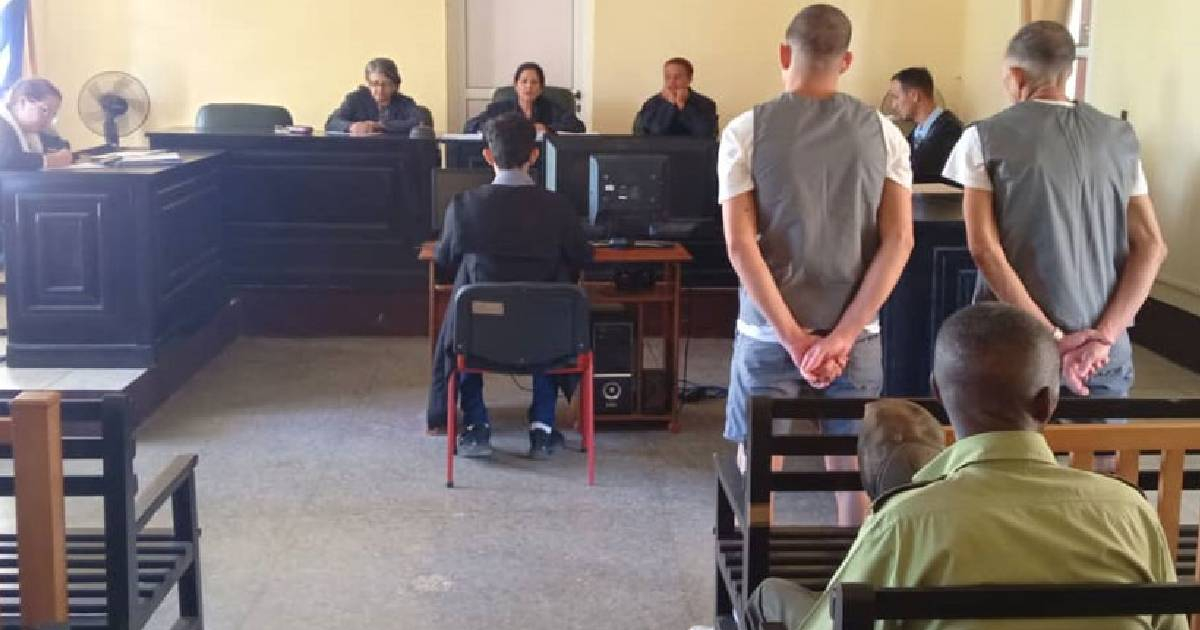
In Ciego de Ávila, two men have been sentenced to nine and seven years in prison for their involvement in the theft of approximately 50,000 screws meant for the assembly of metal structures supporting solar panels.
The official newspaper Invasor reported on Friday that the Criminal Chamber of the Provincial Court in this central province recently issued a guilty verdict against the individuals charged with sabotage, as defined under Article 125 of the Penal Code. This charge was due to the "misappropriation of resources intended for a project of high importance to the National Electric System."
Within the context of Case No. 2 of 2026, the court confirmed the defendants' involvement in the theft during what was described as an "exemplary" trial, according to the source.
The authorities highlighted that the theft resulted in an economic loss exceeding 620,000 pesos for the Electric Company, factoring in the costs of procuring and transporting replacement materials, as well as delays in the project's timeline.
The court's decision took into account the "high level of harm" caused, its economic and social ramifications, the current national climate, and the strategic importance of energy sector investments.
The personal circumstances of the accused, their admissions to authorities, and their cooperation during the investigation were also considered.
Following the judicial process, both individuals received prison sentences of nine and seven years, respectively.
The verdict also includes additional penalties such as the deprivation of public rights and a ban on leaving the country.
Furthermore, the court ordered the defendants to compensate for the material damage inflicted on the Cuban state, estimated at 617,907.77 pesos.
The official report indicated that procedural guarantees outlined in the Constitution and the Criminal Procedure Law were upheld during both the investigation and the trial.
Both the convicted individuals and the prosecution retain the right to appeal the court's decision.
This trial announcement comes amidst Cuba's most severe energy crisis in recent years, characterized by prolonged blackouts, generation deficits exceeding 1,800 MW during peak times, and an outdated thermoelectric system plagued by frequent breakdowns.
In this context, authorities have emphasized the rapid construction of solar parks as a key strategy to mitigate electricity shortages.
At the beginning of February, the Electric Union boasted about achieving a "record" of over 800 MW of photovoltaic generation during a midday peak, while state media highlighted the installation of more than 1,000 MW of solar capacity by 2025.
However, these daytime production highs starkly contrast with the nighttime reality of the electrical system, where demand surpasses 3,000 MW and availability barely reaches between 1,200 and 1,300 MW, leading to widespread power outages nationwide.
FAQs on the Cuban Energy Crisis and Solar Initiatives
What was the reason behind the severe sentencing of the accused?
The court imposed severe sentences due to the high level of harm caused by the theft, its economic and social impacts, and the strategic importance of the energy sector projects.
How does the theft of screws affect the solar panel projects in Cuba?
The theft led to an economic loss for the Electric Company, increased costs for replacement materials, and delays in solar panel project timelines, hindering efforts to address the energy crisis.
Why is the Cuban government focusing on solar energy projects?
The Cuban government is speeding up solar energy projects to alleviate electricity shortages, as the country deals with an outdated thermoelectric system and severe energy deficits.