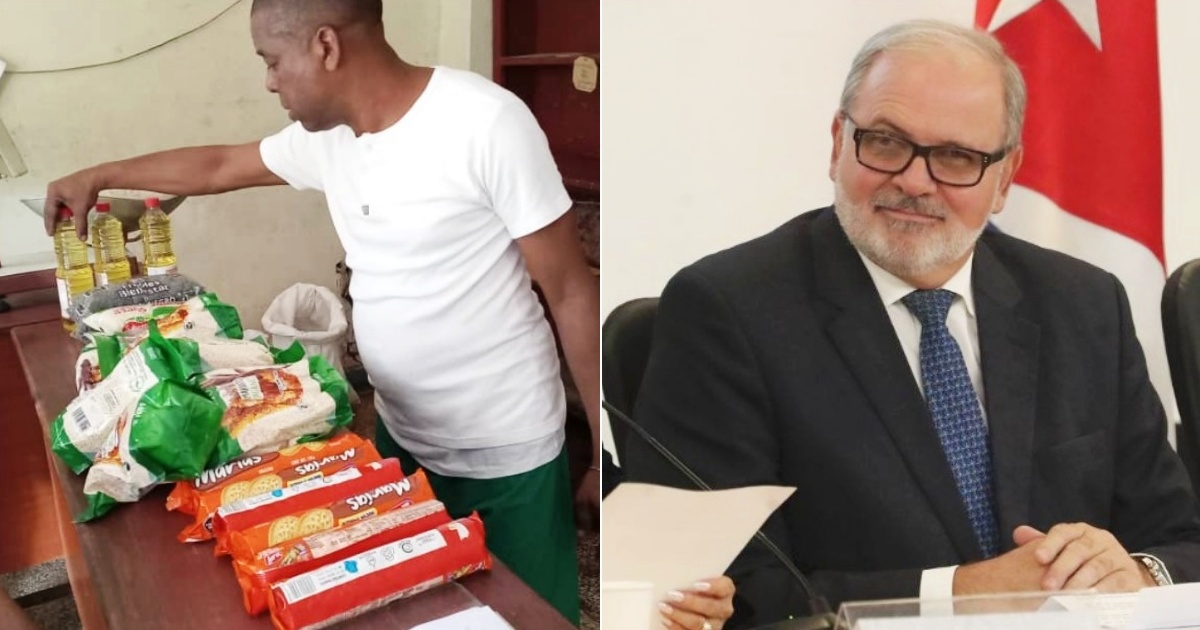
The Cuban Ambassador to Mexico, Eugenio Martínez Enríquez, has firmly denied the claims that items sent as humanitarian aid from Mexico are being sold in foreign currency stores on the island. He accused the Mexican channel, TV Azteca, of spreading "lies and misinformation" about the fate of these donations.
In a detailed statement shared on Facebook this Thursday, the diplomat defended the Cuban government's handling of the aid, asserting that "the help is indeed for the Cuban people," while dismissing the narrative presented by the Mexican media as false.
"The generous aid offered to the Cuban people by the Mexican government and thousands of Mexicans and Cubans, through the donation and delivery of food, medicines, and other essentials, is being smeared by TV Azteca," Martínez Enríquez declared in his statement.
Claims of Political Motives
Martínez Enríquez suggested that the Mexican channel aims to undermine the solidarity between the two countries with information he claims lacks evidence. "Rather than inform, their news coverage is tied to political objectives. To reinforce this pattern, this outlet lies and misinforms," he wrote.
Clarifying the situation, the ambassador stated that images or reports showing Mexican products for sale in Cuba are not related to donations but are instead items imported via commercial contracts. "Without providing evidence, because none exists, TV Azteca accuses Cuban authorities of selling the aid sent," the diplomat asserted.
Understanding the Importation Context
He further explained that in 2025, Cuba imported food products from Mexico worth tens of millions of dollars through formal commercial operations. "The ruse involves presenting as evidence the sale in Cuba of products that Cuban public or private companies imported from Mexico through purchase agreements. In 2025, Mexico exported food industry products to Cuba valued at several tens of millions of U.S. dollars. Of course, those are sold in stores," he stated.
Martínez Enríquez also confirmed that the humanitarian aid sent by the Mexican government and its citizens is being distributed free of charge to the population, particularly to the most vulnerable sectors. "The aid is being distributed transparently and with ample evidence, prioritizing vulnerable sectors such as pregnant women, children, the sick, and the elderly," he claimed.
Direct Criticism of TV Azteca
The ambassador's statement included sharp criticism of the Mexican media outlet that broadcasted the investigation. Martínez Enríquez argued that the allegations are part of a political campaign and insisted that the solidarity between Mexico and Cuba won't be tarnished by what he labeled as "slanders." "In no way will the solidarity of the brotherly Mexican people and the grateful reception of the Cuban people be tainted by the slander of media complicit in the crime that is the U.S. blockade against the Cuban people," he declared.
In a direct message to the channel's owners, he added, "We invite TV Azteca's owners to focus on fixing their finances and paying their massive debts owed to their creditors. With their customary lies, they won't achieve their goals. Things are not going well for them."
The ambassador also attributed the worsening crisis on the island to U.S. sanctions, which he claimed have restricted access to fuel and impacted production and essential services.
The Controversy Surrounding TV Azteca's Report
The diplomat's response came after TV Azteca aired a report accusing that goods sent as humanitarian aid from Mexico are being sold in Cuban state stores that operate in dollars. The investigation, presented by journalist Rodrigo Lema, claimed that some of the donated food items, including the so-called "frijol del bienestar," are being sold in establishments linked to state-controlled and military sectors.
According to the report, 30-kilo sacks of beans are offered for $43 in wholesale distributors, while state stores sell the product for $2.97 per half-kilo. The report also included testimonies from citizens who claimed not to have received the donated food despite the arrival of aid ships in Havana Bay. Some interviewees noted that after these ships arrived, stores that were almost empty began selling Mexican-origin products.
Cuban Government's Stance
Cuban authorities have also rejected the allegations. The Ministry of Internal Commerce (MINCIN) declared that it is false that the products donated by Mexico are being sold in foreign currency stores. "The Ministry of Internal Commerce informs that the news circulating on digital social networks about the commercialization of products donated by the brotherly people and government of Mexico in foreign currency stores is false," the institution stated in a communiqué.
According to the ministry, the food sent as humanitarian aid continues to be distributed free of charge to the population through the country's network of warehouses. "The distribution and free delivery of the products to the population in the warehouses continue," the ministry assured, urging citizens to seek information only through official channels.
Political Reactions from the U.S.
The accusations have also sparked reactions in the U.S. political sphere. Cuban-American congresswoman María Elvira Salazar stated that she has warned for years that international aid sent to Cuba ends up benefiting the ruling elite. "While Cubans go hungry, the dictatorship turns international naivety into a business for the military and the regime's leadership," she wrote on the social network X.
The legislator concluded her message with a warning directed at the Cuban government: "They will fall. And they will be held accountable. Very soon."
As the controversy continues, the Cuban government maintains that the Mexican donations are being freely distributed among the population, whereas TV Azteca's report claims that some of these products have ended up in the foreign currency commercial circuit, which remains out of reach for most Cubans.
Frequently Asked Questions about Cuban Humanitarian Aid Allegations
What are the allegations against Cuba regarding donated goods?
The allegations claim that goods sent as humanitarian aid from Mexico are being sold in Cuban stores that operate in foreign currencies, undermining the intent of the donations.
How has the Cuban government responded to these claims?
The Cuban government has denied these claims, stating that the allegations are false and that the donated goods continue to be distributed freely to the population, especially the most vulnerable groups.
Who has criticized the Cuban government's handling of aid?
The criticisms have come from TV Azteca, which aired a report on the alleged sale of donated goods, and from Cuban-American congresswoman María Elvira Salazar, who accused the Cuban government of benefiting the elite with international aid.