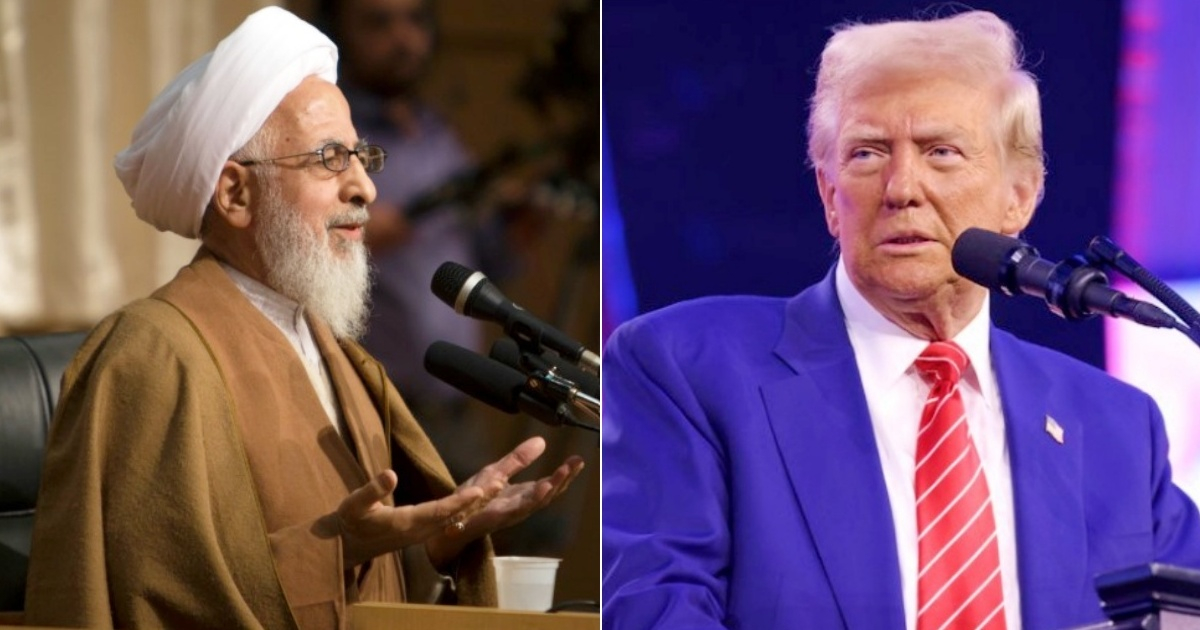
An influential Iranian cleric has made a public plea for the "blood of Trump" as tensions rapidly rise in the Middle East, with the conflict involving Iran, the United States, and Israel already claiming over a thousand lives and threatening to engulf the entire region.
The Ayatollah Abdollah Javadi Amoli, a highly respected figure within Iran's Shiite establishment, made this incendiary statement during a broadcast on state television. His comments rank among the most confrontational from a senior cleric since the onset of the conflict.
Amoli declared that Iran stands "on the brink of a significant test," openly advocating for violence against Washington and its allies. "Fight against the oppressive America, their blood is on my shoulders," he proclaimed, as reported by the Associated Press in recent hours.
He explicitly called for the "spilling of Zionist blood, the shedding of Trump's blood," directly referencing the American president. This pronouncement coincided with Iran launching a fresh wave of assaults against Israeli and American targets, while Israel announced the initiation of "large-scale" military operations against Tehran.
Missiles and Sirens in Israel
In the early hours of Thursday, the Israeli military reported detecting several waves of Iranian missiles, triggering air-raid sirens in Tel Aviv and Jerusalem. Israeli forces responded with "a wave of large-scale attacks" on Iranian infrastructure in the capital, though specific targets were not detailed in the military statement.
Subsequently, explosions were reported at various locations in Tehran, while Iranian state television indicated that American bases in the region were also targeted. Additionally, the Israeli army confirmed launching precise strikes in Lebanon against Hezbollah positions, broadening the scope of the conflict.
Sinking of an Iranian Frigate
Tensions escalated following the sinking of the Iranian frigate IRIS Dena by the United States Navy in the Indian Ocean. According to U.S. Defense Secretary Pete Hegseth, the vessel was destroyed Tuesday night by a torpedo fired from an American submarine.
Sri Lankan authorities reported that 87 Iranian sailors perished, while 32 crew members were rescued. Iranian Foreign Minister Abbas Araghchi condemned the attack as "an atrocity at sea." He stated, "The Dena frigate, invited by the Indian Navy and carrying nearly 130 sailors, was struck in international waters without prior warning," expressing his outrage on social media.
Araghchi further warned that Washington will face consequences. "Mark my words: The United States will come to bitterly regret the precedent it has set," he asserted.
The Attack That Triggered the War
The conflict erupted on Saturday when coordinated attacks by the United States and Israel targeted Iran, focusing on its political leadership and military infrastructure. These operations resulted in the death of Iran's supreme leader, Ayatollah Ali Khamenei, along with other high-ranking officials and assets linked to the country's missile and nuclear programs.
U.S. and Israeli officials have suggested that toppling Iran's theocratic government might be a strategic objective of the military campaign, although specific goals and timelines have frequently shifted.
The conflict has already spread beyond Iran and Israel, threatening to draw in other regional nations. A drone crash near the airport of Nakhchivan, an Azerbaijani enclave bordering Iran, and another incident near a school, which injured two civilians, were reported by the Azerbaijani Foreign Ministry.
In Qatar, authorities temporarily evacuated residents near the American embassy in Doha as a precaution. In Saudi Arabia, the military reported destroying a drone in a province bordering Jordan. An attack on an oil tanker off the coast of Kuwait was also recorded by the United Kingdom's Maritime Trade Operations Agency, heightening risks to international maritime trade.
Since the war's inception, incidents have occurred in the Gulf of Oman and the strategic Strait of Hormuz, through which nearly a fifth of the world's oil passes.
The death toll continues to climb. Iranian authorities have reported at least 1,045 casualties within their territory, while 11 people have died in Israel, along with six American soldiers, including a major whose identity was disclosed this week. In Lebanon, at least eight deaths have been linked to the conflict, including Israeli bombings in the Beddawi refugee camp in Tripoli.
The war has also disrupted global energy trade, with the price of Brent crude, an international benchmark, rising approximately 15% since the conflict began, driven by risks to navigation in the Strait of Hormuz.
The Trump administration has indicated that the military operation could last several weeks. During a Pentagon press conference, the defense secretary refrained from specifying a precise duration for the campaign. "It could be four weeks, but it could be six. It could be eight. It could be three," Hegseth stated. "Ultimately, we set the pace and the tempo. The enemy is off balance, and we will keep them off balance," he added.
Meanwhile, Iran's leadership attempts to regroup following Khamenei's death, seeking a new supreme leader—a process that has only occurred once since the 1979 Islamic Revolution. Among potential successors is Mojtaba Khamenei, the late ayatollah's son.
The head of Iran's judiciary warned that "those who cooperate with the enemy in any way will be considered enemies," signaling that the regime might further tighten internal repression as the war escalates.
Key Questions About the Middle East Conflict
What prompted the recent escalation in the Middle East?
The escalation was triggered by coordinated attacks from the United States and Israel targeting Iran's political leadership and military infrastructure, resulting in the death of Ayatollah Ali Khamenei and other significant figures.
How has the conflict affected global oil markets?
The conflict has disrupted global energy trade, with the price of Brent crude increasing by approximately 15% due to risks to navigation, particularly in the Strait of Hormuz, a vital oil transit route.