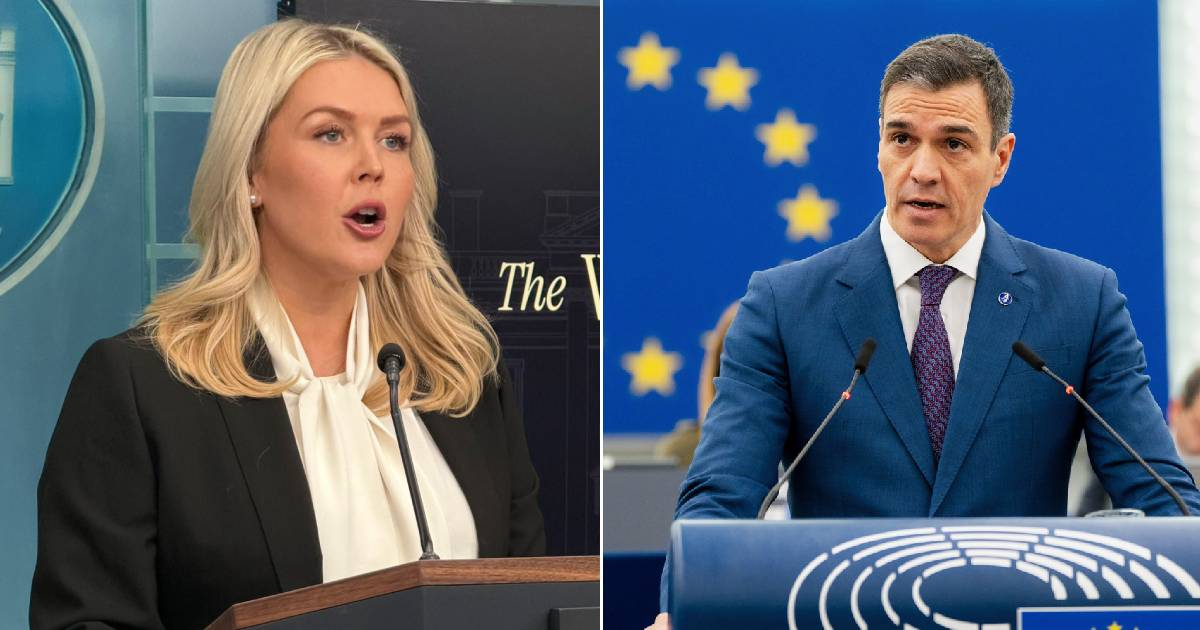
This Wednesday, the White House announced that the government led by Pedro Sánchez has agreed to work alongside the United States military, despite earlier statements opposing Spain's involvement in the conflict against Iran.
White House spokesperson Karoline Leavitt conveyed in a press briefing that Spain has clearly understood President Trump's stance and has recently agreed to collaborate with U.S. forces. This development comes after Donald Trump threatened to cease trade with the European nation.
"With regard to Spain, I believe they received the President's message loud and clear yesterday. From what I understand, they have agreed to cooperate with the U.S. military in the last few hours. Thus, I am aware that the U.S. military is now coordinating with their Spanish counterparts," stated the spokesperson.
Leavitt added that Trump expects all European allies to join the long-sought mission to "crush the rogue Iranian regime," which he accused of posing a threat to both the United States and Europe.
Yet, Spain’s Foreign Minister, José Manuel Albares, immediately refuted these claims on television, denying any recent communications with the U.S.
This exchange of statements follows shortly after Trump threatened to end all trade negotiations and bilateral relations with Spain due to its initial refusal to allow the use of Rota and Morón military bases.
In a joint press conference on Tuesday with German Chancellor Friedrich Merz, Trump expressed his readiness to "sever all trade ties with Spain," labeling the European country as "a terrible ally."
“No one will tell me whether I can use those bases or not,” Trump declared, clearly irritated by Spain's stance.
Subsequently, the White House suggested that Madrid might have reconsidered its position, indicating that coordination between the two militaries is underway.
However, earlier today, Pedro Sánchez reiterated the "No to War" sentiment, a slogan popularized during the 2003 Iraq invasion, to assert Spain's stance on the Middle East conflict following the U.S. and Israeli strikes on Iran and the subsequent military escalation in the region.
After Leavitt's remarks, Foreign Minister José Manuel Albares stated on television that her comments were unfounded and that Spain had not engaged in any discussion with Washington in recent hours.
This diplomatic clash occurs amidst the fourth day of military offensives against Iran. The U.S. and Israel have escalated attacks on strategic targets, while Tehran continues its missile and drone launches in retaliation.
Global tensions have also impacted financial markets; European stock exchanges closed with losses exceeding 3% amid fears of the conflict's potential expansion.
Spain-U.S. Military Cooperation and Diplomatic Tensions
Why did the White House claim Spain agreed to cooperate with the U.S. military?
The White House announced Spain's cooperation following President Trump's threat to end trade with Spain if they refused to collaborate on military efforts against Iran.
How did Spain's Foreign Minister respond to the White House statement?
Spain’s Foreign Minister, José Manuel Albares, denied any recent communication with the U.S., stating that the White House's claims were false.
What impact did the diplomatic tensions have on financial markets?
The ongoing tensions led to a decline in European stock markets, with losses exceeding 3% amid concerns over a possible escalation of the conflict.