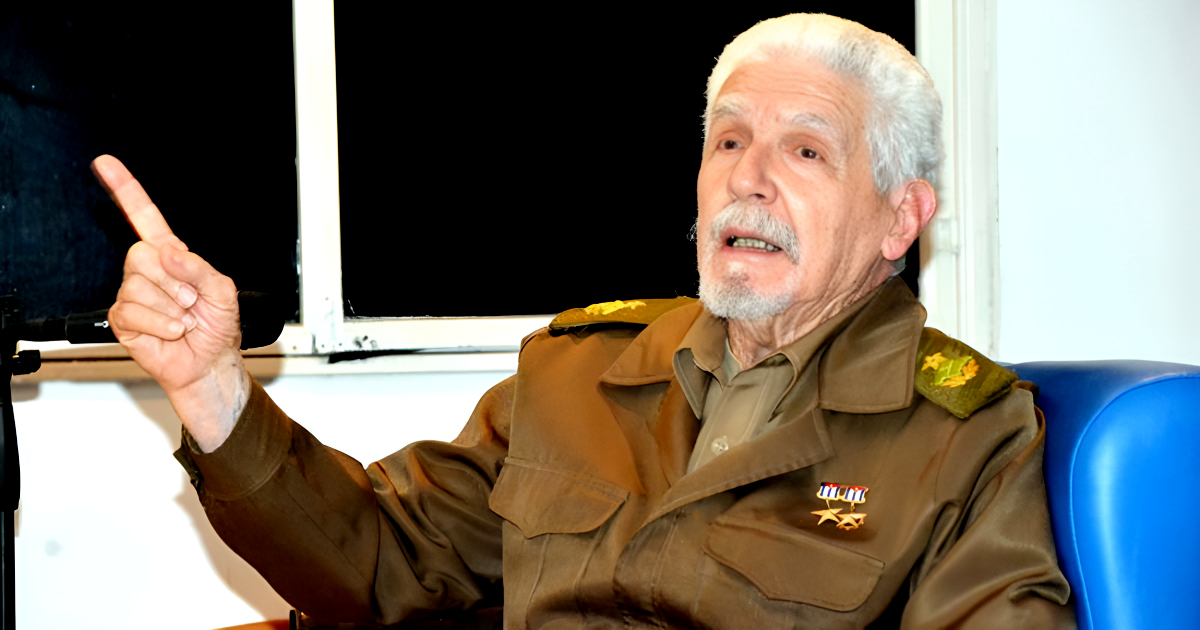
The question is quietly gaining traction, first on social media and now in broader discussions: where is Ramiro Valdés Menéndez?
The veteran commander of the so-called "revolution" and current Deputy Prime Minister of Cuba has been absent from the public eye for months, with no official explanation provided for his disappearance.
On Monday, March 2, another Council of Ministers meeting took place. Just as in several previous sessions since late 2025, Valdés Menéndez, now 93 years old, was notably absent. He was neither mentioned in the official report nor appeared in the images released by the state media. There was no acknowledgment of his absence. A complete silence.
This lack of explanation is particularly striking in a political system that often showcases its key figures as symbols of continuity and control.
Valdés, one of the oldest and most historically significant leaders within the regime's power structure, has been a consistent presence for years at strategic meetings, political events, and inaugurations linked to the energy sector.
However, his absence was especially glaring during the funerals of Cuban military officials who died in Venezuela during the capture of Maduro. He was not seen at the airport, nor during the honor guard, nor at the burial ceremonies, where nearly the entire regime's leadership was present.
His last verifiable public appearance dates back to September 2025, when he attended the inauguration of a photovoltaic solar park in Sancti Spíritus.
Since then, although new solar parks have been launched in various provinces as part of the government's strategy to address the severe energy crisis, he has not been seen or mentioned in any of these recent events.
His absence was also noted on January 27 during the traditional March of the Torches in Havana, one of the most significant propaganda events on the Cuban political calendar.
Valdés used to participate in this symbolic mobilization, historically attended by the country's top leaders. This year, however, he was missing from the official images and reports disseminated by state media.
His absence from the propaganda event coincided with that of two other nonagenarian commanders of the "Cuban revolution": Raúl Castro and José Ramón Machado Ventura.
He was also absent from high-profile events held in recent months, as well as from recent parliamentary sessions. His name did not appear in the reports of the Council of Ministers in October, November, and December 2025. Now, in March 2026, the situation remains unchanged.
The authorities have issued no statement explaining whether it is a health issue, a temporary withdrawal, or an internal restructuring. In a country where information about leaders' health is typically shrouded in secrecy, the void inevitably fuels speculation.
A range of theories circulates on social media: from severe medical issues to a supposed quiet retirement, including speculation about a possible escape with his family amid heightened tensions with the United States.
Some users, with a sarcastic tone, attribute his absence to ailments like chikungunya, which has affected thousands of Cubans in recent months. Others suggest internal conflicts or a shift in the balance of power. There are even those who talk about a hushed death, a hypothesis lacking any confirmation.
Beyond the rumors, the stark absence of official information contrasts with the legal obligation for transparency established by the Law of the Council of Ministers, which underscores the duty of its members to be accountable and maintain ties with citizens.
When one of its most iconic members disappears from the public scene for months, the absence becomes newsworthy.
Ramiro Valdés Menéndez is not just any official. His career is closely linked to the bloody history of Cuba's security apparatus and political power. For decades, he was considered one of the regime's strongmen, with direct influence in strategic sectors.
Today, his prolonged public absence leaves more questions than answers. In a context of deep economic crisis, prolonged blackouts, and growing social unrest, every move—or silence—within the ruling elite gains significance.
As long as there is no official explanation, the question will persist: where is Ramiro Valdés Menéndez?
Speculations on Ramiro Valdés Menéndez's Disappearance
What are the main theories about Ramiro Valdés Menéndez's absence?
Theories range from severe medical issues to a quiet retirement, internal power struggles, or even an unconfirmed death. Some speculate about a possible escape amid tensions with the United States.
Why is the absence of Ramiro Valdés Menéndez significant?
As a prominent figure in Cuba's political history and a key player in strategic sectors, his prolonged absence raises questions about the regime's stability and transparency, especially during a period of economic and social crisis.