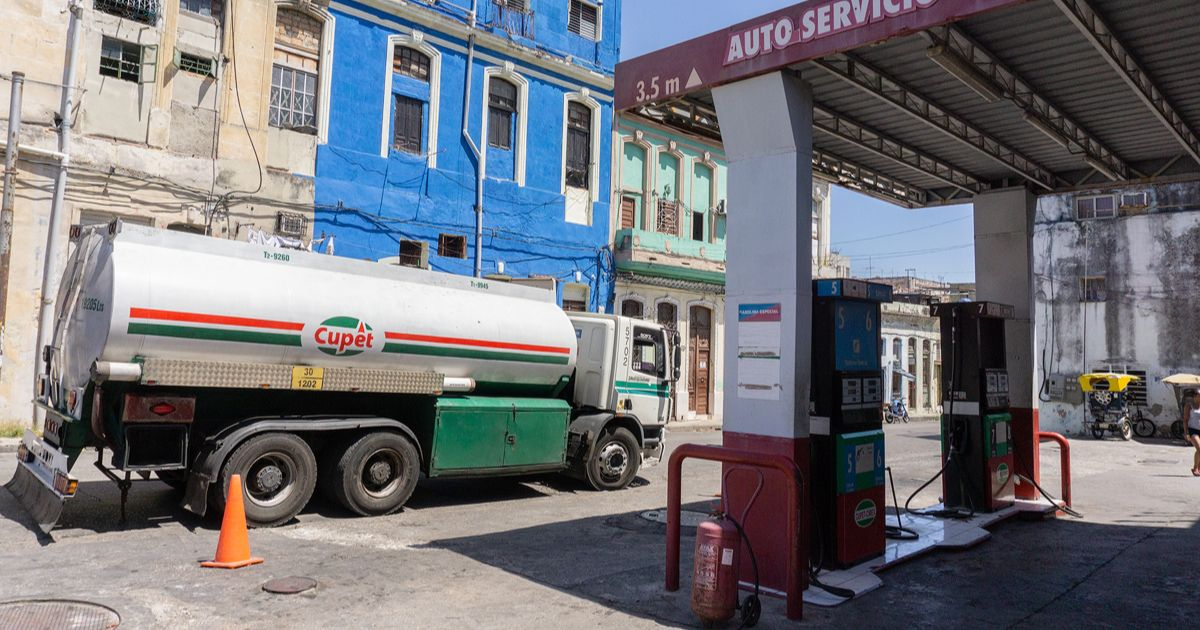
The independent importation of fuel in Cuba is no longer a dream; it's a tangible reality. By late February 2026, at least two or three small and medium-sized enterprises (SMEs) had successfully navigated the process, filling up their fleets at CIMEX gas stations. Nonetheless, this is not the panacea for the country's ongoing crisis.
The End of Monopoly
For decades, the Cuban regime held a firm grip on the fuel import and distribution market. That era has ended. Several private companies have managed to bring in diesel from abroad, primarily from the United States, and are currently using it within the island.
Private sector representatives confirm that fuel tanks from foreign imports are now arriving via cargo ships. Although this process is legal, it is fraught with regulatory uncertainty. The government had pledged to release specific regulations for SME fuel importation but instead mistakenly published an outdated resolution on e-commerce.
As of now, a clear regulatory framework is absent. On February 7, Minister of Foreign Trade, Óscar Pérez-Oliva Fraga, indicated that companies with sufficient financial resources could purchase fuel abroad, yet the state control over the process remains unyielding.
Understanding the Process
The entire process entails purchasing fuel overseas, filling isocontainers, shipping them, handling port operations in Cuba, nationalizing through CUPET, and transporting to the consumption point. SMEs are required to coordinate purchases through state importers like QUIMIMPORT or MAPRINTER.
For storage and consumption, SMEs have two options:
- An assigned CIMEX gas station where CUPET deposits the fuel for the company’s fleet.
- A private storage point, needing a certified project by CUPET, approval from Physical Planning, and certification from the Fire Department, with an operational timeline of 4 to 8 months.
The Cost Breakdown
The financials are striking:
- Isotank (23,000-24,000 liters capacity): approximately $20,000 USD
- Diesel to fill an isotank: $25,000 - $30,000 USD
- Shipping from the U.S. to a Cuban port: $5,000 USD
- CUPET fee for nationalization and station deposit: $0.12 USD/liter (~$2,880 per isotank)
- Final cost per liter in vehicle: over $2.50 USD
- Minimum estimated budget per SME: $60,000 USD
These figures represent only a starting point. The budget excludes operational expenses which can significantly increase import costs: insurance, documentation, export margins, port fees, and internal logistics in Cuba.
If an SME chooses to establish a private storage point rather than relying on CIMEX, costs soar. Building and installing a certified depot can add up to $50,000 USD, excluding regulatory approvals in Cuba—such as certifications from Physical Planning, the Fire Department, CUPET, and ESICUBA—which entail unpredictable delays and bureaucratic hurdles extending the process over months.
In practice, an SME aiming for full autonomy in fuel supply might need a budget approaching $150,000 USD or more.
The recent easing of restrictions by the Trump administration towards Cuba has streamlined operations from the U.S. and opened the door to imports from other regions. There are already reports of trial shipments from Europe. U.S. Secretary of State, Marco Rubio, has affirmed that the U.S. is ready to supply fuel for humanitarian purposes via the private sector.
A Market on the Horizon
The majority of Cuban SMEs don't have $60,000 USD to independently import. According to a study by Auge consultancy, 96.4% of the 9,236 registered SMEs, or 8,904, are severely or critically affected by the energy shortage. On the informal market, fuel prices exceed six dollars per liter.
This scenario will inevitably foster a redistribution market: the few who can import will sell to those who cannot.
Some companies are already planning province-wide distribution networks certified by CUPET to supply other SMEs. The demand is high, and fuel could become a more versatile currency than the cash dollar itself.
However, SME-to-SME sales operate in a legal grey area unregulated by the government.
What It Doesn't Solve
It’s crucial to be clear: private fuel importation doesn't solve Cuba's crisis.
It doesn’t eliminate blackouts. The power deficit approaches 1,800 MW daily, affecting the country around the clock. Havana has experienced up to 22 hours of blackout in a single day.
It doesn’t replenish hospital supplies. It doesn’t repair schools, the water system, or public transport. It doesn't fund any public services.
Here's a key point the regime prefers to ignore: for decades, the government partially financed itself by reselling subsidized fuel, mainly from Venezuela and Russia. That revenue fed the state’s coffers. With private importation, that business fades away.
The fuel imported by SMEs is for their consumption or private redistribution. The regime is left with only a minor fraction compared to what it once received.
Cuba's energy, health, and basic service crises remain unchanged. This is progress for the private sector, not for the nation.
The Significance
Despite its limitations, private fuel importation marks a significant precedent.
Prime Minister Manuel Marrero himself acknowledged the role of SMEs by stating, “There are contributions from non-state management forms to ensure the vitality of some important centers.”
- It ends the state monopoly on a strategic resource.
- It signifies a step towards economic independence for Cuba's private sector.
- It opens new business opportunities in a nation where almost everything was state-controlled.
The future is uncertain, and dynamics are rapidly evolving. Yet the fact remains: Cuban SMEs are now importing their fuel. What the regime couldn’t or wouldn’t resolve, the private sector is beginning to address independently.
Key Questions about Cuban Fuel Imports
How are Cuban SMEs importing fuel?
Cuban SMEs are importing fuel by purchasing it overseas, filling isocontainers, and shipping them to Cuba. The fuel is then nationalized through CUPET and transported to the consumption point.
What challenges do SMEs face in importing fuel?
SMEs face regulatory uncertainty, high costs, and a lack of a clear legal framework. The process also involves numerous bureaucratic hurdles and operational expenses that can significantly increase costs.