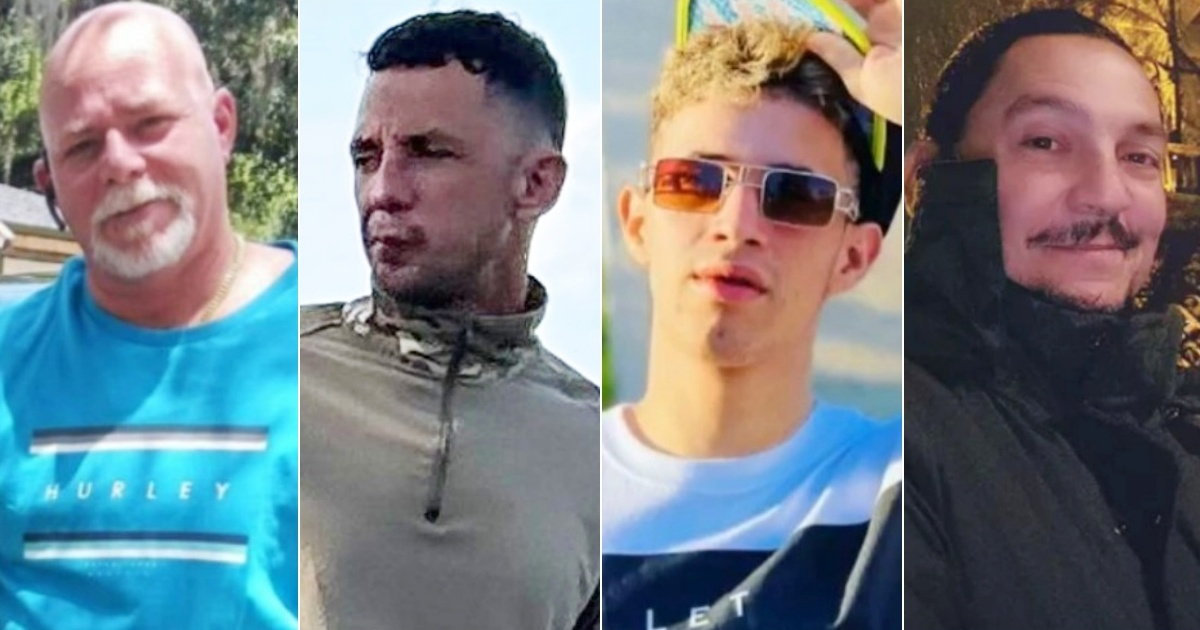
In a shocking incident that has once again strained relations between Havana and Washington, four individuals have been thrust into the spotlight: Pavel Alling Peña, Michael Ortega Casanova, Ledián Padrón Guevara, and Héctor Duani Cruz Correa.
These men lost their lives on Wednesday near Falcones Key, Corralillo, in Villa Clara, when a boat registered in Florida was intercepted by Cuban Border Guard troops. The Cuban government claims the incident was an "armed infiltration with terrorist intentions."
Contrasting Narratives
Family members and friends, speaking from the United States, paint a very different picture of these men, describing them as family-oriented, hardworking, and engaged in exile activism. Here’s a look at who they were, based on available information.
Michael Ortega Casanova
At 54, Michel Ortega Casanova, originally from Morón, Ciego de Ávila, lived in Tampa. His death was the first to be officially confirmed following the incident. Michel, who managed a transportation company, led a stable family and business life in the U.S., according to his brother, Misael Ortega.
Misael expressed surprise at any involvement in armed operations, emphasizing Michel’s non-obsession with militancy. Michel was a member of the Cuban Republican Party and participated in exile activities. In Tampa, Casa Cuba declared three days of mourning for him, with their vice president, René Montes de Oca, honoring him as a "brother in ideas and friend."
Héctor Duani Cruz Correa
Héctor Duani Cruz Correa, aged 42, was identified differently by Monroe County authorities and the Cuban regime. His wife, Yarisleidis, learned of his death hours after reporting his disappearance to the police. He had recently returned from Puerto Rico, where Yarisleidis is studying.
Working as a construction worker and maintenance man in Big Pine Key, Florida, the boat involved in the incident was reported stolen from the marina he worked at. Yarisleidis vehemently denied any political or military affiliations, describing him as the "most noble, kind person, dedicated to doing good and working hard."
Pavel Alling Peña
From Camagüey, Pavel Alling Peña was a scholar in Art History, a literature professor, and a writer. Though not aligned with armed combat, his public persona was one of intellectual engagement and reflections on national identity.
In a widely shared Instagram video, he expressed his thoughts on annexation, stressing his opposition to it: "Cuba is more than just a map location; it’s a collective heartbeat." His death has stirred shock among those who knew him as an educator and creator, leaving questions about his presence on the intercepted boat.
Ledián Padrón Guevara
At just 25, Ledián Padrón Guevara was the youngest of those killed. Residing in Houston, he had moved to Miami with intentions linked to potential actions against the Cuban regime, according to journalist Javier Díaz.
Initially missing from the list of survivors, his family feared for the worst until his death was confirmed. Friends describe him as part of a disenchanted generation, frustrated by Cuba's stagnation and leaning towards direct confrontation.
Contentious Encounter
The Cuban Ministry of the Interior (MININT) claims the Florida-registered boat ignored orders to stop and initiated gunfire, leading to an armed exchange. Cuban officials, including Deputy Foreign Minister Carlos Fernández de Cossío, labeled it an "armed infiltration attempt with terrorist purposes," citing the seizure of weapons and other equipment.
In addition to the deceased, six survivors were named, and two were already on a national watchlist for terrorism-related investigations. Meanwhile, Duniel Hernández Santos was arrested on land as the group's contact, allegedly confessing his role.
U.S. officials have taken a cautious stance. At least one deceased and one injured were American citizens, with another having a K-1 visa. The boat’s owner, a 65-year-old, reported it stolen from a Florida dock. Senator Marco Rubio has vowed an independent U.S. investigation, emphasizing skepticism towards Cuban authorities' accounts.
In Miami, a vigil held outside Café Versailles saw activists and families decrying the incident as a "massacre," criticizing the "disproportionate" use of force.
Unresolved Questions
As diplomatic tensions simmer and allegations fly, the reality is that four men have died, and six remain detained in Cuba. The Cuban government frames this as an exiled-initiated aggression, while families argue they were merely idealistic workers and activists unheard thus far.
Investigations continue in both nations, but the waters off Villa Clara still hold more mysteries than answers.
Key Questions About the Cuba-Florida Boat Incident
What was the Cuban government's claim regarding the intercepted boat?
The Cuban government alleged that the boat was involved in an "armed infiltration with terrorist intentions" and claimed to have seized weapons and other military equipment from the vessel.
How did the U.S. respond to the incident?
U.S. Senator Marco Rubio announced an independent investigation into the incident, expressing a need for information beyond Cuban authorities' accounts, and confirmed that at least one of the deceased and one injured were U.S. citizens.