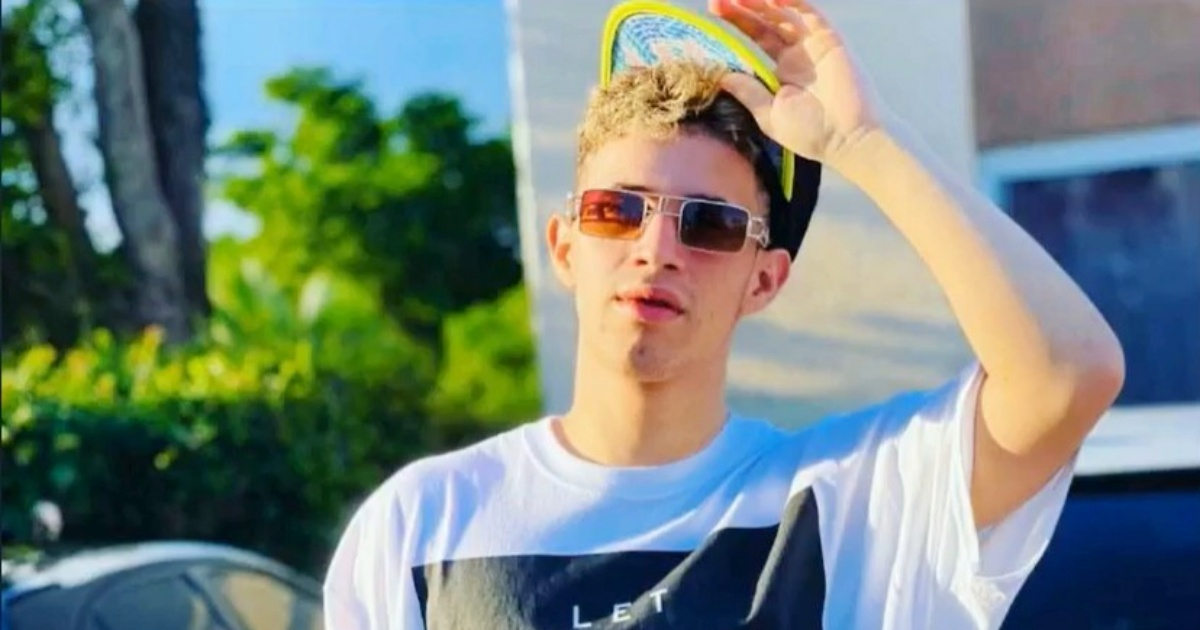
At just 25 years old, Ledián Padrón Guevara, a Cuban national, is believed to have perished on February 25th during a violent incident off the northern coast of Villa Clara involving a boat from Florida and Cuban Border Guard units.
The revelation of his identity came from Javier Díaz, a journalist with Univision 23 in Miami, who reported being in touch with Padrón's family.
While the Cuban Ministry of the Interior (MININT) has confirmed four fatalities resulting from the operation, it has officially named only one individual so far.
Padrón Guevara's name is absent from the government's official statement. However, as Díaz reported, his family fears he is among the dead, given that his name does not appear on the survivor list released by authorities.
In a recent report, Díaz displayed images of Ledián alongside Cristian Acosta, both holding long rifles.
Between Miami and Houston
Information about Ledián Padrón Guevara is limited and somewhat scattered. According to those close to him, he lived in Houston before recently moving to Miami.
It was in Miami, as per these accounts, that he began training to participate in an action against the Cuban regime.
Based on his social media profiles, Padrón hailed from Camagüey and once harbored artistic ambitions, including a desire to become a singer.
Beyond these snippets, little is publicly known about his personal journey or motivations.
Díaz mentioned that the young man's relatives insisted the group did not view themselves as terrorists.
"They went to fight for Cuba," the journalist quoted, based on conversations with those close to Padrón. "They believed the people would join them, but it seems the plan was rushed and didn't unfold as expected," he added.
The reporter further noted that the operation had been in the planning stages for an extended period by a group of Cubans in Miami, initially connecting through TikTok and later training on a farm in southern Florida.
Speculating on Two Boats
Unofficial accounts shared by Díaz and other sources on social media suggest the armed action involved two boats, each carrying roughly ten people, departing from Miami in the early morning hours.
It remains uncertain if both vessels approached Cuban territory or if only one was intercepted.
If it turns out that Ledián Padrón Guevara was among those killed, he would be one of the three deceased individuals not yet officially identified by the Cuban government as of Wednesday night.
Thus far, the only recognized victim is Michel Ortega Casanova, who reportedly had been in the United States for a short time and was living in Tampa.
Later, the Cuban Republican Party (PRC) confirmed Ortega's affiliation with their organization but distanced themselves from any involvement in the armed incursion.
"The PRC does not endorse armed actions, nor does it control personal decisions or actions by its members or followers," the organization stated in a Facebook post, emphasizing their lack of knowledge about Ortega's intentions.
Official Stance on the Skirmish
The MININT reported that a so-called "speedboat" bearing Florida registration (FL7726SH) was detected approximately one nautical mile northeast of El Pino channel, near Cayo Falcones, in the municipality of Corralillo.
According to the official account, a Border Guard surface unit with five personnel approached the vessel for identification purposes.
At that point, according to the government's version, shots were fired at the Cuban soldiers from the boat.
The exchange of gunfire resulted in the injury of the Cuban unit's commander.
The official report indicated four individuals were killed and six injured, all of whom were evacuated and received medical attention.
The authorities claimed the boat was transporting ten armed individuals intending to enter the country with "terrorist aims," based on preliminary statements from those detained.
They also reported the seizure of assault rifles, handguns, homemade incendiary devices, bulletproof vests, telescopic sights, and camouflage uniforms.
Among those arrested are Amijail Sánchez González, Leordan Enrique Cruz Gómez, Conrado Galindo Sariol, José Manuel Rodríguez Castelló, Cristian Ernesto Acosta Guevara, and Roberto Azcorra Consuegra.
However, Roberto Azcorra Consuegra denied from Florida that he was arrested or involved in the incident.
Additionally, in Cuba, Duniel Hernández Santos was arrested as the person responsible for receiving the group on the island.
The Cuban government stated that most of those involved are Cuban residents in the United States, some with criminal records.
Amijail Sánchez González and Leordan Enrique Cruz Gómez are also named on a list the current regime submitted to the UN in July as part of its national registry of individuals considered terrorists.
A Former Member Speaks Out from Florida
Amid the controversy, a former group member anonymously spoke to Javier Díaz from Florida.
His testimony suggests the movement originated on TikTok, involving an individual with special forces experience, described as having extensive military knowledge and leadership skills.
"What happened now should have happened before," he stated, implying that the incursion was not a spur-of-the-moment decision. However, he claimed to have distanced himself due to internal disagreements. "There were ambitions to seize power in Cuba that didn't align with me," he declared.
The former member indicated that after his departure, the original group weakened and sought alliances with others. According to him, preparation for the action took place in Florida, with plans for a "second wave" if the initial operation succeeded.
Despite claiming knowledge of the group's structure and participants, he insisted on having no involvement in the ill-fated incursion.
The Clash of Narratives
As the Cuban government labels the event a "terrorist infiltration" orchestrated from the United States, narratives from southern Florida portray a group convinced they would lead an uprising.
Amidst these conflicting accounts lies the still incomplete story of Ledián Padrón Guevara: a young man from Camagüey who lived between Texas and Florida, at one point harboring artistic dreams, now possibly one of the four men killed in an operation shrouded in questions about its true scope and planning.
His name does not appear in any official communication from Havana. Yet in Miami, his family mourns him as one of the presumed fatalities from the intercepted boat off the Cuban coast.
Key Questions Surrounding the Incident
What led to the identification of Ledián Padrón Guevara?
Ledián Padrón Guevara's identity was revealed by journalist Javier Díaz from Univision 23 in Miami, who was in contact with Padrón's family, despite the Cuban government's official statement not listing his name.
What is the official version of the armed clash near Cuban shores?
According to the Cuban Ministry of the Interior, a Florida-registered speedboat was intercepted near Cayo Falcones, leading to an exchange of gunfire with Cuban Border Guards. The incident resulted in four deaths, six injuries, and the arrest of several individuals, with claims of terrorist intentions.
What were the motivations behind the group's actions?
The group, as reported by journalist Javier Díaz, believed they were fighting for Cuba and expected local support. However, the plan did not unfold as anticipated, and was reportedly rushed.