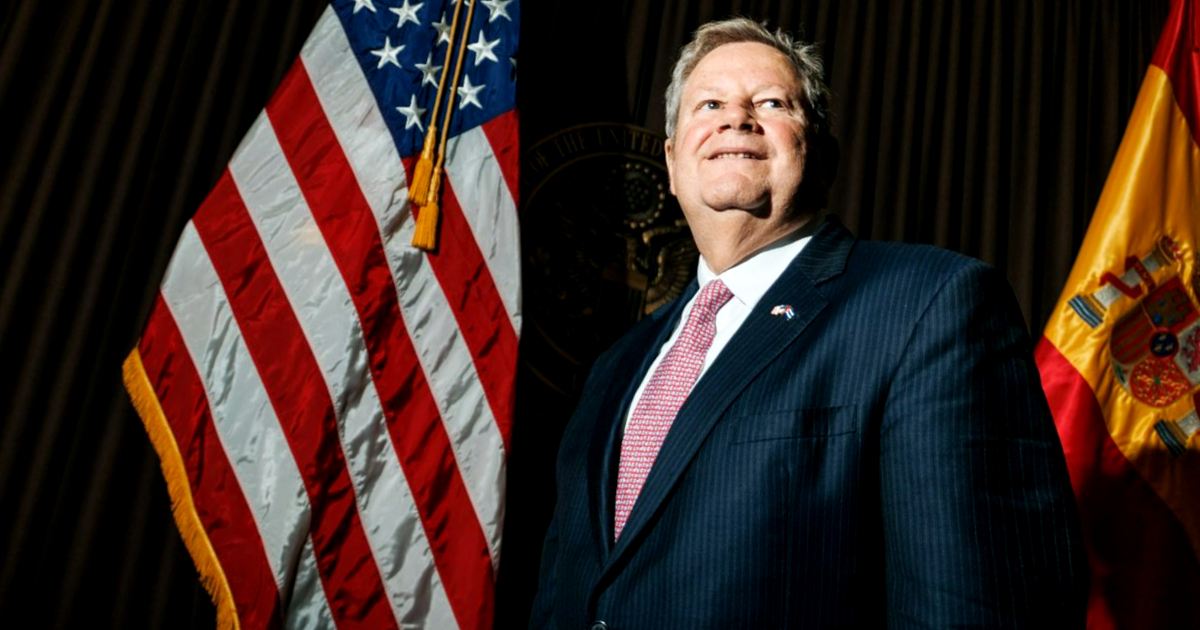
Mike Hammer, the United States' top diplomatic official in Havana, delivered one of his most forthright critiques of Cuba's political climate, labeling the regime as a dictatorship and emphasizing the urgent need for the release of all political prisoners.
Hammer, in his role as the U.S. Chargé d'Affaires, also noted a shift in the Cuban populace's mood, driven by economic hardship and a diminishing fear of repression.
During a recent interview with the Spanish newspaper ABC, Hammer did not mince words when addressing those who hesitate to call Cuba's system a dictatorship. "If you're in a country where you can't speak freely and are jailed for holding a small sign, tell me that's not a dictatorship," he asserted. He challenged skeptics to visit the island, explore its streets, and converse with everyday Cubans, not just the official spokespersons.
Highlighting the reality of repression, Hammer pointed to young people behind bars and the constant surveillance faced by independent journalists. He also criticized the government's priorities amid the energy crisis, noting that while citizens endure prolonged blackouts and fuel shortages, security forces remain well-equipped to operate.
"Police vehicles have fuel to tail me or to arrest anyone who voices dissent," Hammer remarked, encapsulating Washington's key criticism: the repressive apparatus remains functional even as basic services collapse.
The diplomat reiterated the U.S. commitment to prioritizing the release of political prisoners, a stance that aligns with the increased pressure from President Donald Trump's administration on Havana, including energy sanctions and warnings to nations supplying oil to Cuba.
Despite these criticisms, Hammer highlighted a potential shift in social dynamics. Since his arrival in Cuba in November 2024, conversations about political change have become more common. "People aren't asking if change will happen, but when," he observed.
This perception aligns with a backdrop of structural economic crisis. Cubans face daily blackouts lasting up to ten hours, food and fuel shortages, deteriorating healthcare, and mass emigration that has left entire neighborhoods empty. Over a million Cubans have left the island in the past decade, in a country with a population under 11 million.
Hammer believes that "Cubans are losing their fear." He attributes this to a combination of international pressure, economic fatigue, and increased access to information, which has altered the stance of those who previously refrained from openly criticizing the government.
Nonetheless, the repressive machinery remains effective. Surveillance of dissidents, journalists, and activists is relentless, and any engagement with foreign entities can result in reprisals.
The current situation is defined by the stark contrast between an exhausted society and a closed, authoritarian regime. As Washington ramps up pressure and openly discusses possible changes, Havana decries external interference and defends its model.
Hammer's statements refocus attention on human rights as a central theme in the debate over Cuba's future.
Apart from geopolitical scenarios, the diplomat emphasized that the focus should be on the average citizen: their right to express themselves without fear, to choose their leaders, and to live free from repression.
Whether political change materializes in the short term depends on myriad internal and external factors. However, the direct critique of the regime's nature and the perceived shift in social sentiment underscore the notion that the island is experiencing a period of accumulated tension, where political pressure and economic strain intersect with a populace increasingly aware of its reality.
Understanding the Political Climate in Cuba
What did Mike Hammer say about the political situation in Cuba?
Mike Hammer labeled the Cuban regime as a dictatorship and stressed the need to release all political prisoners. He also observed a shift in the Cuban people's mood, marked by economic hardships and a reduced fear of repression.
How does the Cuban government prioritize resources according to Hammer?
Hammer criticized the Cuban government for prioritizing resources for security forces despite widespread blackouts and fuel shortages affecting the population. He pointed out that police vehicles remain operational for surveillance and arrests.
What changes in Cuban society did Hammer note?
Hammer noted that discussions about political change are more frequent, with Cubans increasingly questioning not if change will happen, but when. He attributes this shift to international pressure, economic fatigue, and greater access to information.