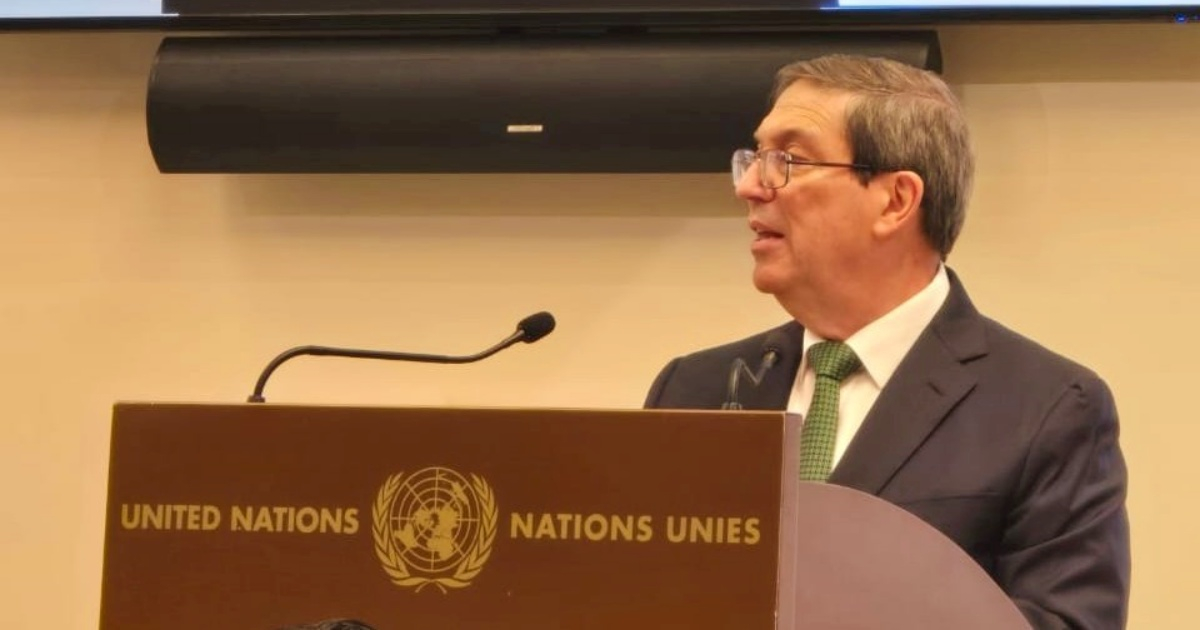
The Cuban government has ramped up its rhetoric against Washington, yet left the door ajar for potential negotiation.
From Geneva, at the United Nations Human Rights Council, Foreign Minister Bruno Rodríguez declared that Havana is ready to "vigorously and courageously defend its right to self-determination," while emphasizing his openness to dialogue with the United States, provided specific conditions are met.
During his High-Level Segment speech, Rodríguez accused Washington of imposing an "energy siege," referring to the U.S. threats of tariffs against countries exporting oil to the island. He argued that this policy is designed to trigger a substantial crisis in Cuba.
"Can a great power be allowed to attempt the destruction of a small nation, incite a humanitarian tragedy, and shatter its national culture... all under the crude pretext of national security?" the foreign minister questioned at the international forum, as reported by EFE.
Rodríguez acknowledged that the current scenario could lead to "hardships and suffering," yet assured that the government would seek "creative solutions" to prevent a humanitarian crisis. This message blended outright denunciation with the familiar narrative of resilience.
Dialogue Amidst Tension
Despite the confrontational tone, Cuba's chief diplomat confirmed a willingness to engage in dialogue with the United States. However, any approach must adhere to "international law, mutual respect, reciprocal benefit, without preconditions nor interference in internal matters," he insisted.
According to Rodríguez, the aim is to "achieve a civilized relationship amidst our differences and even promote cooperation." His statements come amidst conflicting reports about possible bilateral contacts.
Recently, U.S. authorities have claimed ongoing talks with Cuban regime representatives, suggesting some in Havana might be unaware of these interactions. Speculations revolve around who within Cuba's power structure might be involved in these dialogues.
The Cuban government has dismissed these claims, asserting that Washington seeks to sow distrust. Nevertheless, it acknowledges limited and routine discussions on specific topics such as migration and drug trafficking.
Denunciations at the UN and Support for U.S. Protests
During his address, the foreign minister also criticized U.S. immigration policy and praised the "community resistance of the people of Minnesota," referring to protests against actions by the Immigration and Customs Enforcement (ICE).
On social media platform X, Rodríguez reinforced his stance. He wrote about denouncing "the collective punishment imposed on the Cuban people by the U.S. government through its executive order, aimed at creating a humanitarian catastrophe via an energy siege."
In the same post, he reaffirmed Cuba's official commitment to "the defense and promotion of all human rights for everyone," and its intent to remain "an active, sovereign, and indigenous voice within this Council."
He added that Cuba will continue to defend "the inalienable rights of the Palestinian people and the integrity of migrants," while opposing "double standards and political manipulation."
In another message from Geneva, the foreign minister reported his participation in the High-Level Segment of the Conference on Disarmament, warning of a "progressively more dangerous and challenging" global stage.
He highlighted a world marked by nuclear arsenal modernization, the incorporation of emerging technologies in weapon systems, "aggressive militaristic rhetoric," and increased military spending "at the expense of Official Development Assistance."
A Dual-Track Message
Cuba's communication at the UN combined resistance warnings against what it terms economic aggression, with an offer for dialogue under strict conditions. Havana insists that Washington aims to incite a humanitarian collapse through energy pressure, while maintaining its readiness to engage in talks if its terms are respected.
In practice, the situation remains characterized by public tensions, rhetorical exchanges, and limited technical contacts, with no clear signs of comprehensive normalization. Meanwhile, the Cuban government is preparing its population for an indefinite period of "hardships and suffering," while promising to find "creative solutions" to avert a larger crisis.
Frequently Asked Questions on Cuba's Stance and Dialogue with the U.S.
What conditions has Cuba set for dialogue with the United States?
Cuba has stipulated that any dialogue with the United States must be based on international law, mutual respect, reciprocal benefit, and must occur without preconditions or interference in internal matters.
What is Cuba's accusation against the United States regarding energy?
Cuba accuses the United States of imposing an "energy siege" by threatening tariffs on countries exporting oil to Cuba, which it claims is aimed at provoking a crisis in the country.
How does Cuba plan to address potential hardships from the current scenario?
The Cuban government plans to seek "creative solutions" to prevent a humanitarian crisis despite acknowledging that the current scenario might lead to hardships and suffering.