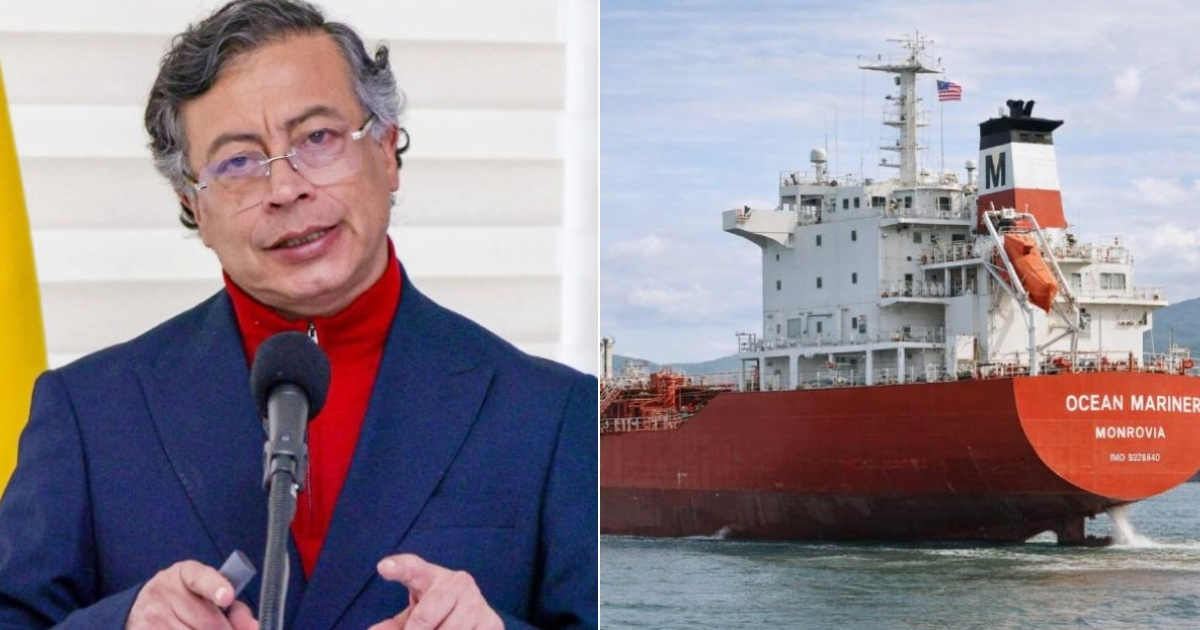
Colombian President Gustavo Petro has publicly admitted that a private company from Colombia was responsible for loading oil onto the Ocean Mariner, a tanker recently intercepted by the U.S. Coast Guard in the Caribbean after it strayed twice into waters near Cuba.
However, Petro emphasized that there was no wrongdoing involved and firmly denied any allegations that his government was acting as an "accomplice" to the Cuban regime.
The incident gained attention after it was revealed that the vessel, which embarked from a port near Barranquilla with the Dominican Republic as its stated destination, altered its course in the Caribbean, prompting intervention by U.S. authorities.
This event unfolded amid warnings from President Donald Trump about imposing tariffs on nations selling oil to Cuba.
President Petro took to his account on X to address accusations from journalist and presidential candidate Vicky Dávila, who labeled his administration as "corrupt and complicit."
"Complicit in what?" Petro retorted, defending the legitimacy of the transaction and emphasizing that it was a private business deal.
"The entity loading the tanker is a private oil company, and they were provided with documentation indicating the vessel was headed to the Dominican Republic," he clarified.
Petro reiterated that the Colombian state had no role in the logistics or sale of the oil, dismissing any claims of misconduct: "There is no Colombian irregularity, neither public nor private."
According to media reports, the commercial transaction was valued at approximately $6.9 million, and the tanker was inspected by customs officials prior to departure.
Yet, near the Dominican coast, the tanker performed maneuvers that brought it closer to Cuba, resulting in its interception and escort by the U.S. Coast Guard.
Criticism of U.S. Embargo and Support for Cuba
In a comprehensive statement, President Petro not only clarified the commercial issue but also criticized the U.S. embargo on Cuba, describing it as a practice that leads to "genocide and extortion against the people."
He went on to commend Cuba for its role in international peace processes, stating: "I appreciate Cuba's collaboration with Norway for the peace of Colombia."
Petro also highlighted Cuba's development of COVID-19 vaccines: "Did you forget that Cuba produced a timely COVID vaccine, saving tens of thousands of lives worldwide?"
He proposed a shift in U.S. policy towards Havana, suggesting, "I invite the U.S. to change its policy towards Cuba and to spearhead a solar energy program across the island."
Petro's Previous Statements on Maritime Oil Transport
Prior to the main statement, Petro had already addressed the issue on X, defending the free transport of oil in the Caribbean and reiterating his advocacy for transitioning from oil to solar energy as the regional energy focus.
This position set the stage for his response to the "complicity" accusations.
The Ocean Mariner case emerges amid significant economic pressure on Cuba, which faces a fuel shortage and an internal crisis.
It also introduces potential tension in Caribbean trade relations, as Washington has toughened its stance against countries engaging in energy exchanges with the island.
Nevertheless, Petro remains steadfast: the operation was private, lawful, and the debate should, in his view, focus on cooperation and energy transition rather than sanctions.
Understanding the Ocean Mariner Incident
What was the intended destination of the Ocean Mariner?
The Ocean Mariner was initially declared to be headed to the Dominican Republic after departing from a port near Barranquilla, Colombia.
Why was the Ocean Mariner intercepted by the U.S. Coast Guard?
The tanker was intercepted because it altered its course in the Caribbean, bringing it closer to Cuban waters, which prompted U.S. authorities to intervene.
What was President Petro's response to allegations of complicity?
President Petro denied any complicity, stating that the operation was a legal private transaction and that the Colombian government was not involved.