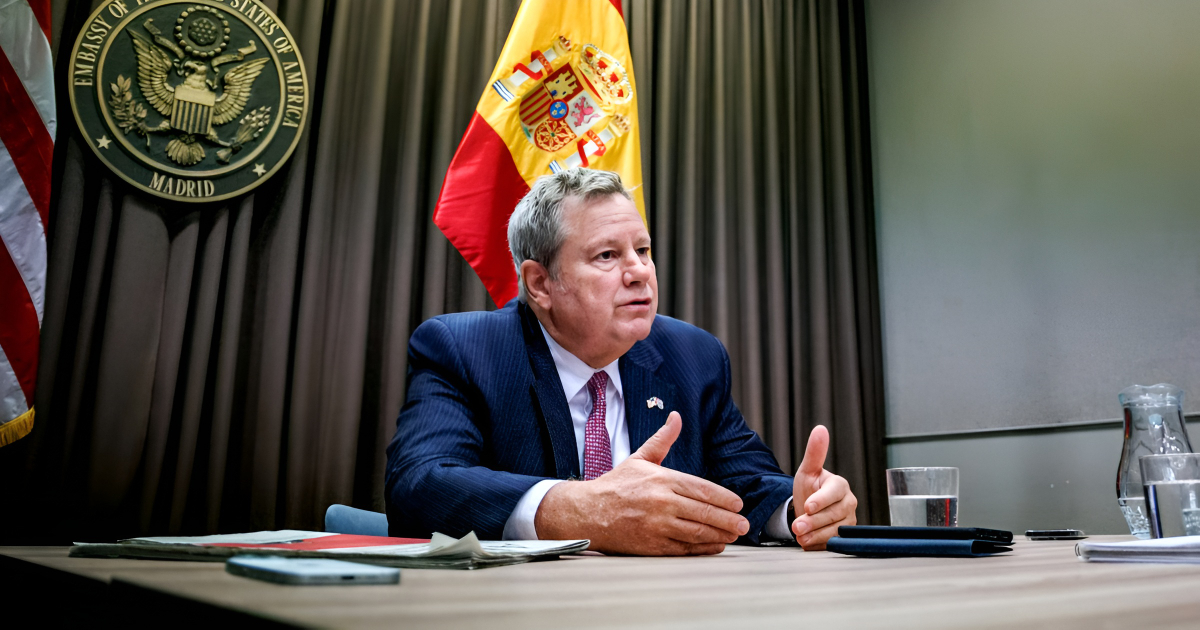
The recent remarks by Mike Hammer, the U.S. Chargé d'Affaires at the Embassy in Havana, have sparked a fresh wave of political interest: Washington is reportedly in "communication with certain individuals" within the Cuban regime.
In an interview with the Spanish newspaper ABC, Hammer hinted at internal shifts occurring amidst heightened external pressure on Havana's authoritarian rule. He stated, "There are communications with certain people," echoing sentiments previously expressed by former President Donald Trump. Hammer chose not to disclose specifics but added a noteworthy caveat: "Some members of the Cuban regime might claim there's nothing happening; perhaps they're not informed, or perhaps it's not with them..."
This statement introduces a critical aspect: not everyone within the power structure is privy to these exchanges. In Cuba's tightly controlled and secretive system, this suggests the existence of discreet channels or specific interlocutors.
Hammer further asserted that there are individuals within the system who "recognize that the project is nearing its end" and might be inclined to facilitate an orderly exit. Washington's goal, as he explained, is a "peaceful transition without bloodshed," paving the way for economic and political openness that restores rights, freedoms, and prosperity to Cubans.
In addition to Hammer's statements, recent reports indicate that the White House and Secretary of State Marco Rubio have considered communication lines with Raúl Guillermo Rodríguez Castro, known as "El Cangrejo," the grandson and personal bodyguard of Raúl Castro, as part of potential negotiated transition scenarios.
El Cangrejo is entrenched in the Castro elite, closely tied to the military-business conglomerate GAESA, and enjoys privileges and business ventures amid the crisis affecting millions of Cubans. However, the notion of Castro family members participating in any transition process has been met with skepticism and opposition from Cuban exile communities, who view it as unacceptable for a member of the elite, who has amassed power and luxury while the majority suffers systemic crises, to be involved in political change.
Public figures have even questioned the authenticity of these contacts, dismissing them as political maneuvers with speculative aims.
The context surrounding these statements and supposed revelations is crucial. The Trump administration intensified pressure on Havana, including blocking Venezuelan oil supplies, imposing energy sanctions, and adopting a more aggressive stance toward allied regimes in the region.
Amidst prolonged blackouts, fuel shortages, and deteriorating basic services, Cuba's economic and energy crisis has heightened internal pressure. In this scenario, the confirmation or speculation about internal contacts raises inevitable questions. Who could be engaging in dialogue? Hammer provided no names or concrete hints, making any definitive statement speculative.
Structurally, power in Cuba is concentrated in three main areas: the Communist Party's political apparatus, the military-business sector linked to GAESA, and specific technical or economic cadres responsible for management. Historically, transitions in closed systems have involved negotiations with sectors seeking to maintain stability or ensure certain conditions. Hammer's reference to a "peaceful" and "less chaotic" exit suggests Washington is exploring precisely this type of scenario, akin to a negotiated transition rather than an abrupt collapse.
Another significant element is the shift in social perception noted by the diplomat in the same interview: "People aren't asking if it will happen, but when." Though a subjective observation, it aligns with the evident economic exhaustion on the island and a rise in mass emigration in recent years.
Meanwhile, the regime has repeatedly denied formal negotiations with Washington. Hammer's assertion thus creates a stark contrast between the Cuban government's official narrative and the American perspective.
It's important to emphasize that confirming "communications" does not equate to announcing an imminent agreement or an open fracture at the top. In diplomacy, contacts can be exploratory, indirect, or preliminary. Nonetheless, publicly acknowledging their existence represents a calculated political move.
Beyond the details, the central message is clear: Washington believes there are actors within the Cuban system willing to discuss the future. In a context of sustained external pressure and prolonged internal crisis, this combination could signal the beginning of a new political phase on the island.
For now, Hammer's statements do not provide specific timelines or outcomes. However, they introduce an element that, if confirmed, would have profound implications: the possibility that change in Cuba might not solely rely on external factors or economic decline but also on internal dynamics starting to shift beneath the surface.
Cuban Regime Communications and Transition Queries
What did Mike Hammer reveal about U.S. contacts in Cuba?
Mike Hammer confirmed that the U.S. maintains "communications with certain individuals" within the Cuban regime but did not provide specific details on these interactions.
Who is Raúl Guillermo Rodríguez Castro?
Raúl Guillermo Rodríguez Castro, known as "El Cangrejo," is the grandson and personal bodyguard of Raúl Castro. He is part of the Castro elite, with close ties to the military-business conglomerate GAESA.
How has the Trump administration affected Cuba?
The Trump administration intensified pressure on Cuba by blocking Venezuelan oil supplies, imposing energy sanctions, and adopting a more aggressive stance toward allied regimes in the region.