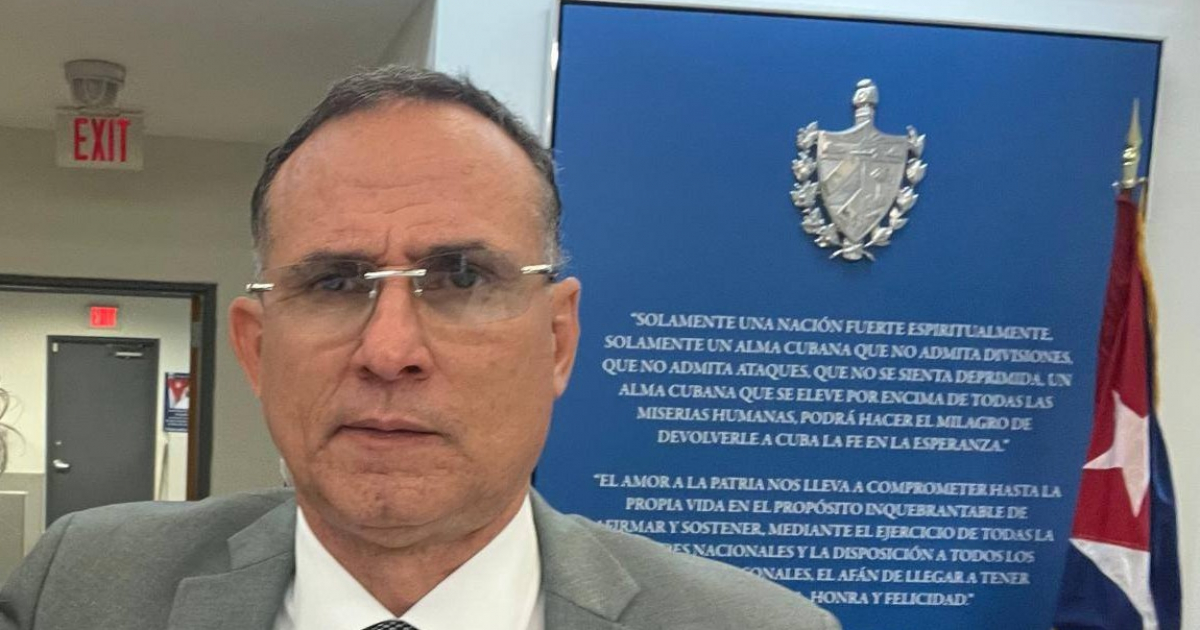
The Cuban opposition leader and former political prisoner, José Daniel Ferrer, has suggested that a decisive move by the United States against the Cuban regime, akin to the operation that led to Nicolás Maduro's capture in Venezuela earlier this year, should remove both Miguel Díaz-Canel and Colonel Alejandro Castro Espín, the eldest son of Raúl Castro, from power.
In an interview with EFE in Miami, where he has been living as a political refugee since October, Ferrer claimed that these leaders are directly accountable for the current hardships faced by the Island. "They are responsible for numerous crimes and even deaths, hence the need to oust them from power," he stated.
While Ferrer expressed support for "serious talks to initiate an immediate transition," he cautioned that if the "Cuban crisis continues to worsen," he would endorse a more forceful approach, even "in the style of Maduro."
Potential Transitional Figures and Cuban Sentiment
When asked who might play a role similar to Delcy Rodríguez in Venezuela, Ferrer mentioned that social media speculates about Ana María Mari Machado, vice president of the National Assembly of People's Power. He described her as a "less despised figure, perhaps by the people," unlike others frequently seen on television, such as Díaz-Canel, Raúl Castro, or Manuel Marrero.
Nevertheless, he reiterated his preference for a transition driven by Cubans themselves. "I've always advocated for Cubans to achieve freedom and democracy through our own efforts," he emphasized. However, he clarified that if the regime blocks all avenues for change, "action is necessary."
Growing Dissent and External Pressure
The leader of the Patriotic Union of Cuba (UNPACU) highlighted conditions that could accelerate a transition for the first time in decades. "It starts with a more discontented and defiant Cuban populace, increasingly unafraid," he said. He noted that protests are now more open and visible.
Ferrer also pointed to the "awakening of the youth" and cited the digital project El4tico, whose members have received unprecedented solidarity from young people within Cuba, indicating a profound societal shift.
Externally, he pointed to several factors: the impact on the Venezuelan government, which has left the Cuban regime without a key ally; Washington's "maximum pressure against tyranny" policy; and the distancing of other strategic partners.
"The regime's allies (China, Russia) are stepping back because they know this is not a beneficial association," Ferrer noted, referring to potential tariffs for those supplying fuel to Havana.
He also reminded that Russia is dealing with its own crisis due to the war against Ukraine, and Brazilian President Luiz Inácio Lula da Silva is maintaining a "rather discreet" stance.
"For years, people have said 'now is the time,' but never before have so many factors aligned to suggest that this year, the Castro-communist regime may truly come to an end. This time, we are very close," he asserted.
International Pressure and Fuel Supplies
Regarding the policy the United States should pursue, Ferrer was clear: "continue the pressure," including enforcing the tariffs announced by Donald Trump on those sending oil to the regime.
He alleged that the Cuban government is sustaining itself with fuel reserves stored in the eastern part of the country.
Regarding Mexico, Ferrer claimed that "the oil they intend to send to the Cuban regime is not for ambulances but for the vehicles of high-ranking officials and primarily for the repressive forces."
He added that genuine support for the people should come in the form of "food, medicine, and essential goods" sent directly to the population, "through the Church or any other intermediary."
Ferrer’s statements reflect a strong stance against the Castro dictatorship, which he holds responsible for repression and deteriorating living conditions on the Island. His call combines advocating for a negotiated transition with a warning that, without openness, a more forceful solution might become necessary.
Key Questions on Cuba's Political Situation
What does José Daniel Ferrer propose for Cuba's political transition?
José Daniel Ferrer suggests a decisive action by the United States to remove key leaders from power, advocating for a transition initiated by Cubans but also open to more forceful means if necessary.
Who is Ana María Mari Machado?
Ana María Mari Machado is the vice president of Cuba's National Assembly of People's Power and is speculated to be a potential transitional figure due to her perceived lower level of public disdain.