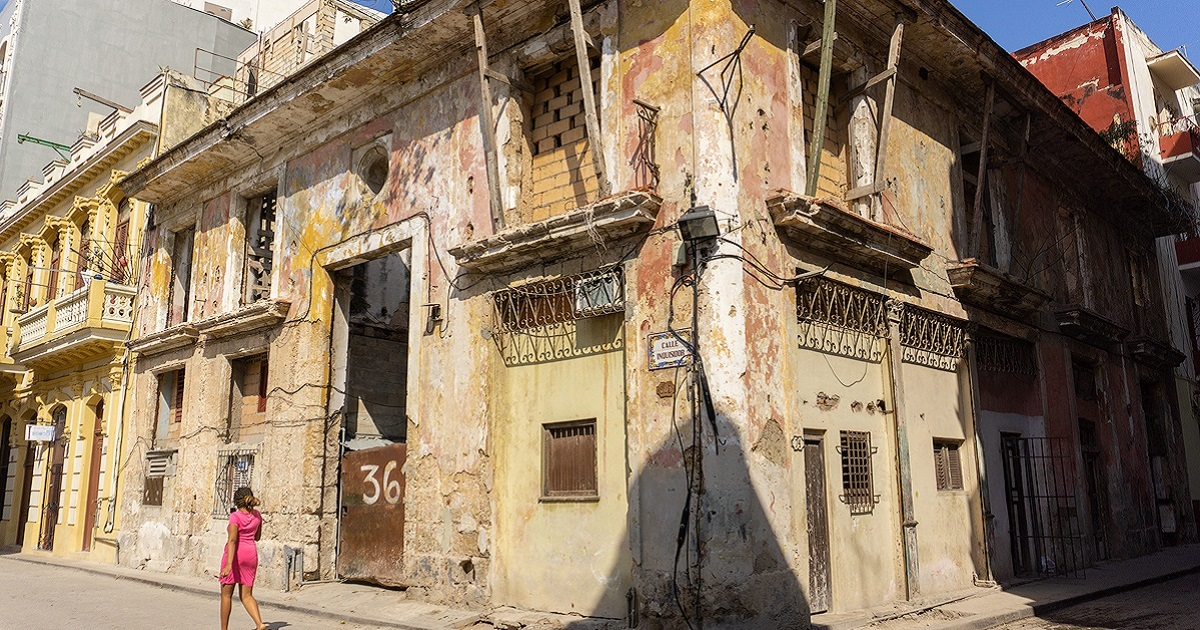
The lifeless body of a 29-year-old transgender woman was discovered in a collapsing building located at 466 Sol Street, between Villegas and Ejido, in the Old Havana municipality, as confirmed by a CubaNet collaborator at the scene.
The deceased has been identified as Gadir Eduardo, originally from Las Tunas.
According to eyewitnesses cited by the source, the young woman is believed to have died from self-inflicted injuries, specifically by hanging. However, the authorities have yet to officially confirm the cause of death.
The discovery occurred this past Friday around 3:00 PM.
Residents of the building—occupied by the homeless and in a state of significant disrepair—decided to investigate after noticing a strong odor. It was then that they found the body.
A CubaNet source, speaking on condition of anonymity, reported that police officers arrived on the scene to launch an investigation into the circumstances leading to such a tragic decision.
The young woman's partner was not present at the time of the discovery but arrived after being notified and was questioned by authorities.
Gadir Eduardo lived irregularly in the building, a critically deteriorated structure that is part of the crumbling housing stock of the Cuban capital, where numerous buildings are at structural risk and are inhabited by those without housing alternatives.
Public Health Crisis: Suicide in Cuba
This incident highlights a broader issue, as suicide has been acknowledged as a public health crisis in Cuba. According to the Health Statistical Yearbook (with data through 2023), 1,671 deaths were recorded due to "intentionally self-inflicted injuries": 1,390 men and 281 women.
The Pan American Health Organization (PAHO) reports a suicide rate of 10.2 per 100,000 inhabitants in Cuba. In 2021, suicide ranked as the tenth leading cause of death in the country and the third among those under 18, as reported by the Ministry of Public Health.
In August 2025, the feminist platform Alas Tensas published an article by sociologist Irela Casañas, warning of rising adolescent suicides in Holguín. Citing data from the National Office of Statistics and Information (ONEI), the article revealed that 977 cases were recorded between 2019 and 2023 in the province, where suicide is now the fifth leading cause of death.
Casañas highlighted issues such as underreporting and the silence of families who, out of fear or shame, avoid reporting suicide attempts. Her analysis pointed to factors such as family exodus, drug use, isolation, and the breakdown of social environments as exacerbating young people's mental health challenges.
This phenomenon is not confined to Holguín. In 2023, health authorities in Sancti Spíritus reported approximately 200 teenagers annually exhibiting suicidal behavior.
As far back as 2019, a PAHO report warned that suicide was among the leading causes of death for young people in Latin America, with Cuba being one of the most affected countries.
Cuba has implemented a National Program for the Prevention of Suicidal Behavior, which includes mechanisms for monitoring and registering at-risk groups.
Additionally, the crisis hotline "103," according to a document from the National Medical Library, handles around 5,000 calls annually.
While authorities continue to investigate the specific circumstances surrounding Gadir Eduardo's death, this case brings to light the ongoing debate about mental health issues in Cuba and the vulnerabilities faced by many, particularly those living in dilapidated housing or without robust support networks.
Mental Health and Suicide Prevention in Cuba
What is the current suicide rate in Cuba?
The suicide rate in Cuba is reported to be 10.2 per 100,000 inhabitants, according to the Pan American Health Organization.
How does the Cuban government address suicidal behavior?
Cuba has a National Program for the Prevention of Suicidal Behavior, which includes monitoring and registering at-risk groups, as well as a crisis hotline that receives around 5,000 calls annually.
What factors contribute to mental health challenges in Cuba?
Factors such as family exodus, drug use, isolation, and the breakdown of social environments contribute to mental health challenges in Cuba, exacerbating the risk of suicide, especially among young people.