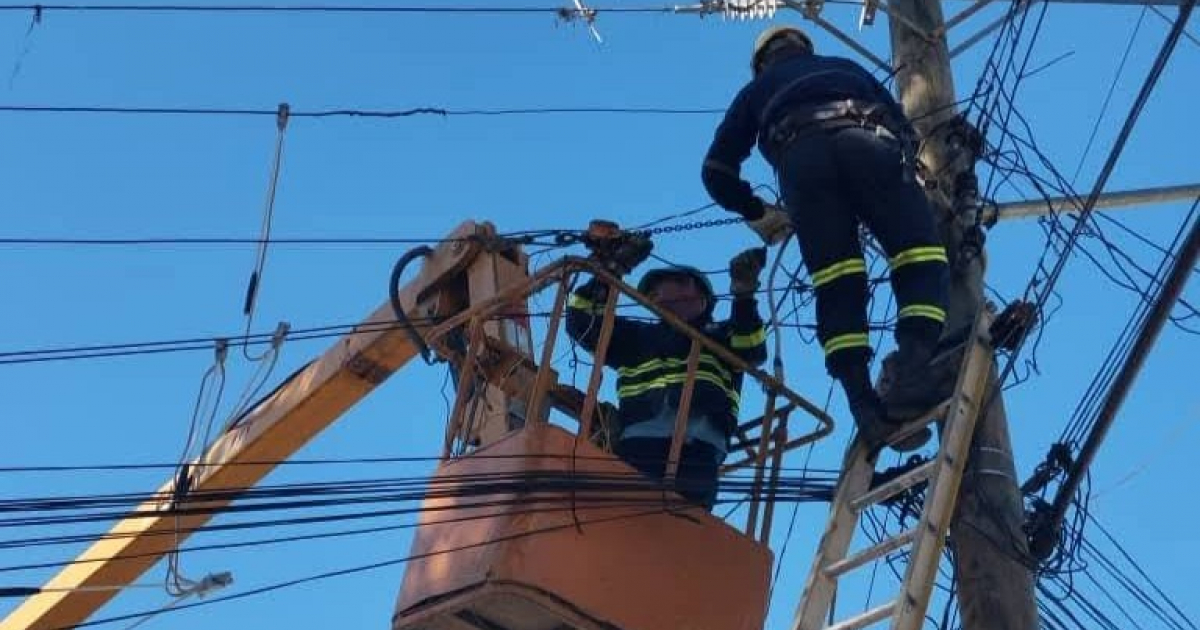
State journalist Lázaro Manuel Alonso revealed on Facebook the identity of the electrician injured in a mishap that took place on Friday morning in Havana.
Alonso identified the injured worker as Joaquín Vázquez Vázquez, a 54-year-old electrician with a quarter-century of experience in the electrical field.
Hospital sources quoted in the report indicate that Vázquez Vázquez is conscious and currently hospitalized with burns. However, details regarding the severity of his injuries remain undisclosed.
The incident occurred at the Habana 220 kV Substation, disrupting power services across several central municipalities of the capital, as well as affecting the regions of Artemisa and Mayabeque.
Alonso had earlier reported that the accident happened at 11:27 am, with a team member immediately taken to emergency medical services following the incident.
Moments before the incident was verified, there were reports of power disruptions across various substations due to an Automatic Frequency Discharge (AFD). Affected facilities included Plaza, Príncipe, Tropical, and Rincón de Boyeros.
Consequently, areas in municipalities such as Boyeros, Playa, Marianao, Plaza de la Revolución, Cerro, and Centro Habana experienced power outages.
Lázaro Guerra Hernández, General Director of Electricity at the Ministry of Energy and Mines, later clarified that the initial fault might have originated at the CUJAE substation.
At 9:59 am, the Unión Eléctrica (UNE) had announced the shutdown of Unit 1 at the Ernesto Guevara de la Serna Power Plant, which went into emergency mode due to a speed regulator failure.
This issue triggered the AFD system, causing an additional 44 MW of power to be affected, which was in the process of being restored.
Technicians from the national electro-energy system are actively working to locate and rectify the defects, aiming to restore service as swiftly as possible, according to official sources.
The chain of events—ranging from the shutdown of a thermoelectric unit to the automatic discharge, substation disruptions, and, finally, a worker injury—highlights the fragility of Cuba's electrical infrastructure.
In recent years, recurrent interruptions and technical failures have consistently impacted the populace, exposing the accumulated decay of the energy infrastructure.
Beyond the official report, the fact that an experienced electrician suffered burns during these operations also underscores the pressure conditions under which sector workers operate.
The aging plants, lack of sustained maintenance, and poor resource management have led to an increase in malfunctions, reducing the safety margin.
While blackouts and technical emergencies continue, electrical system workers face escalating risks within a network that shows evident signs of weakness.
The accident at the Habana 220 kV Substation is not an isolated event but part of an ongoing energy crisis that has escalated without implementing structural solutions capable of stabilizing the service and safeguarding both the population and the workers maintaining it.
Key Questions about the Havana Electrical Incident
What caused the accident at the Habana 220 kV Substation?
The specific cause of the accident has not been detailed, but it occurred amidst a series of technical failures affecting the electrical network, potentially linked to broader system vulnerabilities.
How is the condition of the injured worker, Joaquín Vázquez Vázquez?
Joaquín Vázquez Vázquez is conscious and hospitalized with burns, although the full prognosis of his injuries has not been released.
What impact did the accident and subsequent failures have on Havana's power supply?
The accident, along with other technical issues, caused power outages in several municipalities in central Havana as well as in the Artemisa and Mayabeque regions.