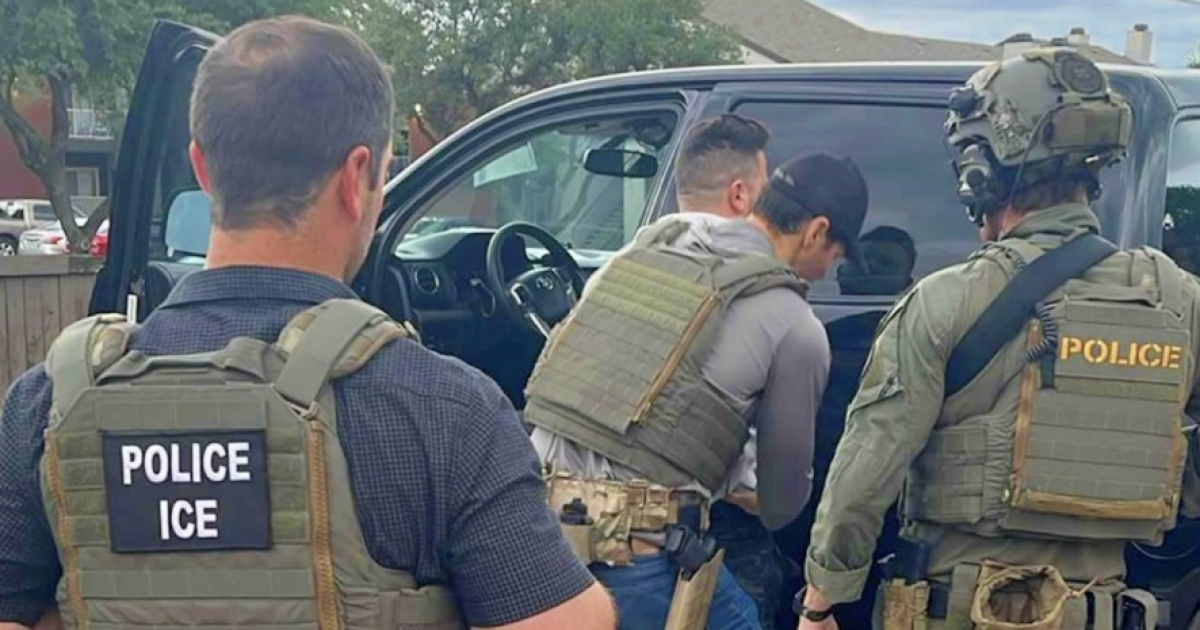
The United States Department of Homeland Security (DHS) has confessed that their website designed to display so-called "worst of the worst" detained immigrants is riddled with inaccuracies.
A CNN investigation has revealed that thousands of individuals were wrongly categorized as having been convicted or arrested for serious offenses, including sexual crimes or various forms of homicide. Meanwhile, hundreds more, also labeled as the "worst of the worst," were actually listed for much lesser infractions such as isolated traffic violations, marijuana possession, or illegal reentry into the United States after a prior deportation.
Launched in December, the site was heavily promoted by DHS Secretary Kristi Noem, the White House, and President Donald Trump as a showcase of their immigration policy.
Currently, the website lists approximately 25,000 individuals alongside the offenses for which, according to the agency, they were arrested or convicted.
However, following the mentioned journalistic review, a DHS spokesperson admitted that the charges against hundreds of immigrants included on the site were incorrectly described.
The spokesperson attributed the inaccuracies to a "technical glitch" that affected about 5% of the entries and assured that the issue had been "resolved."
Amid criticism about whether equating minor traffic violators with murderers could undermine the agency's public message, the DHS defended its list. "Many of those listed with traffic infractions and illegal reentry, a felony, have additional offenses," stated the spokesperson, reiterating it was all due to a technical error on the site.
"All these individuals were arrested by ICE and committed offenses by violating our nation's laws, including some with serious illegal reentry crimes," they added.
CNN clarified that it could not independently verify the individual descriptions of each of the thousands of names included in the portal.
Who Makes Up the List?
Nearly half of the immigrants labeled as the "worst of the worst" are from Mexico. More than 2,100 are from Honduras; Guatemala and Cuba have around 1,900 each; nearly 1,200 are from El Salvador.
Countries like Iran, China, Nicaragua, Haiti, and Jamaica contribute dozens each, and several dozen from Somalia, a nation Trump has repeatedly disparaged and which has been a focus of recent tensions in Minneapolis, home to a large Somali diaspora.
Some family members have reached out to CiberCuba in recent weeks to point out that their loved ones were wrongfully listed as convicted of serious crimes they did not commit.
A Pattern of Inaccurate Descriptions
This isn't the first occasion the Trump administration has admitted to errors in the public characterization of detained immigrants. In a previously reported case by NOTUS, the White House acknowledged that it mistakenly published the image of a man described as convicted of a sexual crime against a minor.
According to an official, the mistake was corrected, and the administration will continue to disseminate information about "dangerous illegal alien criminals being removed from our streets."
Arrests in Cities with Large Prisons
The DHS portal not only exposes names and offenses but also the countries of origin and the city where the immigrants were arrested.
CNN's analysis revealed that some of the areas with the highest number of detentions are small cities with large federal or private penitentiaries. The city with the most arrests on the list is Conroe, Texas, home to the Joe Corley Processing Center, an ICE detention facility.
Other places with high numbers, such as Lompoc (California), Yazoo City (Mississippi), and Eden (Texas), also host large federal prisons. This might suggest that part of the detainees were already in custody, weakening the narrative that they were "public safety threats" lurking in communities, as noted by the media outlet.
The push to publicly display names and faces has been directly encouraged by the president. "Show the numbers, the names, and the faces of the violent criminals, and show them NOW!" Trump wrote on Truth Social last month.
"People will start supporting the ICE patriots, instead of the highly paid rioters, anarchists, and agitators! MAKE AMERICA GREAT AGAIN," he added.
Nevertheless, critics argue that the proportion of immigrants truly convicted of violent crimes directly related to public safety is smaller than the official narrative suggests. "The vast majority of so-called criminal aliens are individuals accused or convicted of traffic offenses, driving under the influence, and immigration-related crimes," stated John Sandweg, former acting director of ICE during the Obama administration.
Key Questions about the DHS Migrant List
What prompted the DHS to admit errors in their migrant list?
A CNN investigation uncovered numerous inaccuracies in the listing of detained immigrants, prompting the DHS to acknowledge and address these errors.
How significant was the technical glitch affecting the DHS website?
The technical glitch affected approximately 5% of the entries, leading to incorrect descriptions of charges against certain immigrants.
Which countries are most represented on the "worst of the worst" list?
Mexico, Honduras, Guatemala, Cuba, and El Salvador are the most represented countries on the list, with significant numbers also from Iran, China, Nicaragua, Haiti, and Jamaica.
What impact do critics believe the list has on public perception?
Critics argue that the list overstates the number of immigrants involved in violent crimes, suggesting that many are listed for minor offenses like traffic violations and immigration issues.