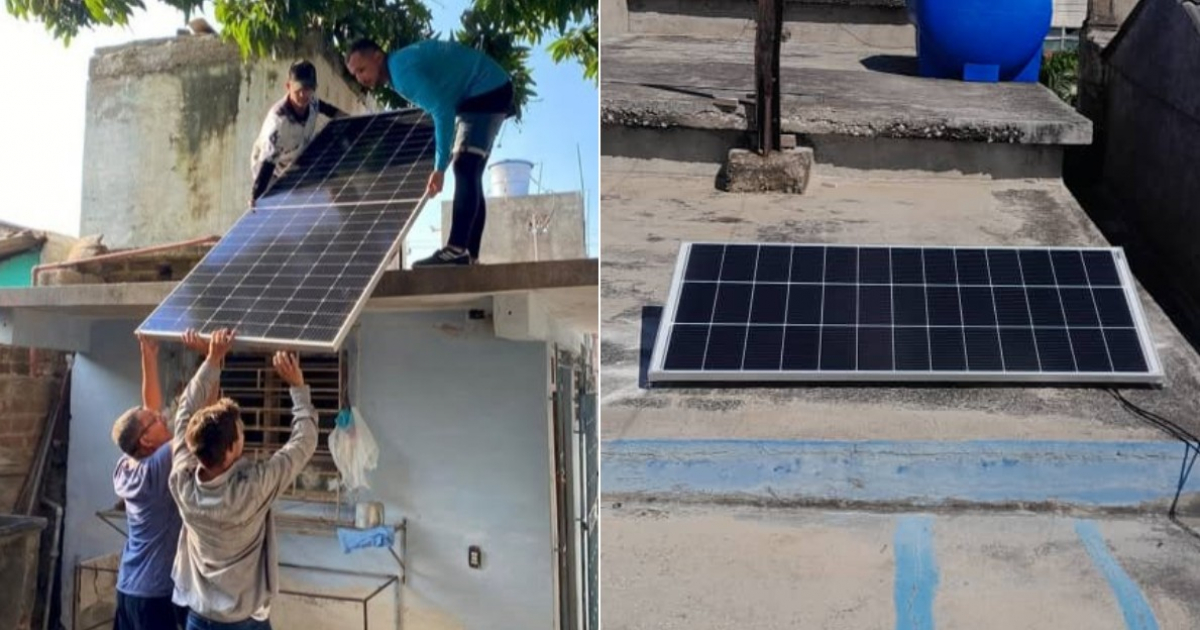
In the midst of an energy crisis leaving Cuba with power outages lasting up to 20 hours a day, the government's decision to distribute solar panels to 180 educational workers in Camagüey has sparked widespread criticism. The move, touted as a "humanistic" achievement and a step towards "sustainability," is being questioned by the public.
While official announcements praise the installation of 800 and 1200-watt systems in educators' homes, citizens are scrutinizing both the initiative's limited scope and the government's priorities amid an electrical collapse affecting millions.
Official Narrative: A "Brighter Future"?
The government claims that the provision of solar panels to 180 education sector workers across 13 municipalities and three provincial centers helps support "clean energy for education and family life." According to their statement, the systems are offered at "affordable prices, with payment facilities through bank credit and prompt financial system response." It was also noted that 143 systems have already been installed, with 37 pending.
Lázaro Rubén Herrera Batista, head of the Department of Specialized Educational Activity at the Provincial Education Directorate, is among the beneficiaries and expresses gratitude to "the Revolution" for the initiative, which he says "transforms the daily lives of educators and families."
A Nation in the Dark
However, outside the official narrative, the country's energy reality tells a different story: prolonged blackouts, insufficient power generation, and a deteriorated electrical grid due to years of neglect and lack of investment.
The crisis is not a temporary issue but the result of inefficient management that has pushed the electrical system to its limits, impacting daily life, the economy, and public health.
180 Panels for an Entire Province
One of the main criticisms in the comments centers around the real impact of the distribution. In a province with thousands of educators, 180 systems are a drop in the bucket.
"What about the hundreds of teachers and health workers in our province who were left out? When are they getting theirs? Or is it, as usual, just propaganda while thousands remain unsupported?" wrote one Camagüey resident.
Another teacher added, "I don't know which teachers got them because I work at a school and I'm constantly dealing with blackouts."
It’s also pointed out that the systems are not free.
Distrust and Accusations of Favoritism
The revelation that a provincial official is among the beneficiaries has fueled suspicions about the process's transparency.
"Of course, a boss would be a beneficiary, nothing new in this country," one commenter noted.
Another added, "It's always the bosses and some chosen ones."
One comment was even more direct: "And where did the panels end up? At the Provincial Education Sector? Go to the homes of the Education Directors and you'll see none were left out, while the teachers, who have sacrificed for years, continue to suffer blackout after blackout."
Questions are also raised about the geographic selection criteria.
A user mentioned, "In San Antonio del Sur, they prioritized teachers and workers living in the town center, the beach, and other distant neighborhoods, according to those responsible for the installations, due to transportation issues, despite there being many cars in the municipality. Priority goes to those who work the least, while those who toil tirelessly have to wait for the second or third round, if they ever come."
The perception of favoritism and lack of transparency reflects growing distrust in the management of resources, especially when they are scarce.
What About the Rest of the Population?
Beyond the teaching sector, many comments extend the focus to other sectors equally affected by the blackouts.
"They should also do this for health professionals, who work so many shifts and come home to continue an endless struggle," one woman wrote.
But the most common concern is about the children. "Where do they leave the children? After spending a night without power, unable to sleep because of the heat and mosquitoes, they have to wake up tired and with no desire to go to school," remarked another woman.
In a country where electricity fails for most of the day in some areas, students arrive at school exhausted after sweltering nights plagued by mosquitoes. Doctors perform shifts in hospitals that also struggle with power limitations. Millions of households continue to rely on an unreliable electrical grid.
In this scenario, the provision of a limited number of solar panels to a specific sector, under payment conditions, is seen by many as a superficial measure presented as a major achievement.
Cuba's ongoing energy crisis is not the result of a single event but of years of misguided decisions and inability to ensure a stable supply. Meanwhile, the population endures blackout after blackout, heat, spoiled food, and paralyzed services.
In this context, the question that emerges on social media encapsulates the sentiment of many: What about the children who can't sleep because of the blackouts and still have to get up for school?
Understanding the Cuban Energy Crisis
What is causing the current energy crisis in Cuba?
The energy crisis in Cuba is primarily due to years of inefficient management, lack of investment, and insufficient maintenance of the electrical infrastructure, pushing the system to its limits.
How are solar panels being distributed in Camagüey?
In Camagüey, 180 solar panel systems have been distributed to educational workers, offered at affordable prices with payment options through bank credit, although this represents a fraction of the need.
Why is there criticism about the distribution of solar panels?
Criticism arises from the limited scope of the distribution, perceived favoritism, and the continued suffering of the majority, including children and health workers, amidst widespread blackouts.