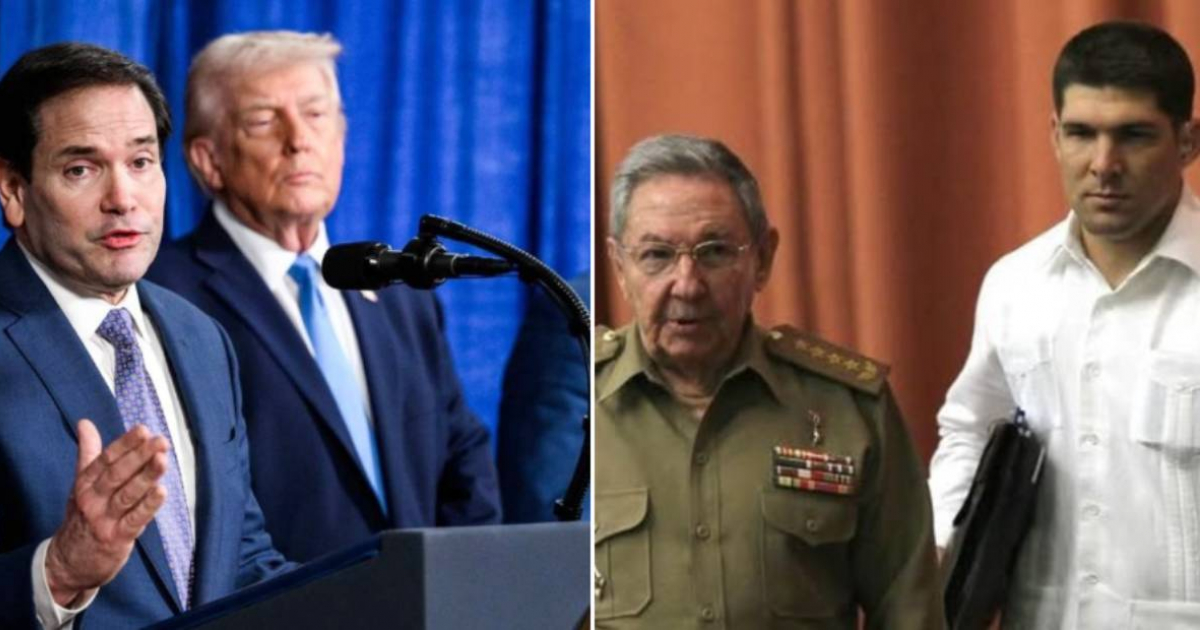
Reports of alleged discussions between Secretary of State Marco Rubio and Raúl Guillermo Rodríguez Castro, the grandson of Raúl Castro known as "El Cangrejo," have sparked a heated debate within the Cuban exile community regarding the boundaries of political transition in Cuba.
Axios has revealed that Rubio has engaged in recent communications with Rodríguez Castro. These exchanges, which exclude the current leader Miguel Díaz-Canel, are directed towards those whom Washington perceives as the real power in Havana.
Miami's Reaction and Opposition to Rubio-Castro Negotiations
The news of the dialogue has prompted skepticism among exiles. Analyst Andy Gómez remarked that "Raúl learned a significant lesson from his brother Fidel: trust no one."
This is likely why the Army General has chosen his grandson, El Cangrejo, for these talks with Rubio. He is considered a trusted confidant and right-hand man.
Eloy Viera, an analyst from the elTOQUE platform, suggested that "the Trump administration is attempting to engage with the real power rather than bureaucratic structures that could serve as a facade or reference point."
He further noted that, in a potential transition scenario, some figures might seek to "retain key economic assets or, at the very least, impunity for those who remain."
This aspect creates tension among the more radical sectors of the Cuban exile community, who have long awaited the opportunity to hold the Castros accountable.
Commentator Miguel Cossio was unequivocal: "No member of the Castro family should be part of that political change process in Cuba."
Historical Context and Continued Tensions
Similarly, analyst Sebastián Arcos Cazabón stated that neither "an Alejandro Castro nor a Raúl Guillermo" would be acceptable, as he believes the father, son, and grandson are all equivalent.
This debate arises just days before the 30th anniversary of the downing of the Brothers to the Rescue aircraft on February 24, 1996, which resulted in the deaths of four men.
On February 13, 2026, Cuban-American congress members Mario Díaz-Balart, María Elvira Salazar, Carlos A. Giménez, and Nicole Malliotakis sent a letter to President Donald Trump urging the Department of Justice to formally charge Raúl Castro for his alleged role in the attack.
"The thugs who have oppressed, tortured, and killed must face justice, and accountability must start at the top," declared Díaz-Balart.
Rubio, Trump, and the Balance Between Justice and Political Transition in Cuba
The revelations from Axios place Marco Rubio at the center of a delicate moment for both nations. As Secretary of State, he needs to explore all possible avenues in U.S. policy toward Cuba to find the most effective path forward.
Washington holds a firm stance: the regime must step down unless substantial changes occur, such as the release of political prisoners and democratic and economic openness.
Rubio's engagement with Raúl Castro's circle is one of the most sensitive moves of his career, dealing with a topic laden with symbolic significance for exiles in Miami and U.S. politics.
Despite his historical positions against the Cuban regime, Rubio operates within an administration that is considering various scenarios amid economic pressure and international isolation on Havana.
Any potential agreement involving members of the Castro family could ignite a new debate between those prioritizing justice and those considering alternative political transition formulas for Cuba, more in line with 21st-century realities.
In this scenario, with Donald Trump ultimately guiding decision-making, the question arises in South Florida whether the exile community will support Rubio unconditionally or demand that justice takes precedence over any political calculations.
Key Questions on U.S.-Cuba Relations and Marco Rubio's Role
What is the significance of Marco Rubio's discussions with Raúl Guillermo Rodríguez Castro?
The discussions are significant as they represent an engagement with what Washington considers the real power in Havana, bypassing the official leader Miguel Díaz-Canel.
Why is the Cuban exile community divided over these negotiations?
The division stems from differing priorities, with some exiles demanding justice for the Castros' actions, while others are open to exploring political transition pathways that might involve the Castro family.
What stance does Washington maintain regarding the Cuban regime?
Washington insists that the Cuban regime must relinquish power unless there are significant changes such as the release of political prisoners and democratic reforms.