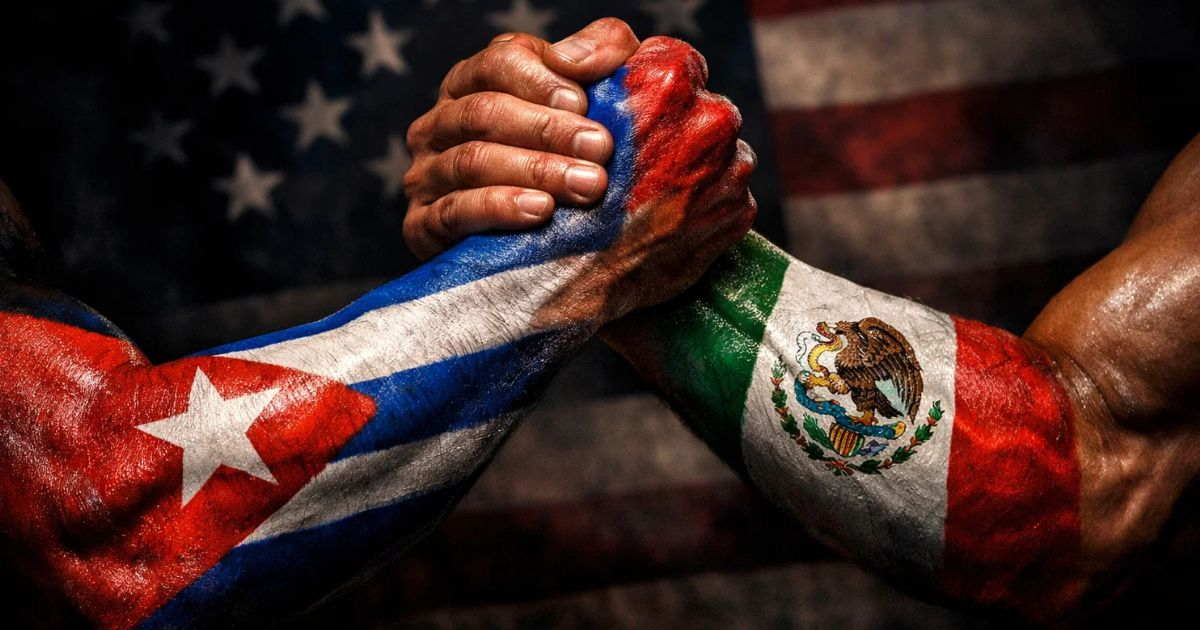
The longstanding alliance between Mexico and Cuba, which has remained steadfast since the Cuban Revolution's success in 1959, is facing one of its most challenging periods due to President Donald Trump's intensified policies towards Havana.
Washington's recent directive to penalize countries that supply oil to the island puts Mexico in a particularly precarious position.
According to an analysis by the BBC, the United States has ramped up its strategy to economically isolate the Cuban regime, implementing measures aimed at halting the flow of fuel.
Trump has expressed a desire to reach a "deal" with Cuba, although he has not specified any conditions, while simultaneously pressuring other nations to cease any energy support to the island.
In recent years, Mexico emerged as a major crude supplier to Cuba, especially after the decline of Venezuelan support, now faces the dilemma of upholding its historic policy of solidarity without jeopardizing its strategic relationship with Washington.
President Claudia Sheinbaum has criticized the U.S. restrictions, labeling them as unjust due to their impact on the Cuban population, yet she has paused new fuel shipments while diplomatic talks are underway.
The bilateral relationship between Mexico and Cuba has deep roots. Mexico was the only Latin American country that did not sever diplomatic ties with Havana in the 1960s, despite pressures from the Organization of American States.
For decades, both governments engaged in political, cultural, and economic exchanges, including energy agreements and technical cooperation.
According to the cited analysis, this historical bond was also characterized by an implicit understanding: Mexico upheld the principle of non-intervention and maintained relations with the Cuban regime, while Havana refrained from promoting revolutionary movements within Mexican territory.
This balance allowed Mexico to occasionally act as an indirect mediator between Cuba and the United States.
With the rise of Andrés Manuel López Obrador in 2018 and now under Sheinbaum's leadership, the relationship strengthened through the deployment of Cuban doctors, vaccine purchases, and supply shipments during the pandemic, as well as favorable oil exports.
However, the current scenario alters the dynamics. The threat of sanctions and tariffs from the Trump administration forces Mexico to recalibrate its foreign policy.
Experts cited by the BBC argue that Mexico is trying to preserve its accumulated political capital over decades in its relationship with Cuba while safeguarding its economic and trade interests with the United States, its primary partner.
The challenge lies in maintaining its doctrine of self-determination and regional solidarity without becoming ensnared in the confrontation between Washington and Havana.
At a time when Cuba is grappling with a deep economic and energy crisis, U.S. pressure not only affects the regime but also its allies.
Given its regional influence and geographic proximity, Mexico becomes a crucial player in a diplomatic standoff that could redefine historical balances in the hemisphere.
Key Questions on Mexico-Cuba-U.S. Relations
What has been the historical relationship between Mexico and Cuba?
Since 1959, Mexico and Cuba have maintained strong diplomatic ties, with Mexico being the only Latin American country not to cut relations with Cuba in the 1960s despite external pressures.
How has Trump's policy affected Mexico's stance?
Trump's sanctions on countries supplying oil to Cuba have placed Mexico in a difficult position, forcing it to balance its solidarity with Cuba against its economic ties with the United States.
What role has Mexico played in U.S.-Cuba relations?
Mexico has often acted as an indirect mediator between the U.S. and Cuba, leveraging its historical relationship and diplomatic stance to facilitate dialogue.