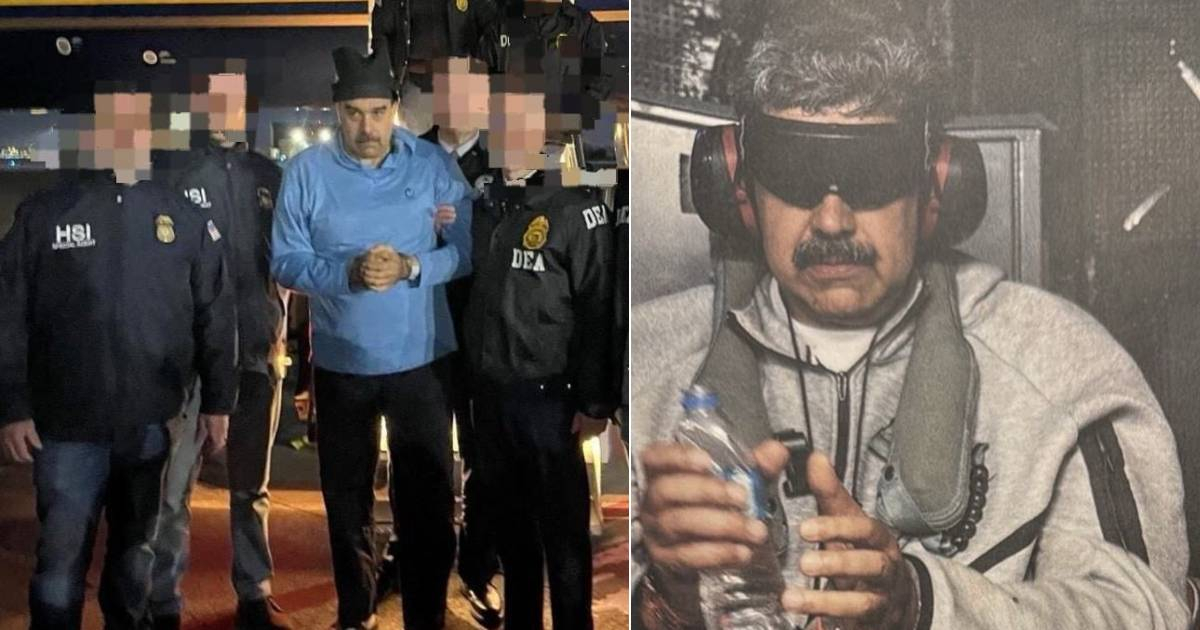
Recent court documents, disclosed on Tuesday, have unveiled that Nicolás Maduro and his wife, Cilia Flores, were granted a consular visit while being held in a federal prison in New York. They await their upcoming hearing in the Southern District court.
The revelation emerged from a letter sent to Judge Alvin K. Hellerstein, confirming that on January 30, 2026, both detainees were visited by an official from the Republic of Venezuela. This was in accordance with a court order issued following their initial court appearance.
Although the consular visit took place at the end of January, it only became public through the digital case archive recently.
Prosecutor's Letter
In the letter addressed to the court, the case prosecutor Jay Clayton highlighted that during the arraignment held on January 5, 2026, the judge mandated that consular access be ensured for the detainees and that formal reports be made on these interactions.
Clayton stated, "The Court ordered the Government to facilitate the defendants' access to consular services and report back to the Court."
According to Clayton, on January 30, Maduro and Flores "received a consular visit from a representative of the Republic of Venezuela to facilitate access to any necessary services."
The visit occurred at the federal detention center in Brooklyn, where both have been held since their transfer to the United States. The identity or rank of the official who visited, as well as the duration of the meeting with Maduro and his wife, has not been disclosed.
Discussion on Consular Visits
Criminal lawyer Robert Pelier explained to media outlets that consular visits are not a guaranteed right for all foreign prisoners in U.S. federal prisons.
"What is guaranteed is the right to have lawyers and legal teams access the detainee, as constitutional rights grant the detained individual the right to review evidence, know who accuses them, and understand the charges," he noted.
According to the attorney, the judge has the authority to instruct detention center administrators to allow such contact, as was the case here.
Arrest and Charges
Maduro, aged 63, and Flores, aged 69, were apprehended on January 3 during a U.S. military operation in Caracas and subsequently transported to New York.
They made their initial court appearance two days later, where they pleaded not guilty and described themselves as "prisoners of war." Maduro also claimed to still be the "constitutional president of Venezuela."
The formal indictment spans 25 pages and includes four main charges: conspiracy to commit narcoterrorism, conspiracy to import cocaine into the United States, possession of machine guns and destructive devices, and conspiracy to possess weapons of war.
If convicted, they could face life imprisonment.
Postponement of Hearing
The next hearing, originally set for March 17, was postponed to March 26 at 11:00 a.m.
The Southern District of New York's prosecution requested the delay with the defense's agreement, citing the need for additional time to review evidence, prepare pre-trial motions, and address logistical matters.
Judge Hellerstein approved the request "in the interest of justice."
During the January court session, it was also revealed that Flores displayed a bruise on her right eye and bandages on her forehead. The defense requested medical attention for possible rib fractures, though no further details about her health condition were provided.
Defense Strategy
Maduro's defense team plans to challenge the legality of his detention on the grounds of sovereign immunity, a strategy reminiscent of the Manuel Noriega case following his capture in Panama in 1990.
In that instance, U.S. courts rejected the immunity claim, and the former Panamanian general was sentenced to 17 years in a U.S. prison.
As the legal proceedings progress in New York, Venezuela's Supreme Court of Justice has assigned executive functions to Delcy Rodríguez following Maduro's arrest, without formally declaring the president's absolute absence.
March 26 will mark the next pivotal moment in a case that may become one of the most significant trials of a former Latin American leader in U.S. federal court.
Key Questions Regarding Maduro and Flores' Case
What were Maduro and Cilia Flores charged with?
The charges against them include conspiracy for narcoterrorism, conspiracy to import cocaine into the U.S., possession of machine guns and destructive devices, and conspiracy to possess weapons of war.
When is the next court hearing scheduled?
The next court hearing for Maduro and Flores is set for March 26, at 11:00 a.m.
Why was the hearing postponed?
The hearing was postponed to allow more time for evidence review, preparation of pre-trial motions, and resolution of logistical issues.