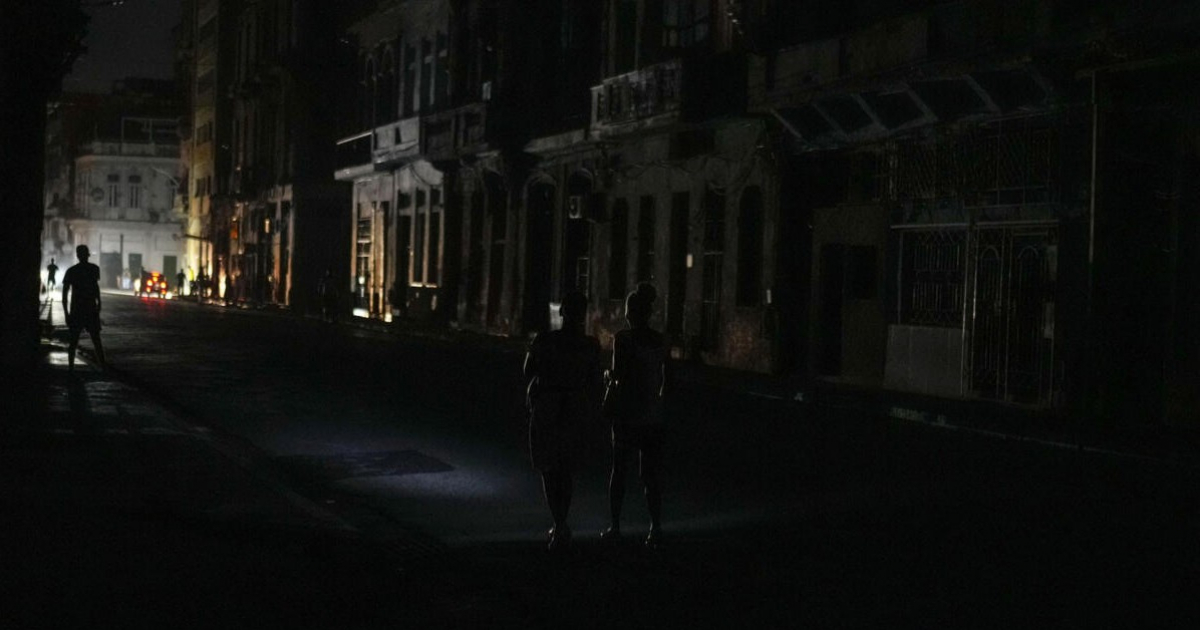
Once again, Cuba finds itself grappling with a severe energy crisis marked by prolonged blackouts and a generation shortfall that approached a staggering 1,800 megawatts (MW). This situation highlights the inability of authorities to provide a structural solution to an ever-worsening issue.
On Wednesday, February 18, the Unión Eléctrica (UNE) reported continuous service disruptions over the past 24 hours due to insufficient capacity, with the peak shortfall reaching 1,793 MW at 7:10 PM.
The situation persisted into the early morning hours. By 6:00 AM, the National Electric System (SEN) had a mere 1,280 MW available against a demand of 2,170 MW, resulting in 915 MW being affected at that time. The forecast for midday estimated an impact of 900 MW.
This degradation isn't an isolated incident. According to UNE, the situation involves malfunctions at four generating units in the Santa Cruz, Felton, and Antonio Maceo thermoelectric plants. Maintenance work on other crucial units in the Mariel, Nuevitas, and Carlos Manuel de Céspedes plants exacerbates the issue, alongside thermal generation limitations keeping 466 MW offline.
For peak hours, UNE expects the addition of 112 MW from the Mariel fuel site, 45 MW from five motors at the Regla platform, and 85 MW from six motors at the Moa fuel site. Even with these additions, the projected availability would be 1,437 MW, against an estimated peak demand of 3,170 MW, leaving a deficit of 1,733 MW. If conditions persist, the shortfall could reach 1,763 MW during this period.
The 51 new photovoltaic solar parks contributed 3,968 MWh, with a maximum output of 760 MW at midday. Still, these figures fall short of bridging the significant gap between supply and demand, leaving the nation in a cycle of daily power outages.
The situation in Havana was equally dire. The capital's electric company reported service disruptions for 21 hours and 58 minutes. The peak capacity was 352 MW at 6:10 PM, with emergency measures providing an additional 70 MW. Restoration was achieved by 3:33 AM on Wednesday, but three blocks representing 116 MW remained offline, with recovery expected by morning.
The company cautioned that without improved SEN availability, energy contingency measures could lead to further unplanned outages, potentially impacting blocks and circuits without prior notice.
This scenario underscores a systemic crisis that didn't develop overnight. Years of underinvestment, deteriorating thermoelectric plants, and reliance on fuel have progressively weakened the system, leading to nearly constant blackouts across the country. The accumulated inefficiencies and lack of sustainable solutions have made power cuts a routine burden for millions of Cubans. As demand significantly outpaces generation capacity and numerous units remain out of commission due to failures or maintenance, the prospect of a stable system recovery remains elusive.
Understanding Cuba's Energy Challenges
What is causing the frequent blackouts in Cuba?
The frequent blackouts in Cuba are primarily due to a significant shortfall in power generation capacity, exacerbated by equipment failures and maintenance on key thermoelectric plants. Additionally, systemic issues like underinvestment and reliance on outdated infrastructure have contributed to the crisis.
How are the Cuban authorities addressing the power shortage?
Cuban authorities are attempting to mitigate the power shortage by integrating additional power sources from fuel sites and motors. However, these efforts fall short of meeting the demand, and no long-term structural solutions have been implemented to resolve the crisis.
Why is the situation in Havana particularly severe?
Havana is experiencing severe power outages due to its high electricity demand coupled with the overall system's incapacity to meet these demands. The capital's electric company has reported almost 22 hours of service disruption, underscoring the crisis's gravity.