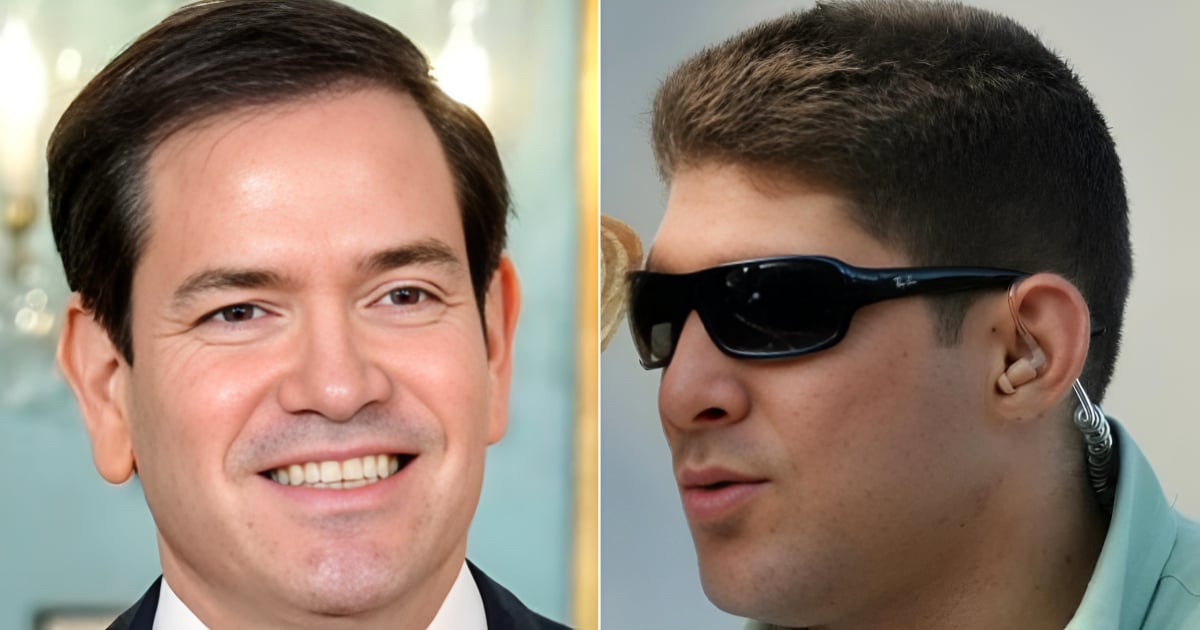
United States Secretary of State, Marco Rubio, is reportedly engaged in clandestine discussions with Raúl Guillermo Rodríguez Castro, the grandson and trusted aide of Raúl Castro. These talks could represent the first organized effort to negotiate a transition in Cuba, bypassing the official government channels led by Miguel Díaz-Canel.
An exclusive report by Axios, corroborated by sources within the Trump administration, reveals that these interactions occur directly with the inner circle of the regime's historical leader, deliberately avoiding the formal Communist Party framework and the Cuban president himself.
“I wouldn't call these negotiations, but rather conversations about the future,” an American official told the media outlet. However, the underlying aim is unmistakable: to explore potential scenarios for political change on the island.
Rubio’s interlocutor, known as “Raulito” or nicknamed “El Cangrejo” due to a finger deformity, is 41 years old and a key figure in Raúl Castro’s inner circle. He maintains connections with GAESA, the military-corporate conglomerate that dominates Cuba's critical economic sectors.
These discussions arise amid heightened pressure on Havana. Following the January 3 arrest of Nicolás Maduro and the dismantling of the Caracas–Havana axis, Washington has intensified energy sanctions against Cuba, even threatening Mexico, one of the island's last oil suppliers.
President Donald Trump has publicly acknowledged that his administration is “talking with people at the highest levels in Cuba” and has suggested that the island “should make a deal.” According to Axios, the State Department neither confirmed nor denied Rubio’s contacts with Castro’s grandson, opting not to issue an official statement.
These revelations starkly contrast with recent comments from Deputy Foreign Minister Carlos Fernández de Cossío, who claimed to EFE that there is “no high-level dialogue” with the U.S. and that only “message exchanges” have occurred. He also dismissed the involvement of intermediaries like Mexico or the Vatican.
Moreover, Fernández de Cossío emphasized that Cuba is unwilling to discuss constitutional reforms, changes to its socialist system, or the release of political prisoners, establishing firm boundaries for any potential negotiations.
Yet, the newly disclosed information implies that Washington might be pursuing a different strategy: negotiating directly with figures in Raúl Castro’s circle, whom the White House perceives as the real decision-makers on the island.
Sources cited by Axios suggest that Rubio and his team view Castro’s grandson as a representative of a more pragmatic, business-minded generation, for whom revolutionary communism has been unsuccessful.
“They are looking for the next Delcy in Cuba,” a source remarked, referring to the approach in Venezuela, where the U.S. fostered a transition without wholly dismantling the power structure.
The parallels with Caracas are clear. After Maduro's fall, Washington retained parts of the chavista apparatus while promoting stabilization and reconciliation processes.
In Cuba, a similar model could be envisioned: a negotiated transition that safeguards certain interests of the military elite in exchange for gradual reforms.
However, Cuba presents greater challenges. Unlike Venezuela, the island lacks an institutionalized political opposition, and its economy is more deteriorated.
While the regime continues to deny formal negotiations, the talks described by Axios suggest a more intricate reality: a discreet dialogue that could shape Cuba’s political future.
The question is no longer whether contacts exist, but what kind of transition the Castro regime would be willing to accept—and under what conditions.
Potential Transition in Cuba: Key Questions Answered
What is the main objective of Marco Rubio's talks with Raúl Castro's grandson?
The primary goal is to explore possible scenarios for political change in Cuba, potentially leading to a transition that bypasses the current official channels.
Why are these talks taking place outside of the official government channels in Cuba?
The discussions are conducted directly with Raúl Castro’s inner circle to avoid the formal Communist Party apparatus and the Cuban president, focusing on those perceived as the actual decision-makers.
How does the current situation in Cuba compare with Venezuela?
While both countries face significant challenges, Cuba lacks an institutionalized political opposition and has a more deteriorated economy compared to Venezuela.