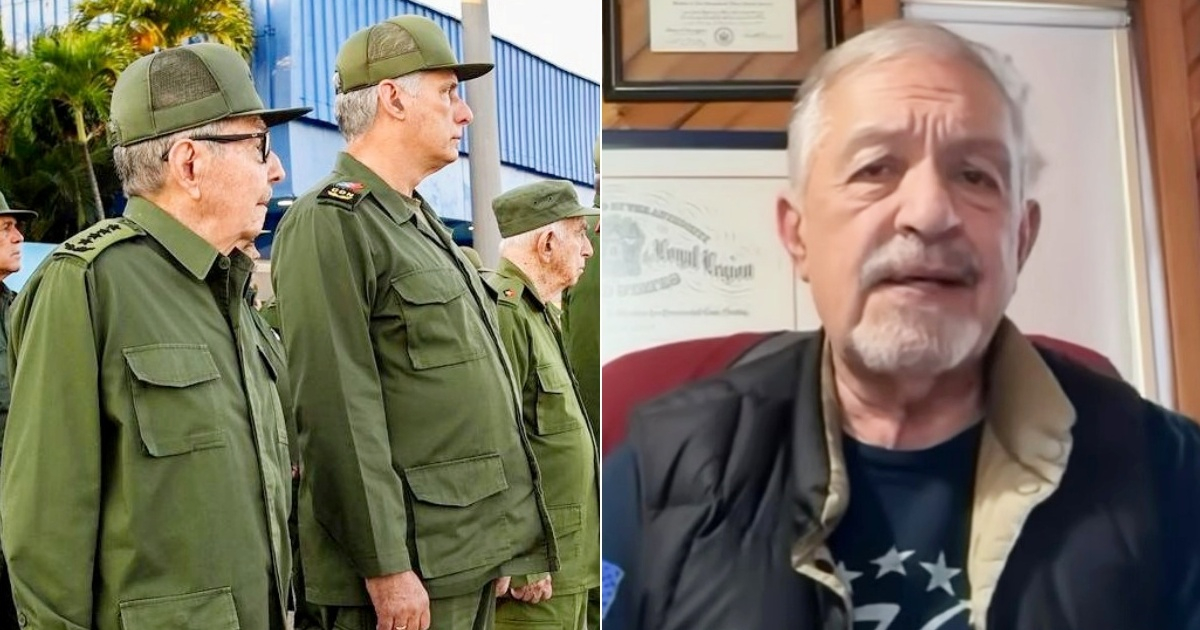
In an interview with journalist Javier Díaz from Univision, retired U.S. Army Colonel and military analyst Eric Rojo shared his insights on possible developments in Cuba, amidst the ongoing political and social tensions on the island.
Drawing from his experience, Rojo suggested that disruptions in authoritarian regimes rarely originate from the top military ranks but rather from the middle echelons.
When asked if the military should side with the people, he candidly remarked, "In dictatorships, high-ranking military officers are often completely aligned with government leaders, whatever they choose to call themselves."
In his view, any internal uprising would likely stem from mid-level officers. "If there's going to be a military revolt, it typically occurs at the level of commanders, majors, or captains, who are not particularly satisfied with the regime and would be willing to take action," he explained.
The Role of External Powers and Military Intervention
Contrastingly, he almost entirely ruled out an initiative from the upper echelons of the military. "The generals and others are completely sold out. It's rare for any of them to take the lead in a revolution, even a non-violent one, to overthrow the country's control," he asserted.
Discussing the potential for military action in Cuba leading to intervention from powers like Russia or China, Rojo was unequivocal. He believes that logistical and geographical constraints render any real involvement against the U.S. presence in the Caribbean unfeasible.
"We're a long way from Russia or China. This is the U.S.'s area of interest. We have the Monroe Doctrine, we have history… The geographical distances make anything more than simple declarations impractical. They don't have the capacity to confront U.S. fleets," he stated.
He concluded, "Practically speaking, they can do nothing but make speeches."
The Military Capacity of the Cuban Regime
Regarding the military capacity of the Cuban regime, Rojo denied that the island possesses sufficient technology or structure to become a regional power. He recalled Cuba's past deployment of forces in Venezuela but emphasized that this does not equate to having the capacity to confront the United States.
"No one can stand up to the U.S. If such a situation arose, it would truly be a disaster for the Cuban army, but again, it would be an unnecessary tragedy," he warned.
Prospects for Regime Change in Cuba
Finally, the retired colonel expressed his thoughts on the possibility of a regime change in the near future. Having arrived in the United States at 13, he recalled a saying often heard in his family: "No evil lasts a hundred years, nor can a body endure it."
Rojo lamented that while he hasn't yet reached a hundred years, several generations have suffered under the Cuban regime. "At some point, with the communications we have today, the Cuban people must tire of being dominated… Somehow, I hope they realize there is a different way of living from what they are used to," he concluded.
Eric Rojo's analysis does not foresee an external military intervention or an immediate uprising from the military's top ranks. Instead, he suggests that any transformation in Cuba would depend on internal dynamics, the accumulated societal wear and tear, and potentially fractures within the military's mid-level ranks.
Key Questions on Cuba's Political and Military Future
What role do mid-level military officers play in potential regime changes in Cuba?
Mid-level military officers, such as commanders, majors, or captains, are seen as more likely to initiate change due to their dissatisfaction with the regime, unlike the high-ranking officers who are often aligned with government leaders.
How likely is external military intervention in Cuba by Russia or China?
According to Eric Rojo, logistical and geographical constraints make it highly unlikely for Russia or China to intervene militarily in Cuba against the U.S. presence in the Caribbean.
Does Cuba have the military capacity to become a regional power?
Rojo argues that Cuba lacks the technology and structure needed to be a regional power, despite past military deployments in Venezuela.