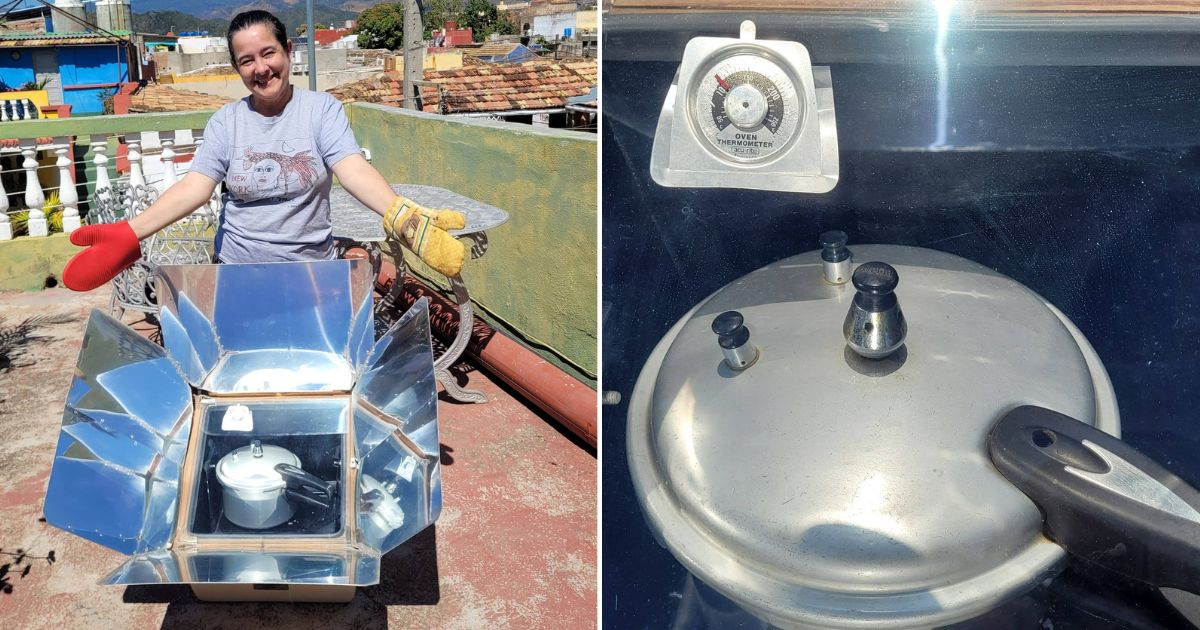
Amidst extended power outages and fuel shortages, many Cubans are turning to past solutions. In Trinidad, Yudit Vidal Faife has dusted off a solar oven brought to the island in the 1990s, using it once again to cook during the ongoing energy crisis.
In a series of videos shared on Facebook, she demonstrated how she used the device to soften red beans, relying solely on solar power.
"Today, Sunday, after a wonderful February 14th, we're back to our daily reality. We're here with no electricity, but the Cuban sun doesn't burn, it heats. Solar oven," she narrated while showing a pot enveloped in steam.
The footage reveals the cooking process spanning over an hour. "Ready to eat. One hour and 35 minutes of cooking," she noted, before mentioning she would prepare the sofrito to complete the dish.
Although she pointed out that the beans didn't reach the pressure of a conventional pot, she showed them boiling thanks to the heat trapped inside the oven.
Vidal Faife also recounted the oven's history. It was a gift from her parents, Pedro Vidal Izquierdo and Olga Lidia Faife Gutiérrez.
She shared that a friend of her father brought it from Canada during the Special Period when she was just 10 years old, as Cuba faced one of its worst economic crises following the Soviet Union's collapse.
Decades later, her parents decided to pass it down to her. She transported it by bus from Placetas to Trinidad, utilizing it for the first time 36 years after its arrival in Cuba.
"It works like the first day," she stated, recalling how in the '90s her father used it to bake cakes, flans, puddings, ice creams, rice, and even roast fish.
The scene evokes survival solutions that defined an entire generation of Cubans.
Today, amidst another phase of severe electrical limitations and fuel scarcity, the solar oven has become a domestic alternative to ensure food without relying on an increasingly unstable energy system.
While acknowledging that there might be more modern models available in the market, Vidal Faife expresses satisfaction with hers.
In a country where power cuts can last over ten hours a day, her experience highlights how many citizens are once again tapping into creativity and past resources to tackle a crisis impacting everyday life.
FAQs on Solar Ovens and Energy Solutions in Cuba
How do solar ovens work?
Solar ovens capture and convert sunlight into heat, allowing food to be cooked without traditional fuel sources. They are an eco-friendly alternative especially beneficial during energy shortages.
Why are solar ovens important in Cuba?
With frequent power outages and fuel scarcity in Cuba, solar ovens provide a sustainable cooking option, helping families to prepare meals without relying on the unstable energy grid.
What are the challenges of using a solar oven?
The main challenge is the dependency on sunlight, which can be inconsistent. Additionally, cooking times can be longer compared to conventional methods, requiring planning and patience.