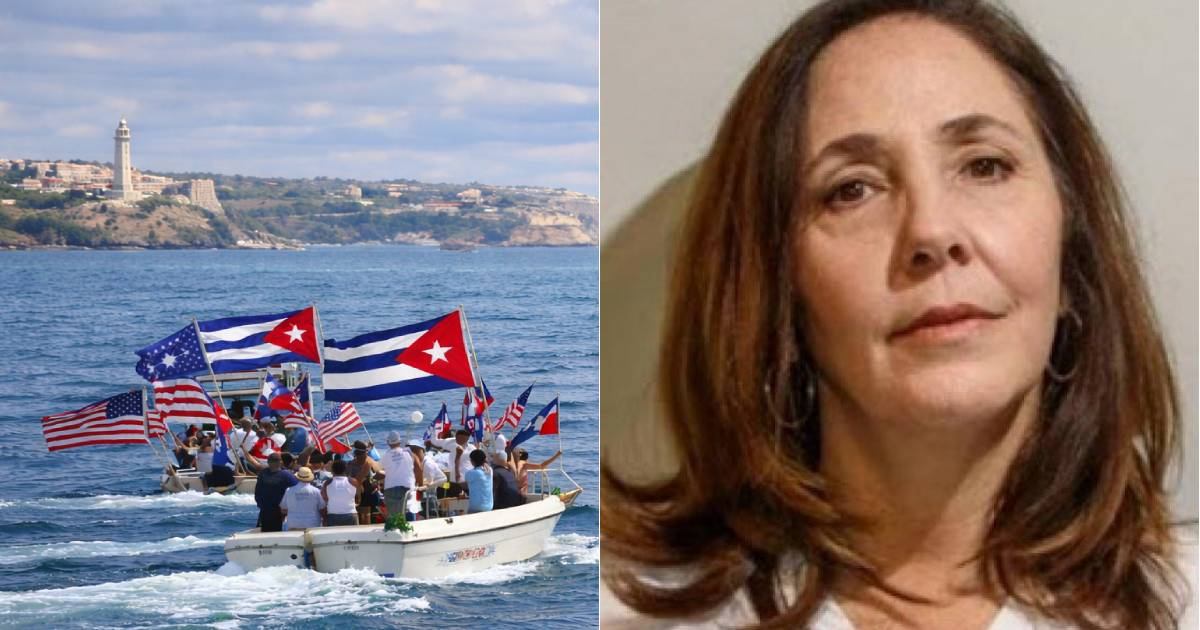
The announcement of an international flotilla set to deliver food and medicine to Cuba in March continues to stir controversy both inside and outside the island. A new twist has intensified the debate: Mariela Castro Espín, daughter of Raúl Castro and a prominent figure in Cuba's political landscape, is listed as a member of the Advisory Council of Progressive International, the coalition pushing the initiative.
Details of this involvement are available on the official Progressive International website, which outlines that the Advisory Council is responsible for setting the "strategic direction" of the movement. Among the advisors is Mariela Castro, identified as a deputy of the National Assembly and the head of the National Center for Sex Education (CENESEX).
This flotilla, named "Nuestra América," was unveiled this week by a global coalition comprising social movements, labor unions, and humanitarian organizations claiming to address Cuba's ongoing fuel crisis, power outages, and medication shortages.
Organizers plan for the mission to embark in March, navigating through the Caribbean, drawing inspiration from the Global Sumud Flotilla that aimed to deliver humanitarian aid to Gaza. Prominent supporters include U.S. activist David Adler, the general coordinator of Progressive International, former British Labour leader Jeremy Corbyn, and Democratic Congresswoman Rashida Tlaib.
Adler stated, "When governments enforce collective punishment, it is the duty of ordinary people to take action," while Corbyn emphasized Cuba’s right to "determine its own future," blaming the U.S. embargo for the country's hardships.
Promotional materials from the organizers directly accuse Donald Trump's administration of "suffocating the island," by cutting off fuel, flights, and essential goods, claiming the "consequences are lethal" for newborns, the elderly, and the sick.
However, the revelation of Mariela Castro's role within the advisory body has further fueled the already heated debate.
For many Cubans, her involvement raises an unavoidable question: How can an initiative driven by an organization featuring a direct representative of Cuba's political power be portrayed as an independent act of international solidarity?
On social media, activist Salomé García Bacallao sharply criticized the announcement, labeling it as a "propaganda spectacle" sanctioned by the regime. Her comment, "If they enter, we enter too," quickly went viral.
This slogan resonated with hundreds of exiled Cubans, sparking discussions about organizing a parallel flotilla, not to support the regime, but to assert their right to return and stand with the Cuban people.
The debate, filled with outrage, transcends ideological lines. For thousands of Cubans who have emigrated in recent years, the term "flotilla" signifies not solidarity, but another scene where others dictate who may enter Cuba—and who may not.
Key Questions about the "Humanitarian" Flotilla to Cuba
What is the purpose of the "Nuestra América" flotilla?
The flotilla aims to deliver food and medicine to Cuba, addressing the island's fuel crisis, power outages, and medication shortages.
Why is Mariela Castro's involvement controversial?
Mariela Castro's role in the Advisory Council of Progressive International raises questions about the independence of the flotilla, given her direct ties to Cuba's political regime.