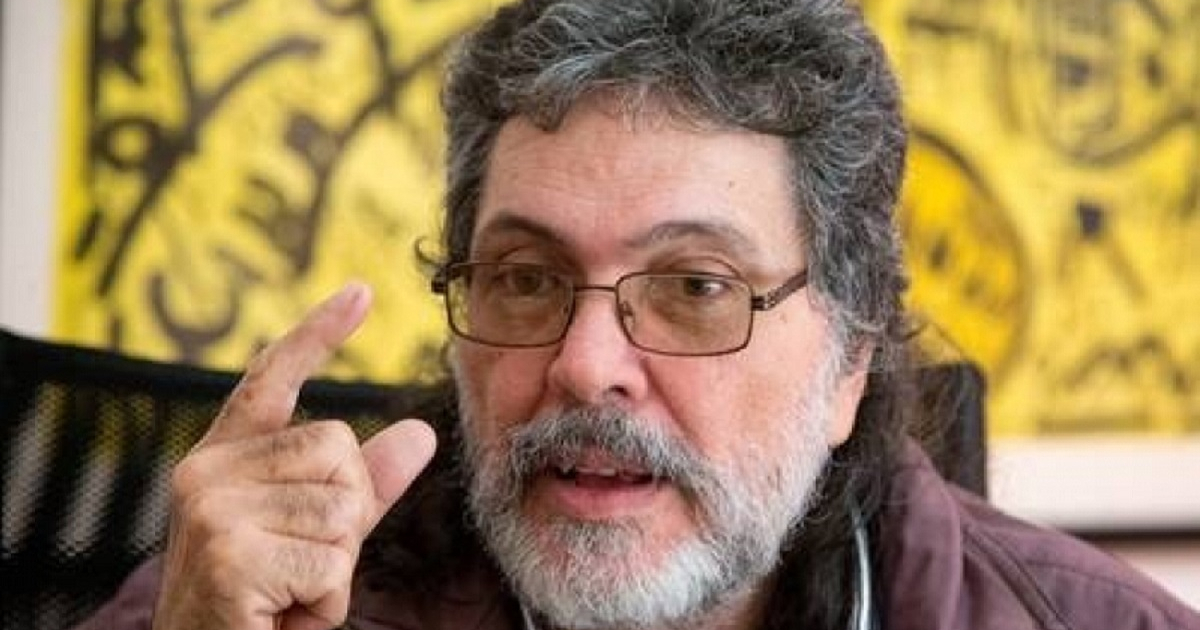
A Cuban woman has publicly challenged Abel Prieto Jiménez, an intellectual and cultural leader, over his recent remarks about the nation's future and his staunch defense of socialism as essential for Cuba's very existence.
On Facebook, Julia Elena Jareno Varcarcel rejected Prieto’s notion that the country would vanish without its current political system. She clarified, "What would be lost is the power of those who have thrived on the system while the people are sinking."
Jareno Varcarcel criticized Prieto for speaking on behalf of the entire country.
"Do not speak for Cuba. Cuba is not the Cuban Communist Party. Cuba is not the 'Revolution.' Cuba is not a slogan. Cuba is the elderly rummaging through trash for food in Havana. It is the mother cooking with wood because there is no gas. It is the young person fleeing through the Darién Jungle because they see no future," she detailed.
She argued that this "real Cuba" stopped believing in official rhetoric years ago.
Jareno Varcarcel also challenged the regime’s frequent accusations against the United States and Donald Trump, blaming them for the island's crisis.
She emphasized, "The suffocation began long before. It was caused by a failed model imposed by Fidel Castro and maintained by an elite that never stands in line, never goes hungry, and never lives on the wages it imposes on others."
In a particularly striking passage, she declared: "The uncomfortable truth is that the people did not abandon the nation; they abandoned the revolution. The revolution that promised equality but created castes. The one that promised dignity but normalized misery. The one that promised sovereignty but ended up reliant on foreign subsidies for decades."
Jareno Varcarcel also questioned the concept of "colony" as used in official discourse: "Is a colony about trading freely, or is it about perpetual dependence on a state that decides what is produced, sold, and thought? Is a colony about opening up to the world, or is it about forbidding citizens to prosper without the power's permission?"
Directing her strongest criticism towards the cultural leader, she wrote: "Cuba today functions for those, like you, who enjoy privileges: travel, positions, access, protection. For everyone else, there are blackouts, collapsing hospitals, and symbolic wages. That is the real inequality your discourse never mentions."
Ultimately, she rejected equating the nation with its political system.
"Claiming that without socialism there is no nation is a threat disguised as patriotism. It’s an attempt to hijack the country's identity to protect a worn-out system. The Cuban nation existed before 1959 and will continue to exist when fear ceases to be state policy," she concluded.
She summarized her text by reaffirming that the homeland isn’t lost when a model changes but when entire generations are condemned to survive amid ruins while a minority clings to power.
"Cuba does not belong to you. Cuba belongs to its people. And those people decided long ago, even if you refuse to admit it, that the revolution does not represent them," she concluded.
Jareno Varcarcel's statements follow an article published by Abel Prieto in the official media outlet Cubadebate, attributed to REDH Cuba, titled "Do We Have Our Days Counted?"
In his piece, the president of the Casa de las Américas insisted on blaming the "Empire" and an alleged international media offensive for the island's ongoing crisis.
Prieto linked this scenario to the capture of Nicolás Maduro on January 3, which he claimed sparked a "wave of anti-Cuban euphoria" on social media.
He also alleged a coordinated "avalanche" of memes from Florida portraying Cuba as the "51st state" and Marco Rubio as a key figure in a supposed transition.
In his article, the cultural leader connected these events to an executive order signed by Donald Trump on January 29, which he described as part of a strategy of "total economic suffocation" against Cuba, citing activists who describe US policy as "collective punishment."
However, while the official narrative insists on external siege, the internal crisis continues to deepen, marked by constant blackouts, food and medicine shortages, high inflation, and mass migration that has profoundly affected Cuban society in recent years.
In this context, Julia Elena Jareno Varcarcel's response offers a direct critique of the government's narrative, focusing responsibility on the political model and the inequality that benefits a minority connected to power while the majority faces daily hardship.
Understanding the Cuban Crisis
What did Julia Elena Jareno Varcarcel criticize about Abel Prieto's statements?
She criticized Prieto for suggesting that Cuba would not exist without its current socialist system, arguing that this view only serves those enjoying privileges while the majority suffer.
How does Jareno Varcarcel describe the "real Cuba"?
She describes the "real Cuba" as the people struggling daily—like the elderly searching for food in trash and mothers cooking with wood due to lack of gas—contrasting this reality with the privileges of the political elite.
What is the main argument against the official discourse on Cuba's crisis?
The main argument is that the crisis is not solely due to external factors like US policies but is deeply rooted in the failed political model and the inequality it perpetuates.