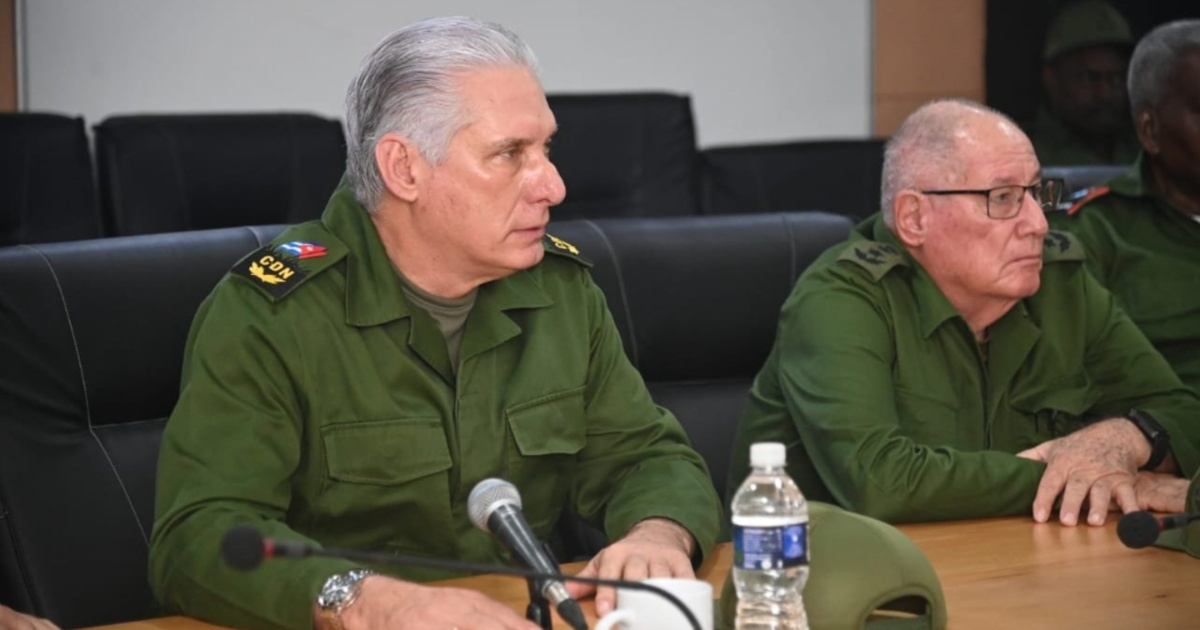
This past Friday, the Cuban government issued a deterrent message amid the National Defense Day, warning of a robust response to any potential aggression.
"With preparation and unity, anyone daring to invade Cuban territory will encounter very hostile forces," was the assertion made during a meeting led by the head of state, Miguel Díaz-Canel Bermúdez.
The day's activities unfolded at the "Armada" Defense Zone in the Cerro district of Havana, featuring an event held at the National Company "Frutas Selectas," according to the official report.
The publication by Cuba's Presidency noted the attendance of key figures such as Esteban Lazo Hernández, a member of the National Defense Council; Álvaro López Miera, Minister of the Revolutionary Armed Forces; General Ramón Pardo Guerra, head of the National Civil Defense Staff; General Ernest Feijóo Eiró, chief of the Western Army; along with Liván Izquierdo Alonso, president of the Provincial Defense Council of Havana, and Vice President Yanet Hernández Pérez, among other officials.
Mai-Lin Alberty Arozarena, president of the Cerro Municipal Defense Council, detailed, according to the text, aspects regarding "defense structures," "tactical and strategic objectives," and organizational measures aimed at "ensuring defense" against a "possible systematic attrition and enemy invasion" in a "non-conventional warfare" context.
After the meeting, Díaz-Canel toured the company’s facilities, conversing with workers engaged in firearm assembly and disassembly exercises, while organizing a display of supplies deemed "vital" in the event of a "war scenario."
In statements to the Presidency's press team cited in the report, Alberty labeled it "strategic" for "every Cuban" to assume the defense of the homeland in a "non-conventional warfare" scenario, characterized by "economic warfare" and "heightened blockades."
She also emphasized the importance of readying the Production and Defense Brigades to protect economic targets and sustain the "vitality of the population and soldiers," according to the note.
Militaristic Rhetoric Amidst Economic Collapse
At the start of 2026, the Cuban regime ramped up its militaristic rhetoric amidst an internal climate marked by economic collapse and public distrust.
In January, the National Television News launched the "Year of Defense Preparation 2026," a campaign that Miguel Díaz-Canel’s administration presented as a bid to "strengthen military invulnerability" and "enhance the combat readiness" of the Revolutionary Armed Forces (FAR).
This militaristic discourse coincided with mounting pressure from Washington following the capture of Venezuelan dictator Nicolás Maduro by U.S. forces, a development that shifted the balance of power in the Caribbean.
As Donald Trump's administration bolstered its military presence in the region, the Cuban government resorted to confrontational ideological language, attempting to portray internal unity amidst its greatest political fragility in decades.
Shortly thereafter, the regime staged new military exercises as part of National Defense Day, portrayed as a demonstration of "military strength and ideological cohesion."
Analysts agreed that the government's insistence on the "war of all the people" is less about a genuine risk of aggression and more about a political necessity: maintaining ideological control, emotionally mobilizing the citizenry, and reinforcing the narrative of external siege that justifies its grip on power. In this context, military exercises symbolize more a theater of resistance than a genuine defense strategy.
Understanding Cuba’s Militaristic Strategy
What was the purpose of Cuba's National Defense Day activities?
The activities aimed to showcase preparedness and deter potential aggressors by demonstrating Cuba's readiness to defend its territory.
Why did the Cuban regime intensify its militaristic rhetoric in 2026?
The heightened rhetoric was a response to internal economic collapse and public distrust, as well as external pressures, particularly from the United States.
How did external events influence Cuba's military strategy?
The capture of Nicolás Maduro by U.S. forces and the strengthening of U.S. military presence in the Caribbean influenced Cuba's decision to emphasize military readiness and internal cohesion.