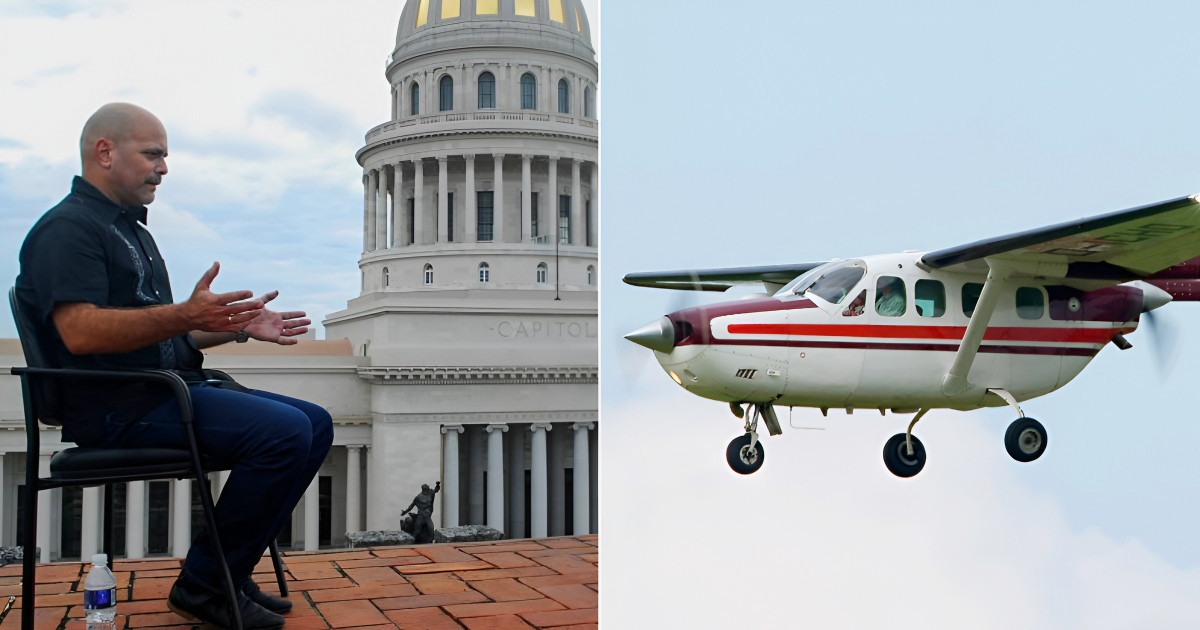
Gerardo Hernández Nordelo, the national coordinator for Cuba's Committees for the Defense of the Revolution (CDR), weighed in on the revived U.S. debate regarding the 1996 shootdown of the "Brothers to the Rescue" airplanes. He questioned the legal feasibility of a potential criminal charge against Raúl Castro for the incident.
In a social media post, Hernández Nordelo—one of the "Cuban Five" agents who were imprisoned in the United States for espionage—reacted to a headline and image circulated by CiberCuba. The post discussed Cuban-American congress members pushing for Raúl Castro's criminal prosecution over the downing of the civilian aircraft.
The Cuban leader, known for his sarcasm, mocked the media coverage, asserting that the legislators were using a legal argument by "lying" about the shootdown's location.
"It seems the trio of congress members hasn't realized that the only legal argument the U.S. could use—by lying—is to say the shootdown occurred in international waters," he wrote.
Hernández Nordelo added that this argument was weakened by recent U.S. Congressional actions authorizing operations against vessels in international waters for "national security reasons."
He argued that this set a "bad precedent" for building a judicial case against the former Cuban leader.
Political Strategy Aims for U.S. Department of Justice's Attention
Hernández Nordelo's statements came after Cuban-American congress members, led by Mario Díaz-Balart, announced plans to formally request that the U.S. Department of Justice consider murder charges against Raúl Castro for the February 24, 1996, incident.
The event involved two Cessna 337 planes from "Brothers to the Rescue" being shot down by Cuban Air Force MiG fighters. Four activists from the organization—Carlos Costa, Pablo Morales, Mario Manuel de la Peña, and Armando Alejandre—were killed. Three were U.S. citizens, and one was a permanent resident. A third aircraft, carrying José Basulto, Sylvia Iriondo, and others, managed to escape to Florida.
For decades, Cuban exile organizations have demanded justice, considering the act a deliberate attack on civilian aircraft. This legislative initiative seeks to reignite the debate, not only as a political memory but as a potential criminal case within U.S. jurisdiction.
The Core Question: Where Did the Shootdown Occur?
The exact location of the downing is the crux of the legal debate. According to the congress members and exile groups, the attack took place in international airspace, which would justify U.S. jurisdiction as it involved a crime against American citizens outside national territory.
This version has long been supported by references to the International Civil Aviation Organization (ICAO) report, which examined the case post-incident. The ICAO—a United Nations specialized agency—concluded that the shootdowns occurred outside Cuban airspace, an argument used by activists and politicians to claim it was an illegal attack under international law.
Cuba, however, has historically maintained that "Brothers to the Rescue" conducted provocative incursions, including violations of national airspace, and that their 1996 operation was a security response.
The distinction is significant: if the shootdown had occurred within Cuban airspace, U.S. legal jurisdiction would face substantial obstacles.
By questioning the "international waters" argument, Hernández Nordelo attempts to undermine the cornerstone of the current political offensive: the notion that the United States has a clear legal basis to charge Raúl Castro with murder.
What are the Chances of Prosecuting Raúl Castro?
Beyond the political debate and the advanced age of the nonagenarian general (94 years), the realistic possibility of prosecution faces several complex hurdles.
Firstly, there is the issue of extraterritorial jurisdiction. The U.S. does have precedents for prosecuting crimes committed abroad when involving American citizens, especially in terrorism, kidnapping, or murders related to federal interests.
However, the 1996 shootdown has not historically been pursued as a federal criminal case against the Cuban leadership.
The second major hurdle is immunity. Although Raúl Castro is no longer head of state, international law and U.S. judicial practice recognize various types of immunity for high-ranking foreign officials, particularly for acts conducted in official capacities.
This is a potential stumbling block: even with jurisdiction, the process could stall over immunity issues.
A third factor is practical viability. Raúl Castro resides in Cuba, and extradition is not a realistic possibility. A criminal trial might result in a symbolic charge or an arrest warrant effective only if Castro were to travel to a cooperating country (unlikely) or through a capture operation akin to that against Nicolás Maduro.
Nonetheless, the congress members behind the initiative argue that the process's value would be political and moral: formally establishing the incident as the murder of American citizens and that the perpetrators should face legal consequences, even if not immediately.
The Case Resurfaces Following Cuban Ex-Pilot's Arrest
The discussion reignited with the late 2025 arrest of former Cuban pilot Luis Raúl González-Pardo by U.S. authorities, accused of immigration fraud and lying about his ties to the regime during his entry process.
González-Pardo has been identified by survivors and activists as part of the 1996 aerial operation. In a recent Hypermedia Magazine interview, attack survivor Sylvia Iriondo publicly claimed the ex-pilot played a key role in the military operation, although he did not fire on the downed planes.
The arrest for immigration offenses—and not direct involvement in the shootdown—has been seen by exile groups as an initial step to reopen the case and reassign responsibilities.
In this narrative, detaining an executor or indirect participant could open avenues to reexamine the command chain, despite the legal complexities.
Wasp Network, Intelligence Context, and the Battle for Narrative
In the background of the debate, the Wasp Network resurfaces—a Cuban espionage network dismantled by the FBI in the late 1990s. Journalistic analyses suggest that infiltrating exile organizations, including "Brothers to the Rescue," was part of the regime's strategic interest.
However, publicly available material lacks conclusive evidence that the Wasp Network directly coordinated the shootdown; the connection is more about prior surveillance and intelligence.
A Struggle Between Historical Justice and Legal Boundaries
Hernández Nordelo's comments illustrate that the case is not just historical but a contemporary battleground: Cuban-American exiles and congress members seek to revive a criminal charge, while the Cuban apparatus attempts to delegitimize the legal basis and portray the case as propaganda.
Nearly three decades after the incident, the question remains: Can the United States transform a historical demand into a genuine criminal case?
The answer will depend less on political noise and more on whether the Department of Justice finds a viable legal path to assert jurisdiction, overcome immunity barriers, and build a solid case.
Meanwhile, the 1996 episode remains one of the most persistent wounds in U.S.-Cuba relations.
Key Questions About the 'Brothers to the Rescue' Incident
Why is the location of the shootdown significant?
The location determines legal jurisdiction. If the shootdown occurred in international airspace, the U.S. could claim jurisdiction as it involved American citizens. If it was within Cuban airspace, U.S. jurisdiction would face significant obstacles.
What obstacles exist for prosecuting Raúl Castro?
Prosecution is hindered by issues of extraterritorial jurisdiction, immunity for former heads of state, and the impracticality of extraditing Castro from Cuba.
What role did the Wasp Network play in the incident?
The Wasp Network was involved in intelligence activities related to exile organizations, including "Brothers to the Rescue," but no conclusive evidence links it directly to coordinating the shootdown.