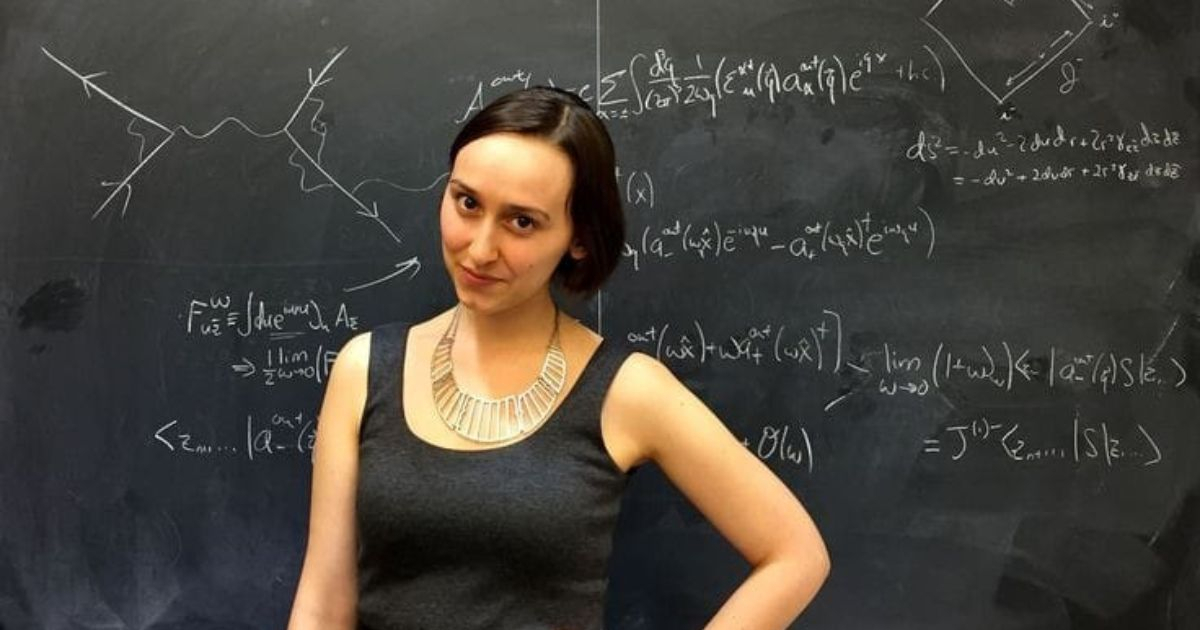
Sabrina González Pasterski, a physicist with Cuban roots and an academic background from MIT and Harvard, seeks to clarify a media label that's been attached to her name.
While some outlets have dubbed her as “the new Einstein,” she finds this comparison unconvincing.
According to the BBC, the Chicago-born physicist, who entered the world in 1993, explained that this label originated when Stephen Hawking referenced a paper she co-authored with Andrew Strominger.
"Firstly, they said that after Hawking cited the work I did with Andrew Strominger. I was merely in my second year of my Ph.D.," she clarified.
Despite the flattering comparison, Pasterski critiques the narrative that elevates a single individual as a standout star.
"To what extent can we better control the narrative? It doesn’t always have to be about standout stars," she reflected, advocating for a more collective approach to scientific advancement.
Her path, however, has been extraordinary from a young age.
"As a child, I wanted a flying broomstick, and my grandfather came up with the idea of gifting me a Cessna aircraft," she recounted.
Between the ages of 12 and 14, she rebuilt that aircraft and later earned her pilot's license.
This inquisitive nature led her to graduate at the top of her class in Physics from MIT and pursue a doctorate at Harvard under the guidance of the esteemed physicist Andrew Strominger.
Her research focuses on quantum gravity, black holes, and the structure of spacetime.
Currently, she is involved in a field called celestial holography. "By celestial, we literally mean looking at the night sky: how is the physical Universe encoded as a hologram?" she explained.
This concept stems from the holographic principle, which suggests that information within a gravitational system might be described using a two-dimensional surface.
Regarding her team's goal, she noted, "The aim is to find a set of highly compressed laws that can then explain all these other phenomena we are observing. I think that’s the mission we have as a group."
Pasterski also emphasizes the significance of her identity and family history.
"What would I be without my mom, and what would she be without her family history? One’s identity is hard to decouple from reality," she asserted.
Apart from the Einstein comparison, the young scientist with Cuban heritage remains focused on a broader goal: determining if the universe's description can be simpler than it seems.
"I want people to know that the description of the Universe can be simpler than all the things that emerge from it, and we are trying to find it," she expressed.
Understanding Sabrina González Pasterski's Scientific Contributions
What is Sabrina González Pasterski's field of study?
Sabrina González Pasterski focuses on quantum gravity, black holes, and the structure of spacetime.
Why was Sabrina González Pasterski called "the new Einstein"?
The label "the new Einstein" arose when Stephen Hawking cited a paper she co-authored with Andrew Strominger during her second year of her Ph.D.
What is celestial holography?
Celestial holography involves studying how the physical universe is encoded as a hologram, based on the holographic principle.
How did Sabrina González Pasterski start her journey in science?
Her scientific journey began with her curiosity as a child, leading her to rebuild a Cessna aircraft between the ages of 12 and 14 and later earning her pilot's license.