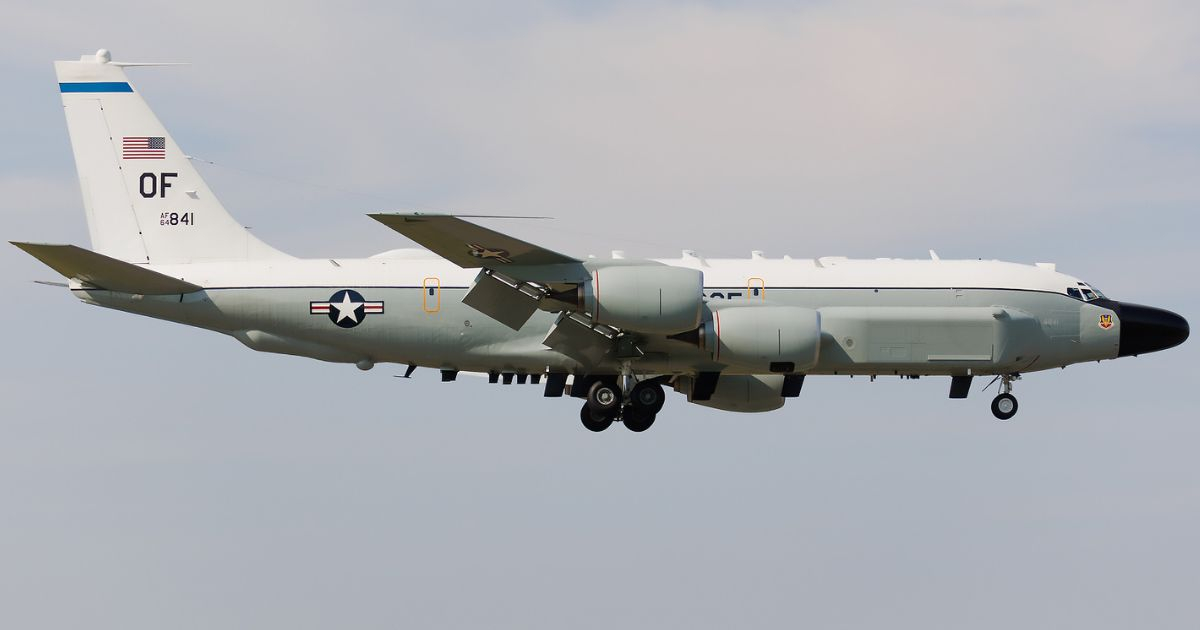
A U.S. spy plane was recently spotted flying close to Cuba's northern coastline, an operation that highlights Washington's ongoing aerial surveillance over the island and its strategic region.
The account AeroNoticiasVE shared the information on the social media platform X, identifying the aircraft as a RC-135V Rivet Joint. This particular plane specializes in electronic and communication intelligence, primarily gathering information without carrying weapons.
The data released indicates that this type of aircraft is employed to intercept military communications, detect radar and air defense systems, and analyze real-time activity patterns, with the information sent directly to U.S. command centers.
The RC-135V typically operates in international airspace but remains close enough to sensitive territories to capture internal signals. It is commonly seen in areas like Russia, China, Iran, North Korea, Venezuela, and Cuba, particularly during periods of heightened geopolitical tension.
In the case of Cuba, such flights might focus on monitoring military communications, air and naval traffic, and any signs of unusual activity or cooperation with external actors like Russia or China, without necessarily signaling an imminent confrontation.
Heightened Visibility of Surveillance Missions
The aircraft's presence was also confirmed via the FlightRadar24 tracking platform, where users observed its path near the island's northern coast, underscoring the public visibility of these missions.
While these operations are not novel, their occurrence is often perceived as a signal of intensified surveillance and specific U.S. interest in movements or changes within Cuba's strategic environment.
Just days ago, a sophisticated RC-135V/W Rivet Joint, one of the U.S. Air Force's most advanced intelligence aircraft, conducted a reconnaissance flight along Cuba's northern coast, spanning from east to west.
Additional Monitoring Measures
Furthermore, a special stratospheric balloon, registered in the United States and designed to monitor surrounding airspace, was launched over the Florida Strait, adjacent to Cuban airspace.
The Russian agency TASS reported the news, citing a source from air traffic control. "The stratospheric balloon, intended for continuous monitoring and control, even across national borders, is currently operating at a low altitude—about 2.5 kilometers—and is situated over the Florida Bay, near Key West, U.S.," the source stated.
Understanding U.S. Surveillance Activities Near Cuba
What is the purpose of the RC-135V Rivet Joint?
The RC-135V Rivet Joint is designed to gather electronic and communication intelligence. It intercepts military communications, detects radar and air defense systems, and analyzes activity patterns in real time.
Why is the U.S. monitoring Cuba's northern coast?
The surveillance is part of ongoing efforts to monitor military communications, air, and naval movements, and any unusual activities, especially those involving external actors like Russia or China.
What is the role of the stratospheric balloon near Cuban airspace?
The stratospheric balloon is designed for continuous airspace monitoring, including cross-border activities, operating at a low altitude near the Florida Bay.