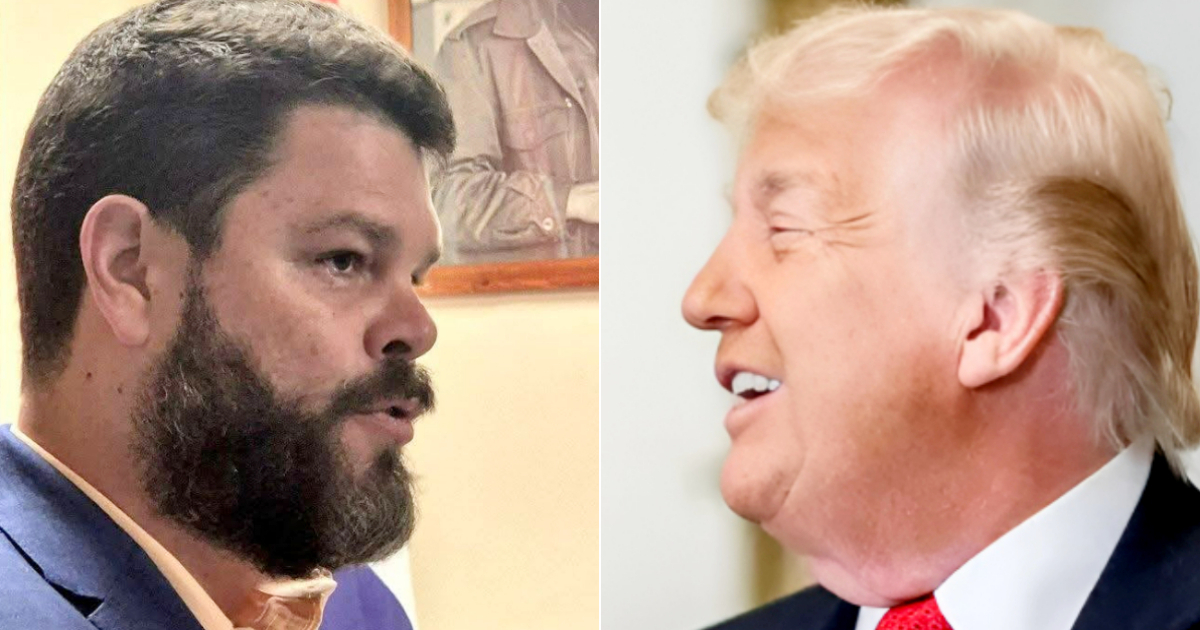
Fidel Castro Smirnov, the grandson of the infamous Cuban leader Fidel Castro, ignited a storm of outrage on social media with his bold declaration, "Cuba will not bow to Trump," made all the way from London.
Instead of going unnoticed, his statement provoked a torrent of reactions on CiberCuba's Facebook page, where over 4,500 users flooded the comments section with harsh criticism, irony, and outright indignation within less than a day. The powerful family name failed to garner widespread support, unleashing a wave of criticism focused on the stark contrast between the rhetoric of "resistance" and the harsh realities faced by ordinary Cubans.
One of the most recurring comments summarized the sentiment: "It's easy to talk about sacrifices from London with guaranteed electricity." Accusations of hypocrisy were rampant. One user remarked, "It's easy to preach resistance from a capitalist country," while another added, "Let him come and say that in my neighborhood, where we cook with wood."
The stark contrast between life in Europe and the power outages, food shortages, and lack of medicines in Cuba was the central theme of the conversation.
Castro Smirnov has positioned himself as a visible proponent of a new wave of Castroism—a blend of inherited slogans, academic jargon, and symbolic gestures intended for an international audience. Although he presents himself as a scientist and a champion of sovereignty, his public persona is more rooted in propaganda than genuine debate, from speeches at international forums to media stunts like his parachute jump honoring his grandfather.
Often accompanied by his wife, Marxlenin Pérez Valdés, the duo forms a political-symbolic tandem that combines ideological loyalty, public visibility, and a privileged lifestyle that starkly contrasts with the everyday life of ordinary Cubans.
Their public image projects a generational continuity of Castroism, defending the system from platforms that openly clash with the crisis, shortages, and power outages affecting millions of Cubans on the island. Many users openly questioned Castro Smirnov's right to speak on behalf of Cuba. "Don't say Cuba, say yourselves," read several comments. Another user emphasized, "Cuba is the people, not the Castro family," underscoring a clear divide between official discourse and public perception.
The constant mention of the statement being made from abroad became a collective refrain. "What is he doing in the UK?" asked dozens of commenters. "If socialism is so good, why don't any of them live here?" questioned others. For many readers, the scene was emblematic: the elite defending the system from afar while the people struggle to survive at home.
Alongside the outrage, there was a hefty dose of sarcasm. "Good joke," "the joke tells itself," or "another 'come for me'" were recurrent phrases, alluding to similar speeches by Nicolás Maduro. "That's what Maduro said... and we know how that ended," wrote one user, highlighting a parallel that surfaced repeatedly.
Beyond the ridicule, many comments expressed exhaustion and frustration. "The people can't take it anymore," "we're tired of being asked to make sacrifices," "we've been resisting for 67 years," were repeated sentiments.
In this context, the word "bow" was reinterpreted by readers: "It's the people who have been on their knees for decades," wrote one woman; "we're on our knees," pointed out another.
The criticism extended beyond Castro's grandson to the entire system. "They defend communism but live off capitalism," summed up a comment that garnered numerous reactions. "They're princes guarding their castle," said another, referring to what many see as a political dynasty disconnected from the national reality.
Questions also arose about the source of the resources allowing members of the Castro family to travel and reside abroad. "What salary does he live on in London?" "Who pays for those trips?" several users asked, while others claimed it was money "stolen from the people" or accumulated through inherited privileges.
Among the indignation, some outright rejected the confrontational rhetoric. "It's not about bowing, it's about lifting a country," wrote one user. Another was more direct: "Nobody wants war or slogans; we want food, electricity, medicine, and freedom." These voices reflect a clear demand: less rhetoric and more real solutions.
A significant portion of comments even expressed hopes for imminent change. "Their time is running out," "start packing," "karma is coming," were repeated in various tones.
For many readers, Fidel Castro's grandson's speech was not a demonstration of strength but of disconnection and nervousness amid an adverse international scenario. Messages separating the country from the regime were also frequent. "Cuba is not Díaz-Canel or the Castros," wrote one user. "Cuba is the suffering people."
This distinction appeared consistently, revealing a widespread perception: the word Cuba has been hijacked by the regime while the population is left to bear the burden of sacrifice.
In summary, the flood of comments sent an unmistakable message. Far from inspiring pride or a spirit of resistance, Fidel Castro Smirnov's discourse deepened the rejection and distrust of an audience marked by fatigue, hardship, and a sense of injustice.
From social media, many Cubans responded with a clear though variably expressed slogan: don't speak on behalf of a people who don't live like you.
The massive reaction on Facebook shows that for a significant part of Cuban public opinion, slogans uttered from abroad no longer convince, and the gap between the ruling elite and national reality has never been more evident.
Public Reaction to Fidel Castro's Grandson's Statement
Why did Fidel Castro Smirnov's statement cause such an uproar?
His statement was seen as hypocritical and out of touch with the daily struggles of ordinary Cubans, highlighting the disconnect between the ruling elite and the population.
What was the central criticism of Castro Smirnov's statement?
The central criticism was the perceived hypocrisy of preaching resistance from a comfortable life abroad, while ordinary Cubans face severe hardships like power outages and food shortages.
How did social media users respond to Castro Smirnov's remarks?
Social media users responded with a mix of sarcasm, frustration, and outright indignation, questioning his right to speak for Cubans and highlighting the disparity between his lifestyle and that of ordinary citizens.