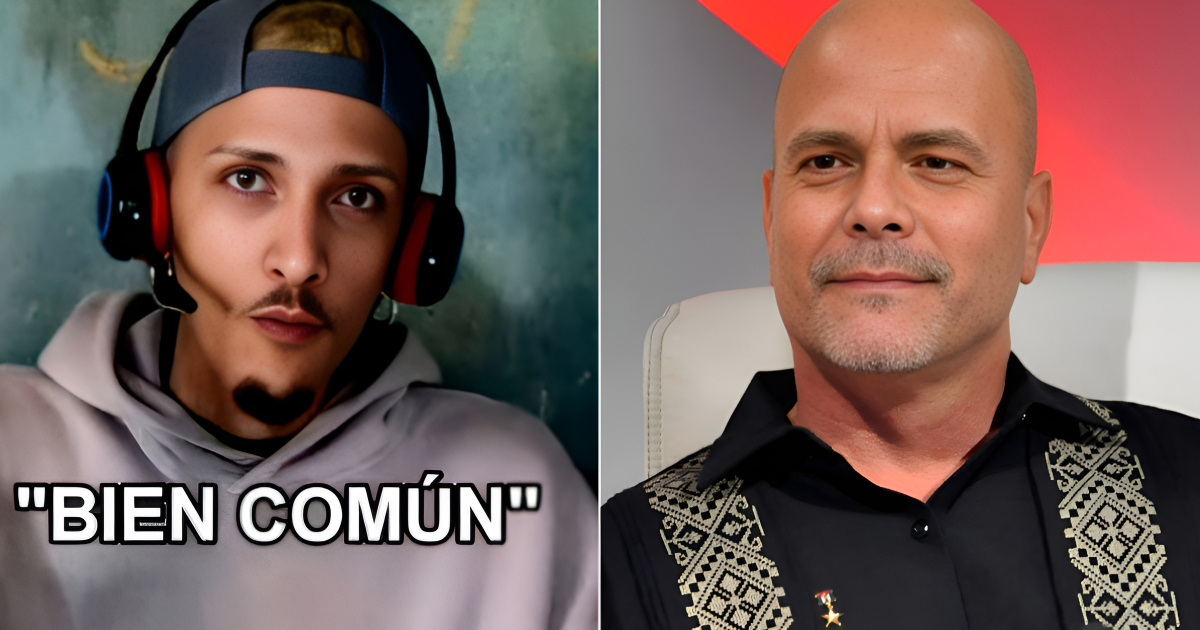
Gerardo Hernández Nordelo has become the target of widespread criticism on social media after posting a series of messages on Facebook. These posts show his support for the regime's defamation campaign against the El4tico project, whose young members were arrested last week in Holguín.
The national coordinator of the Committees for the Defense of the Revolution (CDR) and former failed spy employed his usual sarcastic tone in three posts, echoing the Cuban political elite's narrative: accusing critics of the regime of "hypocrisy" and "treason against the nation."
In one of his posts, he mimicked a citation from the United States Constitution's Article III, which deals with "treason," suggesting that the El4tico youth — and their supporters — were collaborating with a foreign power. "Cipayos don't care about their own country's Constitution, and they also seem to ignore the Magna Carta of the country they praise," he wrote, with the message set against a backdrop of the American flag.
Another post read: "Some artists residing in Cuba feel free to criticize anything (about Cuba). Don't expect them to ever criticize the blockade the USA uses to suffocate their people because that won't earn them likes. Their motto is: 'Don't mess with my Visa!'"
In a third message, he ironically featured an image of the Havana Capitol with the phrase: "The order is given! The same characters who don't dare to condemn Trump's blockade now rush to condemn the latest campaign against Cuba."
Social Media Backlash: A Viral Response
Instead of garnering support, his posts sparked a flood of critical responses, making it one of the most viral digital reactions a regime leader has recently faced. Within less than a day, the three posts amassed thousands of interactions and hundreds of comments, many questioning his cynicism and role as a representative of the oppressive regime.
One user sarcastically remarked, "Gerardo, the sack of coal is already at 2500. What do we do, brother?" Another was more straightforward: "How can two young people making videos cause so much fear? Freedom for El4tico's political prisoners!"
Several comments referenced the detained youths' discourse, repeating Kamil Zayas' words before his arrest: "I'm arrested for the only crime a dictatorship can't tolerate: daring to look it in the eye and say out loud what we all notice."
Among the most applauded messages, one encapsulated the general sentiment: "The true traitor and enemy of the people is the Communist Party that has hijacked sovereignty and imposed a totalitarian dictatorship. Freedom for El4tico's youth. Long live a free Cuba!"
Debate Over Treason, Freedom, and Political Cynicism
The response to Hernández's legal citation was particularly intense. Dozens of users refuted his interpretation of the U.S. constitutional article, highlighting the manipulation of its content and reminding him of Cuba's own human rights violations.
"Treason in the U.S. is not about voicing opinions, criticizing, or denouncing dictatorships; it's about declaring war or aiding an armed enemy. Defending freedom or denouncing abuses doesn't violate any law. What is shameful is using legal articles out of context to justify a dictatorship," one commenter wrote.
Another added: "It's contradictory for a leader who claims to defend sovereignty to use another country's Constitution to accuse his compatriots of treason."
Even those who tried to justify him with patriotic fervor were rebuffed. "There is no political pluralism, no freedom of the press, no authentic elections," they reminded him, citing Cuba's own Constitution.
"Before talking about treason, look at articles 54 and 95: the State recognizes freedom of thought and expression. Where is that today?"
Solidarity with El4tico: A Nation Unafraid
As critical responses mounted, the slogan #TodosSomosEl4tico flooded the comments, reaffirming the wave of solidarity with the detained youth.
"You are not Cuba; you're a dictatorship that's gone 67 years without elections," wrote a user from Havana. "Why such fear of free elections where the people decide?" asked another.
The tone of the responses ranged from indignation to sarcasm and direct denunciation. "Gerardo, leave the networks; you're too old for this kind of battle. You're an official, not an influencer," a Cuban woman advised with irony.
Another summed up the widespread sentiment: "The change has already begun, and this time, neither you nor anyone else can stop it."
The Propaganda Backfire
The regime's attempt to portray El4tico as an example of "cultural mercenarism" backfired, drawing more attention to their cause and igniting a massive debate about the right to dissent in Cuba.
Comments on the leader's profile transformed into an open forum about the national crisis, corruption, shortages, repression, and lack of freedoms.
Among the most shared was: "The only campaign against Cuba is the one you conduct with a police apparatus that silences the people. That's state terrorism."
Another, with a prophetic tone, concluded: "Enjoy your time, because it's running out. Your bosses will abandon you when the system falls. And it will fall."
Social Media: The New Cuban Forum
What was meant to be a propaganda maneuver to reinforce the official narrative of "treason and the external enemy" ended up revealing the rift between the government and Cuban society.
For the first time in years, a high-ranking regime leader was openly overwhelmed on their own social media by citizens both inside and outside the island, confronting him with arguments, indignation, and humor.
This episode clearly demonstrated that censorship no longer controls the conversation. Social media has become the new "room" in Cuba, but one where, as a young commenter noted, "it's no longer the same."
Now, the echo is louder than the gag, and the people, despite everything, no longer remain silent.
Understanding the Backlash Against Gerardo Hernández
Why did Gerardo Hernández face criticism on social media?
Gerardo Hernández received backlash for joining the regime's defamation campaign against the El4tico project, which led to widespread criticism for his perceived cynicism and support of the oppressive government.
What was the public's reaction to Hernández's posts?
The public reacted with indignation, sarcasm, and direct criticism, with many questioning his role in the regime and expressing solidarity with the detained El4tico members.
How did Hernández's actions impact the El4tico cause?
Instead of undermining El4tico, Hernández's actions brought more visibility to their cause, sparking a broader debate about dissent and freedom in Cuba.