Cuba's crisis is no longer just about power outages, endless lines, or food scarcity. In Santiago de Cuba, the situation has deteriorated to such an extent that even death must adapt to the harsh conditions.
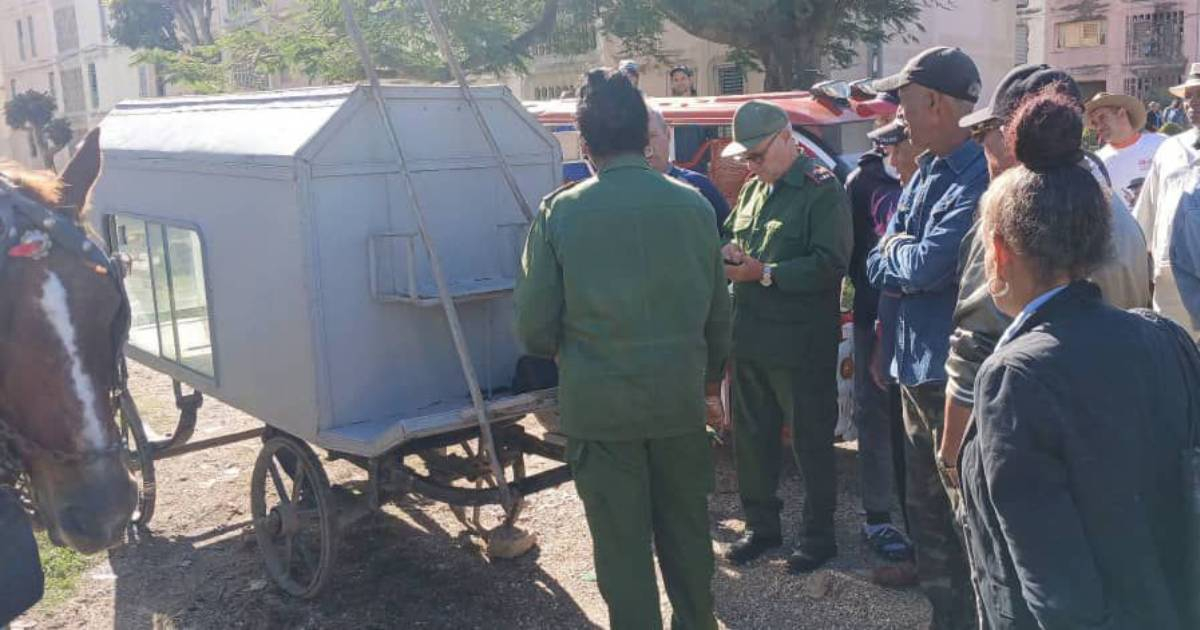
On Saturday, February 7, a horse-drawn hearse was "unveiled" in San Luis, a municipality in Santiago de Cuba. This makeshift metal carriage, designed to transport coffins, is drawn by a horse due to the absence of fuel and the lack of vehicles available for funeral services.
Photos shared on social media depict a group of people gathered around the makeshift vehicle, showcasing a closed structure on wheels with side windows, and the horse harnessed at the front, ready to pull it through the streets.
Instead of causing institutional alarm, the scene has been presented as a practical solution, almost celebrated as an "achievement," amidst the collapse of the state transportation system.
On social media, Raúl Pérez Velázquez, a user in the Facebook group "Revolico Contramaestre," confirmed that this was a "new animal-drawn vehicle for transporting the deceased." He directly attributed the measure to the fuel shortage, highlighting that the government seeks alternatives so families "do not face hardship during their loved ones' final rest."
However, for many Cubans, the stark reality is that even in death, dignity is not assured in today's Cuba.
A Long-Standing Issue Worsening Each Year
The San Luis incident is not isolated. Instead, it is part of a long-standing series of complaints exposing the collapse of the funeral system in Santiago de Cuba and other provinces.
In June 2024, reports emerged of a coffin being transported in a truck meant for mass passenger transport due to the deteriorating fleet of funeral vehicles in Santiago.
At that time, independent journalist Yosmany Mayeta reported that the province had only two operational hearses to serve a population of nearly one million.
Months later, in September 2024, another incident shocked Cubans when a group of people had to carry a coffin on foot for two kilometers in Mayabeque because there was no transportation available for the burial.
The outrage repeated itself in April 2025 in Guisa, Granma, where a family had to say goodbye to a loved one using an improvised vehicle from Flora and Fauna due to the lack of a hearse.
And in December 2025, once again in San Luis, it was reported that a body was transported in a cage truck, a type of vehicle commonly used for animals or goods, after the family waited for hours without a funeral vehicle available.
Understanding the Funeral Transportation Crisis in Cuba
Why are horse-drawn hearses being used in Santiago de Cuba?
Due to a severe shortage of fuel and a lack of operational vehicles, horse-drawn hearses have been introduced as a makeshift solution for transporting the deceased in Santiago de Cuba.
How widespread is the funeral transportation issue in Cuba?
The transportation crisis for funerals is a pervasive issue in multiple provinces of Cuba, with reports of improvised solutions due to the inadequacy of the funeral vehicle fleet.