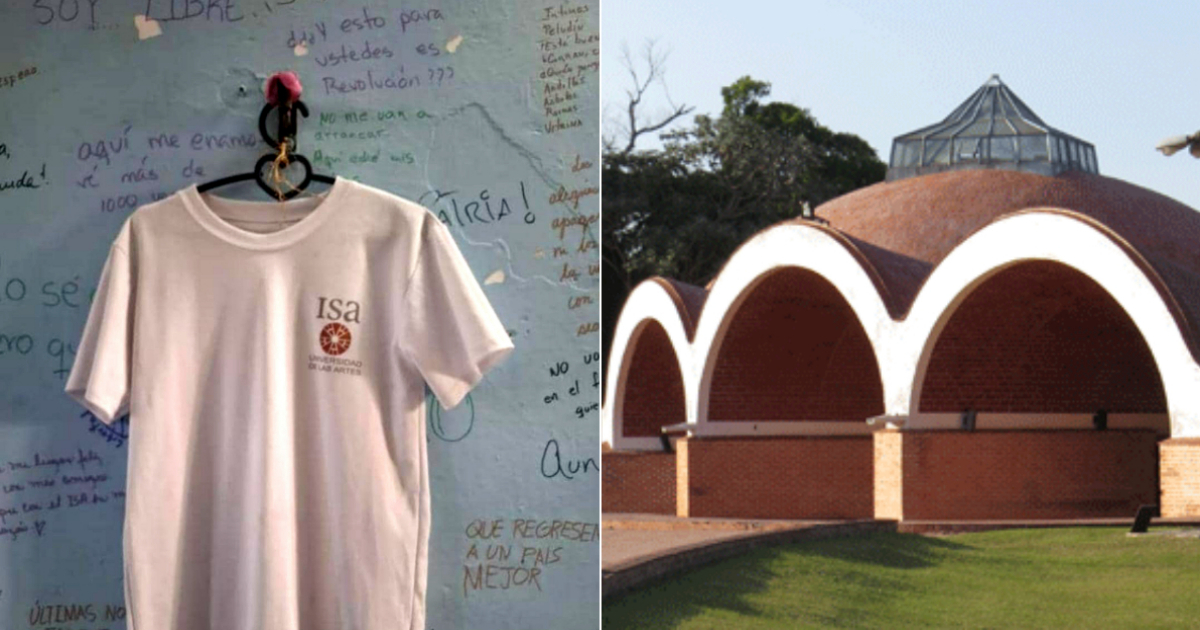
Images received by CubaHeadlines showcase a silent protest by students from the Higher Institute of Art (ISA) in Havana. This demonstration emerged after face-to-face classes were indefinitely suspended due to Cuba's severe energy crisis.
This decision, taken by the Ministry of Higher Education, has sparked concern and frustration among young people who rely on hands-on education for their academic progress.
The photographs depict a near-empty room at the institution, with tables pushed aside and a white ISA t-shirt hanging in the center of a wall covered with handwritten messages. These scattered and overlapping phrases express a mood of disillusionment, rupture, and lost expectations.
Among the clearly visible slogans are "I AM FREE," "Is this revolution to you???", "They lied to me here," "Last notes from the insilio," and "BRING BACK A BETTER COUNTRY." The term "insilio" highlights the feeling of entrapment and exclusion experienced by many young people on the island.
A message sent to our editorial team under anonymity described the protest as an attempt to "speak out" against what they see as an unsustainable reality. The sender emphasized that many students hail from across the nation, reside in university dorms, and currently face uncertainty about their graduation. "We don't know if we will return," they stated, lamenting that their dreams are "going down the drain due to a system and leaders who do not represent" their generation.
The suspension of in-person classes hits art students particularly hard. Disciplines such as theater, dance, music, and visual arts rely heavily on direct interaction, physical practice, collaborative rehearsals, and access to specialized spaces, which cannot be replaced by remote learning in a country plagued by severe technological limitations and constant power outages.
Beyond the academic impact, the protest signals a growing generational discontent. For many young artists, ISA is more than just a place of study; it represents a space for life, creation, and cultural resistance. The indefinite halt of face-to-face classes signifies, for them, a deeper interruption: the disruption of a future vision in a nation where imagining such a future is increasingly challenging.
Tradition of Defiance at ISA Against Political Control
The current dissatisfaction voiced by ISA students connects with a longstanding tradition of critical thought that has made ISA one of Cuba's most politically uncomfortable academic settings since its founding, especially during the 1980s.
Unlike other higher education institutions, ISA has historically been a hotbed of aesthetic, political, and social debates, where generations of young artists have challenged state-imposed limits on creation and free thought.
For decades, the regime has sought to "restore order" at ISA through silent purges, ideological surveillance, control over scholarship access, censorship of works, and the appointment of political figures in leadership positions. However, these efforts have failed to completely eradicate a critical spirit that resurfaces cyclically during times of crisis.
One of the most prominent episodes occurred after the July 11, 2021 protests, when ISA students rallied in support of a detained classmate—music student Abel González Lescay—defying the climate of fear imposed across the country's universities.
Since then, rather than dissipating, the tension between students and authorities has remained palpable. Each new restrictive measure—from academic cuts to unilateral administrative decisions—has reactivated a collective memory of resistance, identifying ISA as a space where art and dissent often intersect.
This legacy contrasts with the presence of figures closely linked to power within the faculty, such as Lis Cuesta Peraza, wife of Cuban leader Miguel Díaz-Canel, who has joined as a professor, or singer-songwriter Israel Rojas, invited by the "not-first lady" to lecture in her cultural management course.
For many students and alumni, their inclusion represents another attempt by the regime to tame a historically challenging center, yet it has not succeeded in fully neutralizing the critical capacity that defines ISA.
The ongoing protest, far from being an isolated incident, confirms that this defiance remains alive, even under extreme conditions of precariousness.
Understanding the Impact of the Energy Crisis on Cuban Education
What led to the suspension of in-person classes at ISA?
The indefinite suspension of in-person classes at ISA was a response to Cuba's deepening energy crisis, which has severely affected the country's infrastructure.
Why are art students particularly affected by this decision?
Art students are deeply impacted because their courses, such as theater, dance, and music, rely heavily on direct interaction, physical practice, and specialized spaces that cannot be replaced by remote learning methods.
How does the protest at ISA relate to its historical context?
The protest at ISA continues a tradition of critical thinking and defiance against political control, a legacy that has made the institute a challenging environment for the Cuban regime since its inception.