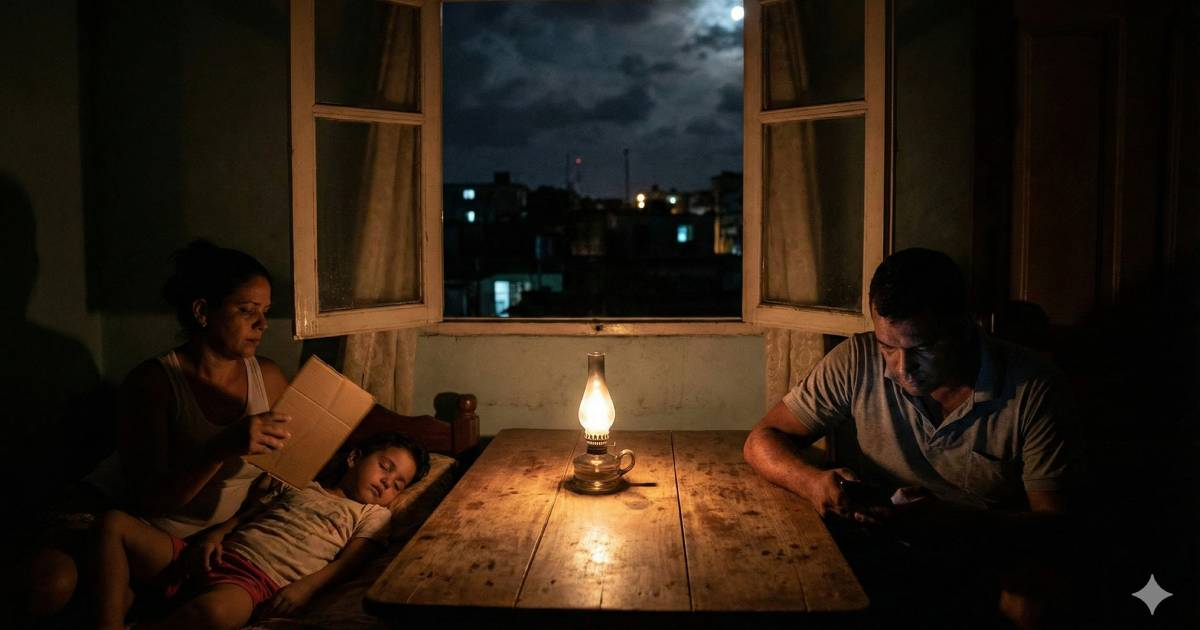
Following several weeks of severe energy generation deficits, the Cuban Electric Union (UNE) reported a slight decrease in power outages over the weekend.
While this reduction doesn't resolve the underlying issue, it does represent a shift from recent days when the gap between supply and demand reached between 1,800 and over 2,000 megawatts (MW), leading to blackouts lasting more than 15 hours in numerous areas.
On Sunday, February 8, UNE disclosed that on Saturday, electricity service was disrupted due to insufficient capacity for 18 hours and 55 minutes, with full restoration occurring after midnight. However, disruptions resumed at 5:23 am.
The peak generation shortfall recorded was 1,536 MW at 6:20 pm.
By Sunday morning, the system had an availability of 1,280 MW against a demand of 1,740 MW, already resulting in a 490 MW shortfall. By midday, an even larger deficit of 900 MW was anticipated.
Ongoing Structural Challenges
The root causes of this scenario are deeply structural. The national electrical grid remains crippled by a combination of breakdowns, prolonged maintenance, and technical limitations in thermal generation.
Currently, four thermoelectric units at the Mariel, Santa Cruz del Norte, Felton, and Antonio Maceo power plants are out of service due to breakdowns.
In addition, two blocks at the Nuevitas and Carlos Manuel de Céspedes plants in Cienfuegos are offline for maintenance.
The thermal generation itself is limited by 490 MW that cannot be integrated into the system.
Efforts to Mitigate Peak Demand
For the evening peak demand, UNE announced plans to complete 70 MW at Felton's Unit One, add 30 MW through four engines at the Regla power barge, and incorporate six engines in Moa contributing 84 MW.
With these reinforcements, the estimated availability would be 1,464 MW compared to a maximum demand forecast of 2,980 MW, resulting in a deficit exceeding 1,500 MW and causing similar disruptions for consumers.
Renewable Energy Contributions
The state-run company also highlighted the output of 49 new solar photovoltaic parks, which generated over 3,300 MW/h during the day, delivering a maximum of nearly 600 MW around midday.
Although this contribution helps to partially ease the load during daylight, it is insufficient to meet nighttime demand or offset the collapse of the thermoelectric plants.
Even though there were fewer power outages this weekend compared to previous days, the underlying reality remains: Cuba is entrenched in a profound energy crisis, driven by years of mismanagement, lack of real investment, and decisions that have left the electrical system without technical support or adequate fuel.
The population continues to bear the brunt of an inefficient model incapable of ensuring a basic service.
While the government persists in presenting daily reports with figures and recovery promises, the daily lives of Cubans continue to be characterized by uncertainty, extended blackouts, and the absence of structural solutions.
The temporary reduction in blackouts does not alter the fact that the country has reached this point due to the State's inability to plan, maintain, and modernize an electrical system crucial to the entire nation.
Understanding Cuba's Energy Challenges
What are the main causes of Cuba's energy crisis?
Cuba's energy crisis stems from structural issues such as outdated infrastructure, lack of investment, and prolonged maintenance, coupled with technical limitations in thermal generation and insufficient fuel.
How is the Cuban Electric Union addressing peak demand challenges?
The Cuban Electric Union plans to address peak demand by completing enhancements at select facilities and incorporating additional engines to increase available capacity. However, these measures still fall short of meeting the maximum demand.
What role do solar photovoltaic parks play in Cuba's energy landscape?
Solar photovoltaic parks contribute to Cuba's energy grid by generating electricity during daylight hours, partially alleviating the load. However, they are not enough to cover nighttime demand or compensate for the thermal plants' deficiencies.