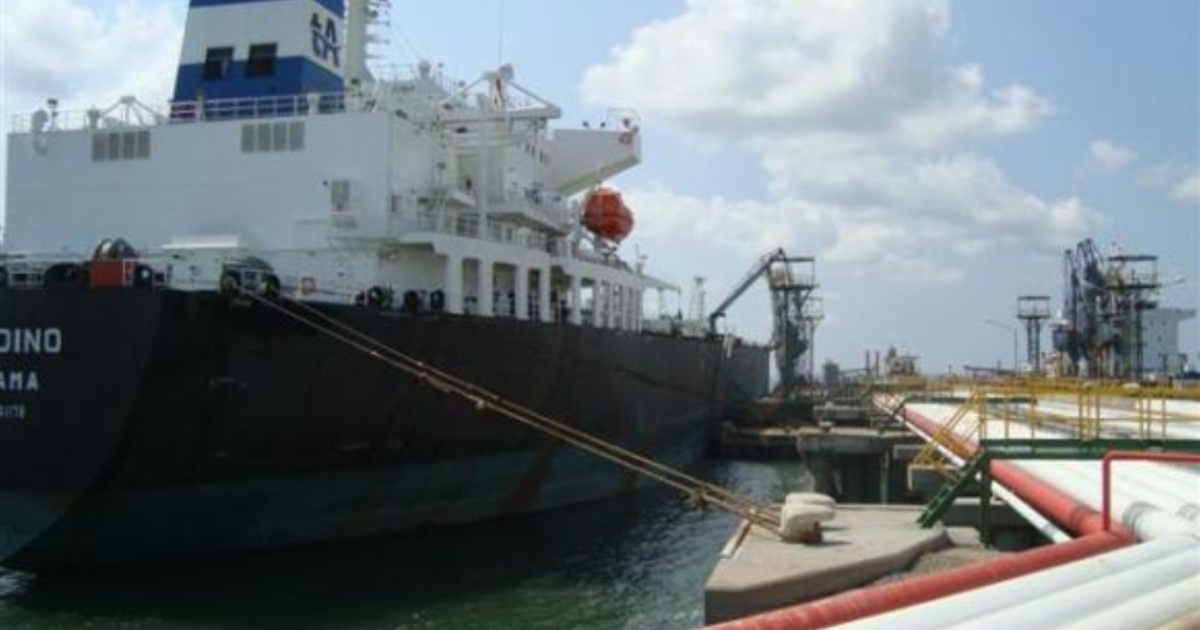
The tanker Sandino made its way to Matanzas Port this past Saturday, coming from the Bay of Nipe in Holguín, reportedly carrying a substantial load of fuel.
According to Joankelin Sánchez, a Cuban source who shared insights based on maritime monitoring statistics, the tanker is believed to be transporting between 390,000 and 410,000 barrels of fuel.
While Sánchez reports that the vessel loaded its cargo in the Bay of Nipe earlier, the original source of the fuel remains unidentified, leaving the initial origin of the shipment unclear.
So far, the report lacks specific details about the type of fuel carried, the final recipient, unloading plans, or an official confirmation of the cargo's volume. It simply confirms the tanker's arrival and estimates the cargo size.
In a related maritime movement, the Sea Horse tanker, flying the Hong Kong flag, is on its way from Malta to Havana. It is expected to reach the Port of Havana on February 27.
The early weeks of 2026 have highlighted a deepening energy crisis in Cuba, underscoring the regime's failure to secure a stable fuel supply.
The year opened with troubling signs: six ships operated by the military conglomerate GAESA amassed the last oil reserves in Matanzas Bay, according to independent reports.
Experts warned that the nation was "emptying its own tanks to buy time," as the electrical grid and fuel distribution teetered on the brink of collapse.
The situation worsened in mid-January when the Mia Grace tanker, initially en route from Togo to Cuba with diesel or fuel oil, diverted to the Dominican Republic. This change in course highlighted the Cuban government's struggles to secure supply deals amid growing financial isolation, which prevents access to traditional energy markets.
A few days later, the tanker LPG Emilia was spotted heading south of Cuba with a potential load of liquefied petroleum gas. The reactivation of its journey, after more than a month of inactivity, was seen as the regime's attempt to sustain minimal domestic energy distribution. Yet, it also underscored the island's reliance on an aging fleet, largely operated by state-controlled entities.
By February, further signs of Cuba's precarious energy condition emerged from Venezuela. A tanker linked to the island loaded 150,000 barrels of gasoline at a Venezuelan port, in what analysts view as an attempt to resume fuel shipments under U.S. oversight. This operation coincided with worsening fuel station lines, prolonged blackouts, and public transport restrictions, indicating an energy system on the brink of structural collapse.
These events collectively reveal an energy crisis in Cuba that goes beyond temporary fuel shortages. The lack of strong allies, reduced supplies from Venezuela, and the inability to secure international credit have forced the country to operate with minimal reserves, relying on occasional shipments.
In this challenging context, the arrival of a tanker like the Sandino in Matanzas is seen less as a long-term solution and more as a brief respite amid an ongoing economic and energy depletion.
Cuba's Energy Crisis and Tanker Arrivals
What is the significance of the Sandino tanker's arrival in Matanzas?
The Sandino tanker's arrival is seen as a temporary relief in Cuba's ongoing energy crisis, providing much-needed fuel, though it does not offer a long-term solution to the country's fuel shortages.
Why did the Mia Grace tanker change its course to the Dominican Republic?
The Mia Grace tanker diverted to the Dominican Republic due to Cuba's increasing challenges in securing supply agreements, reflecting the government's financial isolation and inability to access traditional energy markets.
How does Cuba's reliance on an aging fleet impact its energy distribution?
Cuba's reliance on an aging fleet, largely operated by state-controlled entities, complicates its energy distribution efforts, limiting the country's ability to maintain consistent and effective fuel supply chains.