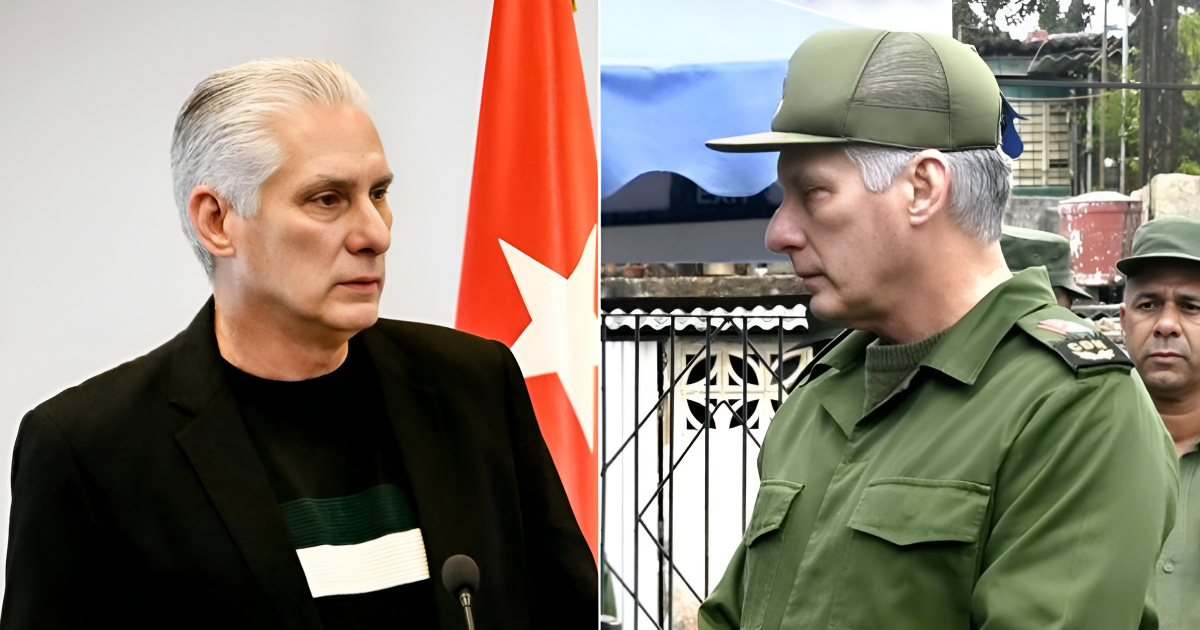
In a surprising turn of events, Miguel Díaz-Canel addressed the nation on Thursday, claiming he never stated what was previously announced. During a broadcast aired on Cuba's official presidential channels and widely shared on institutional social media, the Cuban leader denied that the country had entered a state of war.
He repeated his denial multiple times, despite the fact that the National Defense Council, which he leads, had approved "the plans and measures for transitioning to a state of war" just days prior.
"The Defense Council's note does not state that we are moving into a state of war; it indicates that we are preparing for the possibility of such a transition in the future," Díaz-Canel clarified.
Rather than exuding control or confidence, his appearance seemed more like damage control. Visibly uneasy, Díaz-Canel's fragmented speech, frequent hesitations, and constant body swaying betrayed his discomfort and uncertainty.
Instead of presenting the image of a confident leader, he appeared to be someone forced to adjust a narrative that had spiraled out of control. From this carefully curated setting, he emphasized Cuba's identity as a "nation of peace," asserting that it poses no threat to the United States and has never declared war. According to his explanation, preparing for defense does not equate to waging war.
Contradictions and Context
Nevertheless, the official narrative complicates this distinction. Saturdays have been designated as National Defense Days, with mobilizations of university students, militias, and brigades, and defensive plans updated from municipal levels to the National Defense Council. All of this, he explained, is part of the "War of All the People" doctrine, a defensive strategy inherited from Fidel Castro and reiterated by Raúl Castro. This doctrine, as Díaz-Canel insists, is about defending sovereignty against external threats, not aggression.
The immediate context is problematic. His clarification follows weeks of increasingly belligerent rhetoric. In mid-January, official media unequivocally reported that the National Defense Council had approved the "transition to a state of war." Shortly thereafter, the Ministry of the Revolutionary Armed Forces declared their readiness to "fight to the death for socialism."
Simultaneously, official networks were flooded with images of military exercises, trenches, rifles, controlled explosions, and epic music, creating an atmosphere more akin to war than peace.
A Calculated Retreat
In this charged environment, the sudden insistence that "it was never said" as previously published by Granma and Cubadebate seems more like a strategic retreat than a simple misunderstanding. The preparation and military rhetoric remain intact, but the word carrying legal, political, and symbolic implications—war—is deliberately avoided.
Díaz-Canel attempted to bridge this semantic gap by explaining that, following the January 3 events in Venezuela and regional tensions, his government decided to implement a comprehensive defensive readiness plan. Within this framework, he emphasized, the plan for "transitioning to a state of war, if necessary" was updated and transparently published. The issue, he claimed, was not the content but its "manipulation" by what he termed the "media intoxication system" serving the United States.
During his address, the leader appointed by General Raúl Castro highlighted visits to military units and defensive exercises involving the public, including students participating in defense zone activities. This was presented as evidence of revolutionary consciousness and popular support, with no room for uncomfortable questions or dissenting voices.
Outside the broadcast set, however, the reality is far less heroic: prolonged blackouts, food shortages, fuel scarcity, and a weary population. Inside the studio, the message was different: there is no state of war, but the nation must be prepared as if one could occur at any moment.
Díaz-Canel did not deny the previous belligerent language or the rhetorical escalation. He denied crossing the formal line. In this precise denial—delivered with nervousness and signs of insecurity—lies the essence of the retreat: maintaining the epic narrative of confrontation, reducing internal fear, and avoiding the consequences of prematurely invoking the most dreaded word.
Understanding the Cuban Leadership's Recent Statements
What did Díaz-Canel claim in his recent address?
Díaz-Canel claimed that Cuba has not transitioned to a state of war, insisting that the country is merely preparing for the possibility if necessary.
Why is the word "war" being avoided in official communications?
The term "war" carries significant legal, political, and symbolic implications, which the Cuban leadership aims to avoid while maintaining an image of preparedness.
What is the "War of All the People" doctrine?
The "War of All the People" doctrine is a defensive strategy involving the mobilization of the entire population to protect Cuba's sovereignty against external threats.