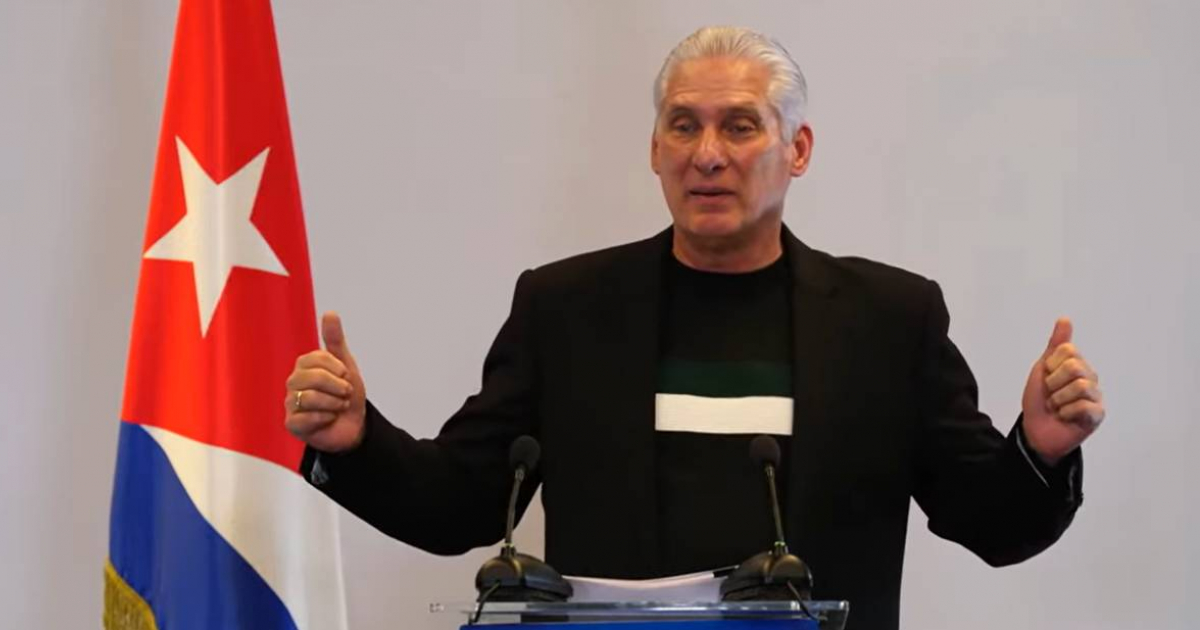
The live appearance of *Miguel Díaz-Canel* sparked a flood of reactions filled with indignation, mockery, and rejection on social media. Hundreds of Cubans commented in real-time as the leader spoke of "unity," "reorganization," and "sacrifices" amid the country's worst economic and social crisis in decades.
Instead of garnering support or calm, the speech was perceived as "more of the same," "empty talk," and a repetition of unfulfilled promises, as reflected in the comments that inundated platforms like Facebook and YouTube.
The Same Old Rhetoric
One of the most repeated grievances was the exhaustion with a message many viewed as recycled. "Cut and paste. The same speech as always," wrote one user, while another summarized the general sentiment with a blunt: "Blah, blah, blah... liar."
Several netizens pointed out that Díaz-Canel spoke at length without offering concrete solutions to urgent problems like the shortage of food, medicine, electricity, and clean water. "How long are you going to keep talking nonsense?" questioned one visibly upset user.
Corruption and the Absence of Free Press
Accusations of corruption and lack of transparency also dominated the chat. Comments like "the entire PCC is corrupt" or "there's no question that isn't preplanned" reflected the distrust of the event's format.
Numerous users questioned the absence of independent and international journalists. "Where is the international press?" and "why don't they bring in a free press to ask real questions?" were common refrains.
Others pointed out the existence of political prisoners and the repression of dissent in Cuba, highlighting the contradiction between official discourse and everyday reality.
Hunger, Misery, and Disconnection
The topic of hunger and precarious living conditions pervaded many reactions. "Empty words and misery are what they've given Cuba," wrote one user, while others demanded rice, beans, medicine, and decent wages.
"With what money are we supposed to develop?" asked a commenter, while others denounced that sacrifices always fall on the people, not the ruling elite.
There were also critiques of what many perceive as the leader's total disconnection from the real lives of Cubans. "Divorced from reality," "doesn't live what the people live," and "speaks from privilege" were frequent expressions.
Youth, Migration, and Lack of Future
Mentions of the youth sparked a wave of ironic and critical responses. "Which young people are you going to call upon if most have left the country?" wrote one user, referring to the mass migration that's emptied entire neighborhoods in Cuba.
Others noted that those who remain on the island do so without prospects for progress, trapped between insufficient wages and a system that offers no real opportunities.
Calls for Freedom and Political Change
Among the comments were also direct calls for political change. "The alternative is freedom," wrote one user, while others claimed that economic development cannot happen without political pluralism and the end of the communist model.
Phrases like "there's no development under dictatorship" and "67 years of the same" reflected the accumulated frustration after decades of broken promises and reforms that never transform the lives of ordinary citizens.
The appearance of Díaz-Canel became a thermometer of the deep social discontent in Cuba. For many, the message not only lacked concrete announcements but reinforced the feeling that the regime is trying to buy time as the country's situation worsens.
As the broadcast ended, numerous users bid farewell to the live session with messages of exhaustion, frustration, and resignation, convinced that, once again, the speech offered no real answers to the problems suffocating millions of Cubans.
Frequently Asked Questions About Díaz-Canel's Speech
What was the general reaction to Díaz-Canel's live address?
The general reaction was one of indignation, mockery, and rejection, with many viewing it as a repetition of unfulfilled promises and empty rhetoric.
Why did critics accuse Díaz-Canel of disconnection from reality?
Critics accused Díaz-Canel of being disconnected from reality because they believe he fails to address the real and urgent problems faced by ordinary Cubans, such as shortages of food and medicine.
What specific issues did Díaz-Canel fail to address according to critics?
Critics pointed out that Díaz-Canel did not offer concrete solutions to the pressing issues of food, medicine, electricity, and water shortages, among others.