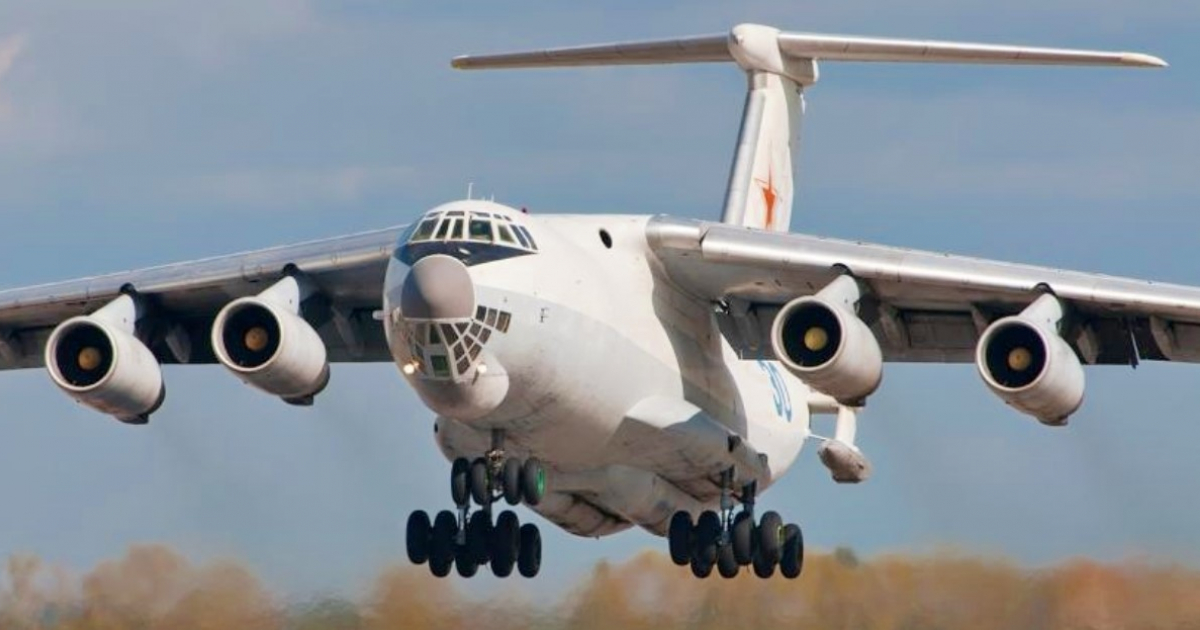
The Russian government has addressed Washington's apprehensions following the landing of a Russian military cargo plane at a Cuban airbase, asserting that the event is a routine part of their bilateral cooperation with the island nation.
The aircraft, an Ilyushin Il-76 operated by a sanctioned state-owned airline, was spotted last weekend at the San Antonio de los Baños military airfield, located south of Havana, raising alarms in the United States.
Military expert Alexander Mikhailov from Moscow has downplayed the incident, dismissing any threatening interpretations of the flight. "The landing of the Russian Il-76 in Cuba is nothing out of the ordinary and falls within the regular international visits and cooperation between Moscow and Havana," he told the newspaper Pravda.
Continuing Support for Cuba
According to Mikhailov, Russia maintains technical-military and political-military collaboration with Cuba, involving periodic visits and joint events as part of international cooperation. "Our planes regularly fly to Cuba, which is entirely normal practice. Thus, I see no cause for alarm or concern in this matter," he emphasized.
Highlighting Russia's stance, he added, "Russia has always opposed pressure on Cuba and continues to support it. We condemn any attempts to blockade the island or impose new sanctions." Mikhailov emphasized that collaboration with Havana is essential for its internal stability.
For Cuba, the partnership is crucial for survival, requiring energy resources, electricity, and technology. Russia and China remain key partners, assisting Cuba in withstanding external pressures, Mikhailov noted.
Geopolitical Tensions
Mikhailov argues that Washington's real concern isn't the isolated landing of the plane but rather the strengthening ties between Cuba, Russia, and China, which the U.S. perceives as a direct threat in its historical sphere of influence. "The alarmed reaction of the United States to the Russian plane's flight likely stems from the growing influence of Russia and China in the Caribbean region," he warned.
He further stated, "To Americans, any contact between Cuba, Russia, and China is part of a geopolitical game they see as threatening their interests. But Cuba is a sovereign state and does not need to seek U.S. permission."
In his analysis, it is Washington, not Moscow, that has generated tensions in the hemisphere for decades. "Other countries are reluctant to openly aid Havana due to U.S. pressure, leaving Cuba to rely on itself and the support of Russia and China," Mikhailov concluded.
U.S. Concerns Over Cargo Plane
The Russian Il-76, capable of carrying up to 50 tons of heavy cargo, belongs to Aviacon Zitotrans, a Russian state airline under sanctions by the United States, Canada, and Ukraine. Flight records show the plane departed from Russia, making stops in St. Petersburg, Sochi, Mauritania, and the Dominican Republic before arriving in Cuba.
While the Cuban government hasn't disclosed the cargo's contents, U.S. analysts have noted that the same aircraft has previously transported advanced air defense systems to Venezuela, fueling speculation of potential military reinforcement for the island.
The flight pattern mirrors movements from October 2025, when the same Il-76 flew over Venezuela, Nicaragua, and Cuba amid rising tensions between Caracas and Washington. Days later, a U.S. operation culminated in the capture of Nicolás Maduro, reshaping the regional balance and leaving Havana without its primary political and energy backer.
Currently, the Russian cargo plane's new flight occurs in a similarly tense context: the Trump administration has hardened its stance against Miguel Díaz-Canel's government, recently declaring a "national emergency" and labeling the Cuban regime as an "unusual and extraordinary threat" to U.S. security. Additionally, sanctions have been imposed on any country supplying oil to the island without Washington's approval.
Routine Flight or Coded Message?
Thus far, neither the Cuban nor Russian governments have revealed the exact content of the cargo. This silence, along with the plane's history and passage through countries allowing its transit despite sanctions, has fueled speculation about a possible delivery of military technology or energy assistance.
What seems evident is that for Russia, the Caribbean once again represents a strategic space for geopolitical presence and projection, with Cuba, despite its economic fragility, remaining an indispensable ally. This Wednesday, Vladimir Putin reiterated his support for the Cuban government in a video conference with Chinese President Xi Jinping.
Key Questions on Russian-Cuban Relations
Why did the Russian cargo plane land in Cuba?
The Russian government states that the landing is part of routine bilateral cooperation with Cuba, involving regular international visits and exchanges.
What concerns does the U.S. have regarding the Russian plane?
The U.S. is worried about the strengthening ties between Cuba, Russia, and China, which it views as a strategic threat in the Caribbean region.