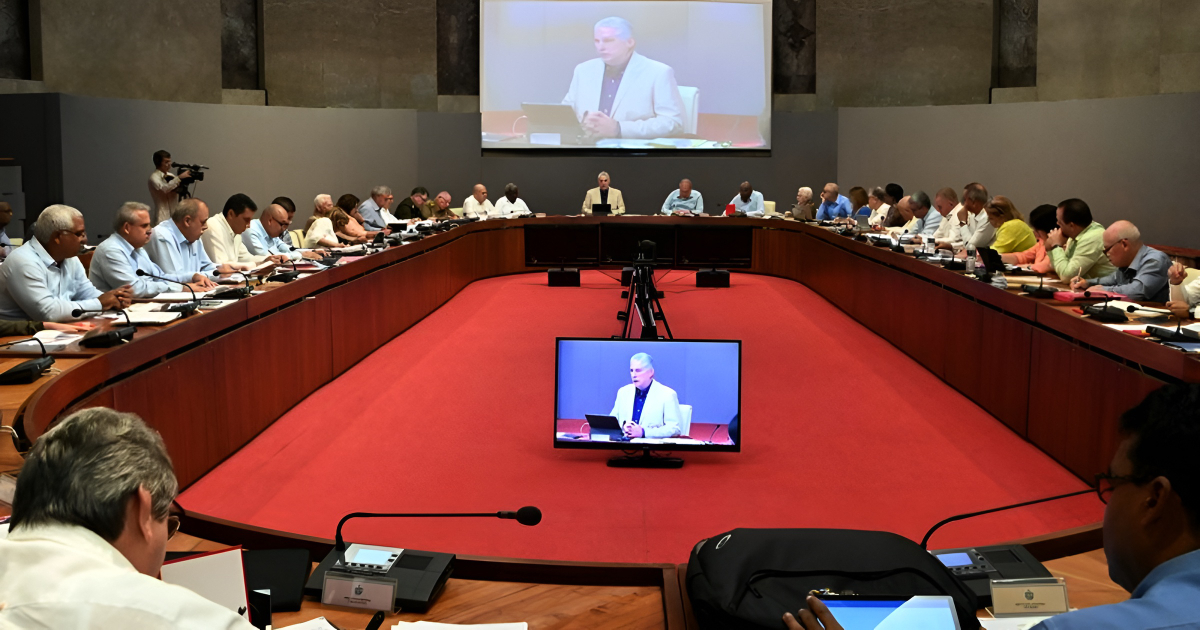
The Cuban government has started psychologically preparing its citizens for an impending economic jolt, possibly one that could reshape the paradigms and power dynamics that have persisted for over six decades.
In a conversation with the EFE agency, Carlos Fernández de Cossío, the Deputy Foreign Minister, acknowledged that the nation is gearing up for a "reorganization process" that will be "very challenging for the populace."
Though the diplomat refrained from providing specifics, the choice of words—process, reorganization, difficulty—speaks volumes. It implies that Cuba is bracing itself to manage a collapse rather than avert it.
This old euphemism has proven effective: when the Cuban regime refers to "reorganization," it typically means adjustments, rationing, centralization, and control.
Collapse in the Background: An Economy in Intensive Care
The admission by Fernández de Cossío comes during the worst economic crisis of the post-Castro era. The loss of its major ally, Venezuela—following the capture of Nicolás Maduro by U.S. forces on January 3—has drastically reduced oil shipments.
The energy blockade enforced by the White House, which penalizes any nation supplying oil to the island, has brought industries, transportation, and distribution networks to a halt. The situation is compounded by rampant inflation, a devalued currency, and a state devoid of liquidity and productive capacity.
The dollar now exceeds 480 Cuban pesos, power outages last more than 20 hours daily in many parts of the country, and shortages surpass even those of the “Special Period.” Given this scenario, the "reorganization" that Miguel Díaz-Canel's government has promised to be "difficult" for the people seems unavoidable. The question remains: what type of reorganization is on the horizon?
Potential Scenarios for Reorganization
Hypothesis 1: Internal Adjustment of the State Apparatus
One possibility suggests an internal adjustment of the state and public enterprise sector aimed at cutting costs and concentrating resources in critical areas: energy, defense, controlled tourism, and internal security. The government might soon announce mergers or closures of state companies, layoffs of unproductive staff, and a severe reduction in subsidies.
Hypothesis 2: A New Cycle of Rationing and Social Control
Another scenario could involve implementing a new rationing scheme for food, fuel, and foreign currency. The government might reinstate stricter controls over retail commerce and self-employed workers, restrict foreign currency operations, and perhaps introduce "digital bonds" or electronic consumption control mechanisms, under the guise of "equity and distribution efficiency."
Hypothesis 3: Concealed Monetary Reform
This could also be an attempt to revamp the monetary system amidst the devaluation of the Cuban peso. The government might announce measures to unify exchange rates, restrict access to MLC, or freeze foreign currency deposits.
Hypothesis 4: Total Centralization of Economic Power
The fourth scenario sees the "painful reorganization process" as a political survival operation designed to re-centralize economic power in the military apparatus and shield the country's strategic resources from external pressure.
Hypothesis 5: Moving Toward Cuban-Style Oligarchic Capitalism
A more far-reaching structural possibility is that the "reorganization process" is a prelude to a transformation of the Cuban model into a form of oligarchic capitalism, akin to the transition experienced by Russia in the 1990s.
"Reorganizing" as a Political Discourse
The use of the term is deliberate. Speaking of "reorganization" allows the regime to acknowledge collapse without admitting failure. It is a way to reconstruct the heroic narrative of resistance, appealing to collective sacrifice.
The International Context: The Venezuela Mirror
This announcement should also be viewed in light of the new U.S. policy toward the region. After Maduro's capture, Donald Trump's administration has applied the Donroe Doctrine in Venezuela, promoted by Secretary of State Marco Rubio: stabilization, recovery, and democratic transition under Washington's supervision.
In conclusion, the "reorganization process" that the government claims will be "very difficult for the population" seems more like an emergency plan to manage shortages and maintain political control than a national recovery program. The regime is preparing not to change but to survive under prolonged suffocation, while the official discourse calls for sacrifice and patience.
Understanding Cuba's Economic Reorganization
What does the "reorganization process" mean for Cuban citizens?
The "reorganization process" likely indicates further economic adjustments, such as rationing and increased government control, which could lead to more hardships for the Cuban people.
How might the Cuban government implement this reorganization?
The government might execute this plan through internal state adjustments, increased rationing, monetary reforms, economic centralization, or even a shift towards an oligarchic capitalist model.