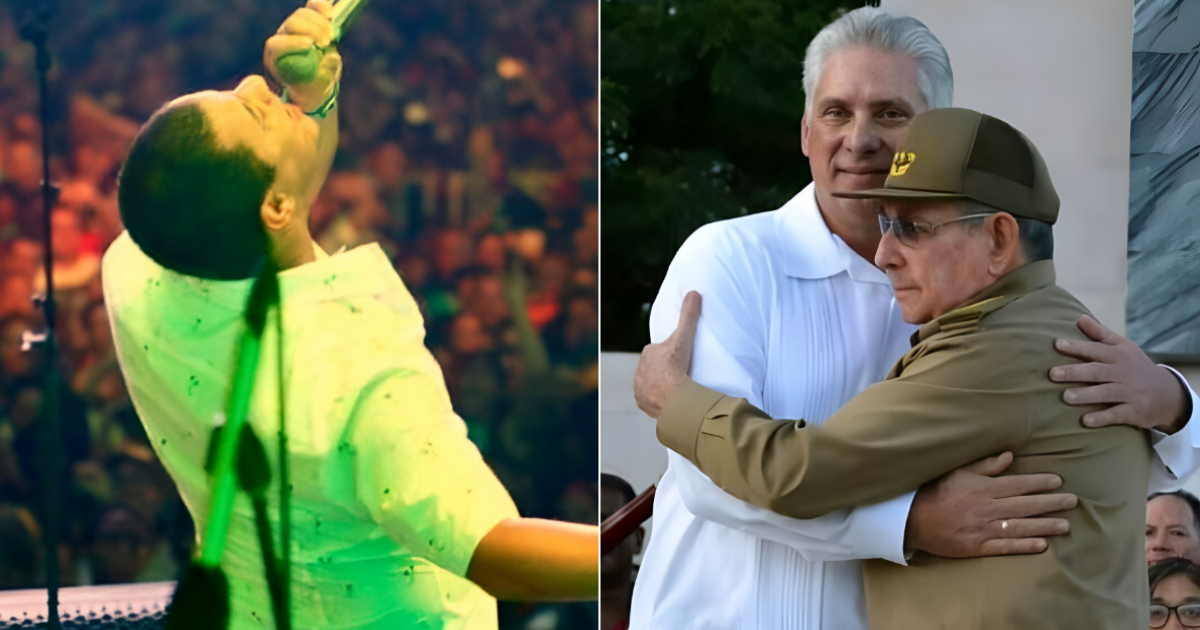
Israel Rojas, the prominent voice of the Cuban cultural establishment and leader of the duo Buena Fe, recently shared a Facebook post that, while attempting to appear epic and patriotic, ended up being a metaphorical act of defiance.
In his message, filled with anti-imperialist rhetoric, Rojas achieved what few in the officialist sphere dare to do: he referenced the "venerable elder" and his family, making it clear that he would not sacrifice his life for them.
"I will not fight or shed my blood for any president or general secretary of any political party. I will not fight for a venerable elder, nor for his son or grandson, nor for his family," Rojas wrote, a statement many interpreted as a direct nod to Raúl Castro and his lineage, including Mariela Castro Espín and Alejandro Castro (El Tuerto), as well as the well-known "Cangrejo," the grandson-bodyguard.
In essence, the troubadour who once set the slogans of the so-called "revolution" to music seems now weary of performing for the family that holds the microphone.
This is the same Rojas who was awarded the replica of General Máximo Gómez's machete by none other than General of the Army Corps and trusted Raúl ally, Álvaro López Miera; the Rojas linked with repressive actions during his time with the Ministry of the Interior (MININT) in Guantánamo, now declares his willingness to shed blood... but not for the Castros nor their dynasty, nor even their pawns and straw men.
However, true to the Buena Fe style, his breakaway comes wrapped in literary epic and recycled slogans: Martí, Fidel, the full dignity of man, Baraguá, the poor of the earth, and even Yolanda and Ojalá all blend in a monologue striving for transcendence, yet unable to mask the scent of disillusionment.
"I will fight for a sovereign Cuba," Rojas emphasized, "for my children, my nephews, and the children of my children." He added, with grandiosity: "Cuba carries in its blood the sacred fire of those who dreamed of a nation standing tall." A phrase that, in another context, might have fit a Ministry of Culture event but today, amidst Washington's threats and "national defense" exercises, sounds more like group therapy than a rallying cry.
The musician didn't abandon the revolutionary script but distanced himself from its performers. His "Patria o Muerte" was more aesthetic than political, more slogan than militancy. Without naming them, he excluded the Castros and their heirs from the altar, the same figures many of his peers still vow eternal loyalty to.
The result is a curious piece: a patriotic ode wrapped in controlled rebellion, attempting to salvage the myth of the "revolution" while sacrificing its "saints."
Or, put with irony, it's the song of a faithful who no longer wishes to sing for the grandfather or the grandson but still believes in the shrine.
Understanding Israel Rojas' Statement
What did Israel Rojas mean by his statement?
Israel Rojas expressed his unwillingness to fight or die for the Castro family, symbolized by the "venerable elder" and his descendants, highlighting a shift from his previous alignment with the Cuban cultural officialdom.
Who is the "venerable elder" mentioned by Rojas?
The "venerable elder" is interpreted as a reference to Raúl Castro, the prominent figure in Cuba's political landscape and the Castro family's patriarch.