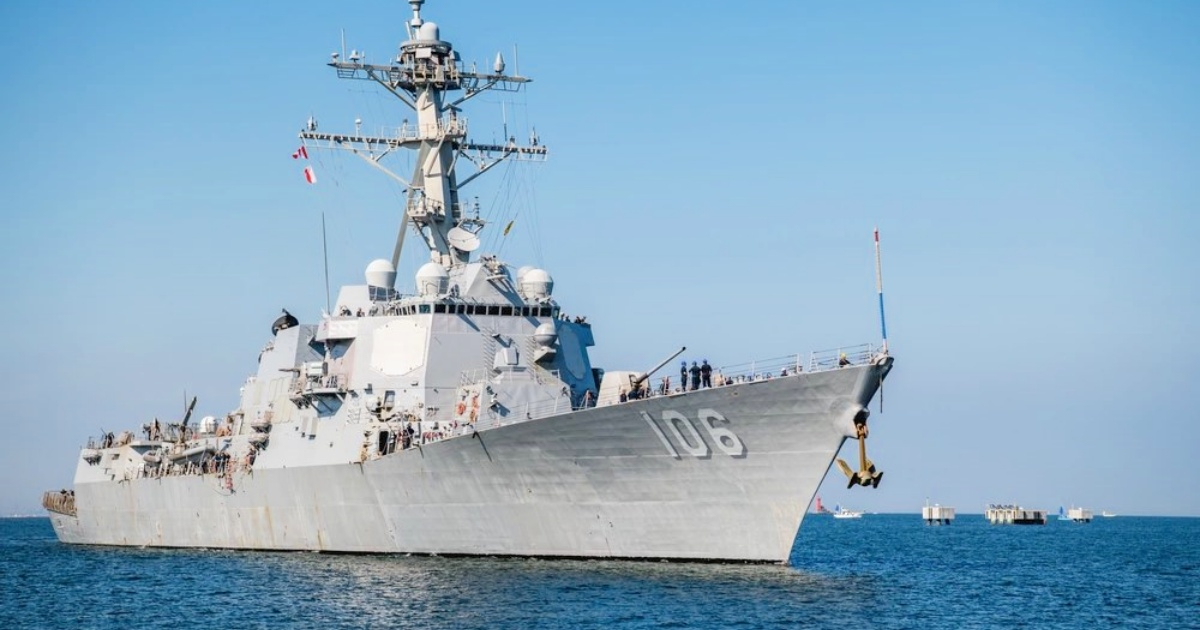
This week, the Caribbean Sea saw the arrival of three U.S. warships sailing close to Cuba's eastern tip en route to Port-au-Prince Bay, Haiti's capital.
Led by the missile destroyer USS Stockdale and accompanied by two Coast Guard vessels, this deployment highlights the increasing militarization of the region, officially under the guise of combating drug trafficking.
The U.S. Embassy in Haiti announced this move via a statement on social media platform X, noting that, per orders from Defense Secretary Pete Hegseth, "The USS Stockdale, USCGC Stone, and USCGC Diligence have reached Port-au-Prince Bay as part of Operation ‘Southern Spear.’”
The statement, also shared by the Southern Command, emphasizes that the mission is part of a regional security initiative aimed at reaffirming Washington's commitment to Haiti's stability.
"Their presence underscores the United States' strong commitment to security, stability, and a brighter future for Haiti. The U.S. Navy and Coast Guard reiterate their collaboration and support to ensure a safer and more prosperous Haiti," the statement added.
Political Instability in Haiti: A Nation on the Edge
This military arrival occurs amid a period of severe instability in Haiti. With the expiration of the Transitional Presidential Council (TPC)'s mandate on February 7 looming, the Caribbean nation faces an imminent power vacuum.
The absence of an announced electoral schedule or clear political succession mechanism has exacerbated the paralysis, alongside escalating violence that grips the nation’s streets.
Armed criminal organizations control vast portions of the country, committing crimes such as murders, rapes, looting, and kidnappings, amid a long-standing security crisis.
Beyond the military deployment, the U.S. government has declared new visa restrictions against senior Haitian officials, including TPC members, accused of links to gangs operating on the island.
Concerns in Cuba: The Proximity of U.S. Military Forces
While the official narrative frames the U.S. mission in terms of anti-narcotics and organized crime efforts, the proximity of these warships to Cuba—less than 400 kilometers from Santiago de Cuba and just 80 kilometers from Cuba's eastern edge—has not gone unnoticed by regional geopolitical analysts.
Cuba, though silent publicly, views any U.S. military deployment near its shores with suspicion, particularly when involving offensively capable warships like the USS Stockdale.
This development rekindles memories of past Caribbean tensions and raises concerns about the increasing militarization near the island amidst heightened regional conflict and internal fragility in neighboring countries.
Official Narrative: Regional Security and the Drug War
Operation Southern Spear is part of a broader campaign initiated by Defense Secretary Hegseth, which includes naval deployments, military aircraft, and tactical presence at strategic points in the Caribbean and eastern Pacific.
The Pentagon states these efforts aim to intercept vessels utilized by drug cartels for narcotics transportation northward.
According to U.S. figures, over 100 suspected criminals have died in maritime confrontations or interdiction actions since the operation began.
In this regional context, on January 3, U.S. authorities arrested Venezuelan leader Nicolás Maduro in New York on formal narcotics charges, interpreted by some analysts as a shift in the U.S. hemispheric security strategy, now explicitly linking organized crime to regional political actors.
A Strategic Caribbean: The Bigger Picture
While the military deployment in Haiti is framed as support for the country's stability and the drug war, the geopolitical context suggests a broader operation.
The presence of warships less than 100 kilometers from Cuba, the arrest of Latin American political leaders on drug charges, and coordination with diplomatic efforts at the UN paint a new power landscape in the Caribbean.
Haiti’s situation not only reflects state collapse but also the increasing influence competition and regional military presence in a key area for migration routes, trade, and strategic control of the Western Hemisphere.
As in previous critical regional moments, the Caribbean is once again at the epicenter of the continent's diplomatic, military, and economic tensions.
Key Questions About U.S. Military Actions in the Caribbean
What is the main objective of Operation Southern Spear?
Operation Southern Spear aims to enhance regional security by targeting maritime drug trafficking routes used by cartels between Latin America and the United States.
Why is the U.S. deployment near Cuba significant?
The deployment is significant due to its proximity to Cuba, which historically views U.S. military actions near its territory with suspicion, increasing regional tensions.
How does the political situation in Haiti impact the region?
Haiti's political instability and security crisis contribute to regional instability, influencing migration patterns, and potentially affecting regional security dynamics.