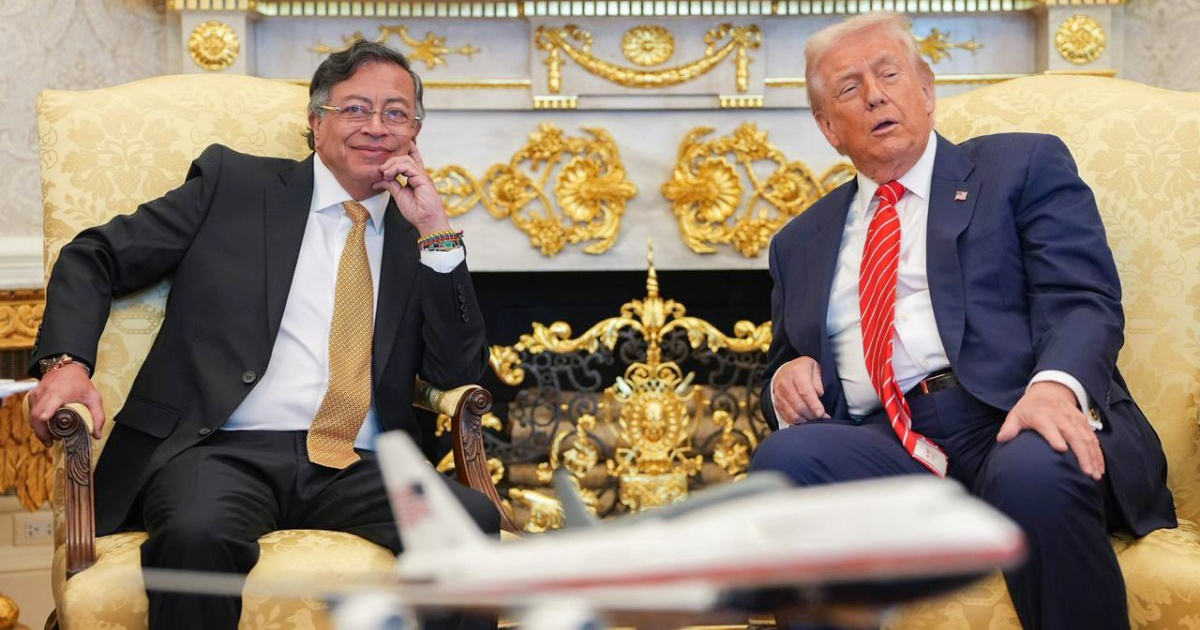
On Tuesday, U.S. President Donald Trump welcomed Colombian President Gustavo Petro to the White House amid one of the most strained periods in U.S.-Colombia relations in recent decades.
This meeting, held behind closed doors, marked the first official encounter between the two leaders, whose ideological differences and public disputes have significantly influenced their respective administrations.
Petro's arrival in Washington was anything but typical.
Despite arriving in an official Secret Service vehicle bearing the Colombian flag, President Petro was neither greeted by Trump nor the customary military honor guard at the entrance. Additionally, there was no ceremonial protocol or joint press statements, in stark contrast to recent visits by leaders like Javier Milei or Nayib Bukele.
The meeting itself was conducted privately, with no media access and without the usual images of initial discussions in the Oval Office.
However, the Colombian Presidency released official photos showing Trump and Petro shaking hands in the West Colonnade and later sitting in a relaxed manner in the Oval Office.
A Robust Delegation and Sensitive Topics
Both delegations arrived with a full agenda.
Accompanying Trump were Vice President JD Vance, Secretary of State Marco Rubio, and Colombian-American Senator Bernie Moreno. Petro's entourage included Foreign Minister Rosa Yolanda Villavicencio, Defense Minister Pedro Arnulfo Sánchez Suárez, Interior Minister Armando Benedetti, Ambassador to Washington Daniel García-Peña Jaramillo, along with key figures like Ecopetrol President Ricardo Roa and National Intelligence Director René Guarín.
The discussions centered on three main areas: regional security cooperation, combating drug trafficking, and shared economic opportunities. According to Colombian government sources, topics such as illicit crop substitution, extradition of drug traffickers, and the future of bilateral trade agreements were also addressed.
Drug Trafficking: The Primary Source of Tension
The issue of drug trafficking has been a major source of tension over the past year.
The Trump administration has accused Petro of encouraging cocaine production and trafficking, even withdrawing Colombia's certification as a cooperating country and revoking his visa.
Last October, the Treasury Department added Petro, his wife, and his son to the "Clinton List," a measure that entails financial sanctions and legal restrictions.
"Today's Colombia is led by a sick man who likes to make cocaine and sell it to the United States," Trump stated last month, remarks that ignited diplomatic tensions and protests in Bogotá.
Nonetheless, the recent capture of Nicolás Maduro by U.S. forces in January—which Petro described as an "abduction"—and a subsequent phone call between the two leaders opened the door for dialogue.
Trump noted, "Somehow, after the raid in Venezuela, he became very friendly. His attitude changed a lot."
The White House issued a special visa for Petro to enter the country, and just hours before the meeting, Colombia extradited alleged drug trafficker Andrés Felipe Marín Silva, aka Pipe Tuluá, in a gesture seen as an attempt to de-escalate the conflict.
Conflicting Statements and Contradictory Gestures
The meeting unfolded in a context of significant contradiction.
While seeking rapprochement with Trump in Washington, Petro had called on Colombians to mobilize in the streets of Bogotá during his White House visit, an act many interpreted as symbolic pressure before the public.
In a video released just before the meeting, the Colombian leader stated, "Most of my children live outside the country because of the fight against drug trafficking that we have waged. Because we have truly suffered it directly."
Simultaneously, his government resumed deportations of Colombians to the United States, a policy suspended months earlier, another gesture well-received by the Republican administration.
A Pragmatic Alliance Amid Disagreement
Historically, Colombia has been the main ally of the United States in South America on matters of security, anti-drug efforts, and military cooperation.
However, the relationship between Petro and Trump has been marked by belligerent rhetoric and mutual accusations.
Petro has labeled the U.S. president a "genocide accomplice" in Gaza and has harshly criticized U.S. military deployments in the Caribbean, as well as attacks on suspected vessels that, according to recent data, have caused at least 126 deaths in 36 known operations.
Despite their differences, both leaders share one characteristic: unpredictability. This has left a cloud of uncertainty over the real content of their meeting.
It remains unclear whether a joint statement will be issued later, although Petro has announced a press conference at the Colombian embassy in Washington.
The question remains: Will this be the beginning of a new chapter between Washington and Bogotá, or just a temporary truce to avoid a greater crisis?
Key Issues in U.S.-Colombia Relations
What was the main focus of the Trump-Petro meeting?
The meeting primarily focused on regional security cooperation, combating drug trafficking, and exploring shared economic opportunities.
Why was Gustavo Petro added to the "Clinton List" by the U.S. Treasury Department?
The U.S. Treasury Department added Petro to the "Clinton List" due to accusations of encouraging cocaine production and trafficking, leading to financial sanctions and legal restrictions.
How did Colombia respond to U.S. concerns about drug trafficking?
Colombia extradited alleged drug trafficker Andrés Felipe Marín Silva to the United States as a gesture to de-escalate tensions and address U.S. concerns.