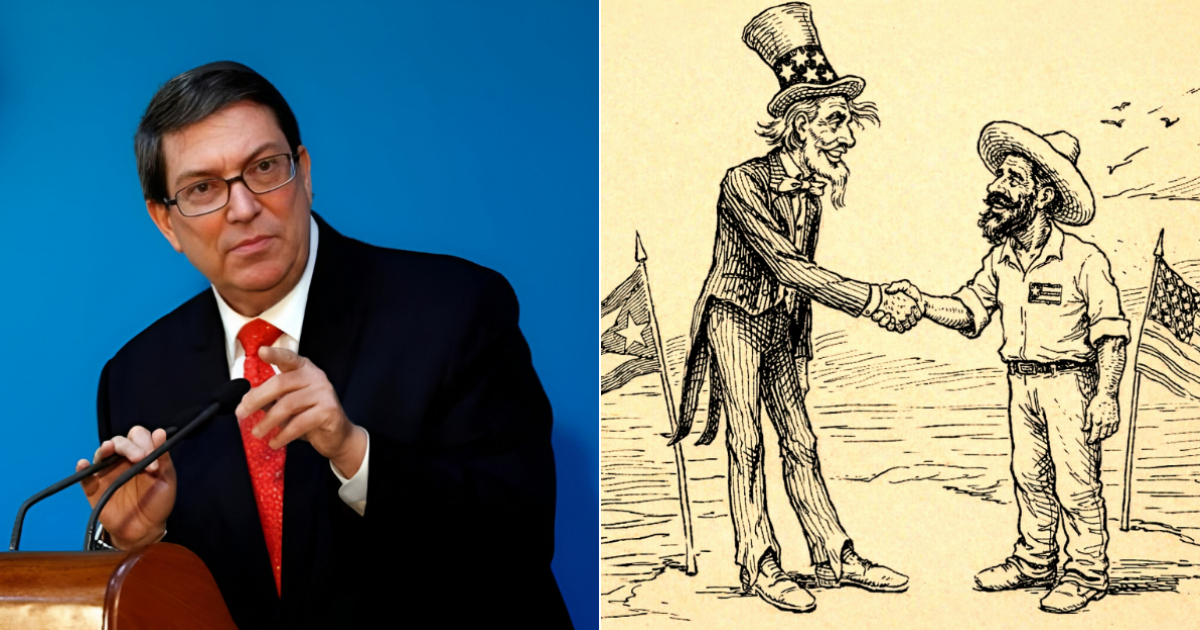
News of the recent announcement from Cuba's Ministry of Foreign Affairs (MINREX), where the Cuban regime notably avoided mentioning the "blockade" and instead discussed "cooperation and mutual respect" with the United States, has triggered an unprecedented wave of reactions.
In just twenty-four hours, over 2,600 comments flooded the social media pages of CiberCuba. It wasn't an ideological debate but rather a surge of emotions: disbelief, anger, sarcasm, relief, and above all, exhaustion. The regime attempted to project diplomatic maturity; the public saw it as a "surrender."
Right from the start, the tone was set with mockery. "They've surrendered and are now on their knees," someone remarked amidst a flurry of laughing emojis. Another quipped, "Seventy years claiming a blockade existed, and now that there's a real one, they're open to dialogue."
This sharp irony, so characteristically Cuban, served as a collective means to express a shared sentiment: no one believes them anymore. Neither those residing on the island nor those observing from exile.
The "blockade" narrative has died, taking with it the moral excuse of a regime that used the term as a smokescreen for six decades. The comments echoed a common sentiment: MINREX's language doesn't signify genuine openness but a desperate maneuver.
"Every time they're in a bind, they resort to dialogue," one reader noted. "This isn't diplomacy, it's a lifeline." Others, more skeptical, labeled it as "theater," "trickery," "maneuver," or "smoke screen."
For many, the government's conciliatory language merely reflects fear of Washington's new policies. "They're not seeking peace," reads a widely liked comment. "They're buying time."
The perception that the regime is "kneeling" to survive is nearly unanimous. Where national dignity was once touted, now it's about the survival of power.
"They have no choice but to open up," one person wrote, with the bluntness of a Cuban who no longer hides their disdain. Others put it more analytically: "When the government stops blaming the blockade and avoids mentioning Fidel, it's not diplomacy; it's panic. They change their discourse because no one believes them anymore."
The phrase was repeated in various forms, summarizing the collective feeling: the Castro regime doesn't negotiate, it disguises itself.
Amidst sarcasm and indignation, Donald Trump emerges as a liberating figure. His name appears more frequently in discussions than Miguel Díaz-Canel's. He is revered as a symbol of strength, the man who "won't be fooled," the only one capable of "tightening the noose" until the Castro regime falls.
Alongside him, Marco Rubio is seen as the mastermind behind the strategy. "Trump doesn't ease up, and Marco won't be confused," someone wrote. "That duo has them scared," another added bluntly. In the exile community's narrative, the Trump-Rubio duo embodies a historical reckoning: the moment of settling scores with the regime.
In contrast, the word "dialogue"—which in any other nation might signify hope—translates to betrayal in the Cuban lexicon. Hardly anyone defends it. "We don't want dialogue, let them go," is repeated many times. "You don't talk to communists"; "Dialogue only serves them to buy time."
Some even turn it into a joke: "They're already strumming the guitar"; "When you see a communist talking, buy Vaseline." The official rhetoric, once based on heroic resistance, has become a subject of ridicule. And humor, a form of rebellion.
The disillusionment permeates all tones. Many comments are lengthy, personal, almost confessional. People declare themselves exhausted, fed up with double standards and daily misery.
"Slogans don't provide bread or medicine," one woman wrote. "We want light, water, food, and freedom. Nothing more." Another added, "Hate doesn't feed, nor does silence. It's time to live."
There is a rational despair that no longer seeks heroes or speeches, only concrete solutions: electricity, food, stability. Cuba is tired even of the words that once defined it.
Other comments recall, with nostalgia or resignation, the idea of respect and sovereignty. In them, the old revolutionary rhetoric can be heard, though now seemingly without echo. Most respond with skepticism or outright mockery: "Sixty years of equality and we're still eating air."
The divide is evident even across generations. Younger Cubans, both inside and outside the country, speak with a brutal, uninhibited language, stripped of solemnity. "This is over"; "Out with everyone"; "No respect is worth it," they write.
The older generation appeals to caution, the memory of harsh years, or the need to avoid war. But everyone agrees on one thing: the system doesn't work. Communism, as a word and a model, no longer inspires; it provokes rejection or laughter.
Among the thousands of messages, one of the most cited sums up the general atmosphere: "After sixty-seven years of manipulating emotions and blaming the blockade, the regime can only offer a piece of paper and a change in tone. But the facts remain the same: hunger, repression, and exile."
This is the prevailing perception: MINREX may change the words, but not the reality. The announcement may sound diplomatic, but the streets hear the echo of an imminent defeat.
The comments also mix in improvised geopolitical analyses, personal memories, conspiracy theories, and surprisingly lucid reflections. One user wrote: "No external blockade surpasses the internal blockade. The lack of economic and political freedom is the real wall."
Another added: "This generation wants to be the parent of its present and stop being the child of the past. What's coming is called change." Amid insults, prayers, and sarcasm, a deeper thought emerges: the recognition that the "revolutionary" cycle is exhausted.
The final message, though scattered, is unequivocal. Cuba no longer debates ideologies. It debates its survival. The people do not expect promises or dialogue; they demand action. "Release political prisoners, return what's been stolen, hold free elections," they repeat.
In a country where official language has always been a trench, the popular reaction to MINREX's new discourse is historic: the first time the people massively respond not with fear, but with mockery.
Because when laughter replaces silence, something has irreversibly broken. The "blockade" no longer serves as an excuse, the word "revolution" has lost its meaning, and the people, amid sarcasms and spells, seem to have reached a certainty: there is no turning back.
The Cuban regime may talk of dialogue, but the real country—the one that comments, laughs, prays, and complains—no longer listens.
Understanding Cuba's Shift in Rhetoric and Public Reaction
Why is the Cuban Ministry of Foreign Affairs changing its rhetoric?
The Cuban Ministry of Foreign Affairs has altered its rhetoric from a focus on the "blockade" to "cooperation and mutual respect" with the United States, likely as a response to changing international dynamics and internal pressures. This shift may reflect desperation or an attempt to adapt to new U.S. policies under the Biden administration.
How did the Cuban public react to the MINREX's new tone?
The Cuban public reacted with a mix of disbelief, sarcasm, and frustration. Many saw the change in rhetoric as a sign of surrender rather than genuine diplomatic maturity. Social media was flooded with comments expressing skepticism and a lack of trust in the regime's intentions.
Why do some Cubans view the word "dialogue" as betrayal?
In the Cuban context, "dialogue" is often seen as a tactic for the regime to buy more time rather than a genuine attempt to resolve issues. This perception stems from a history of unfulfilled promises and lack of meaningful change, leading many to view dialogue as a betrayal of the people’s needs for freedom and basic necessities.
What does the public sentiment indicate about the future of Cuba?
The widespread disbelief and mockery in response to the MINREX's announcement suggest a significant shift in public sentiment. There is a growing demand for concrete actions over rhetoric, indicating that the Cuban people are increasingly disillusioned with the current regime and are seeking real change.