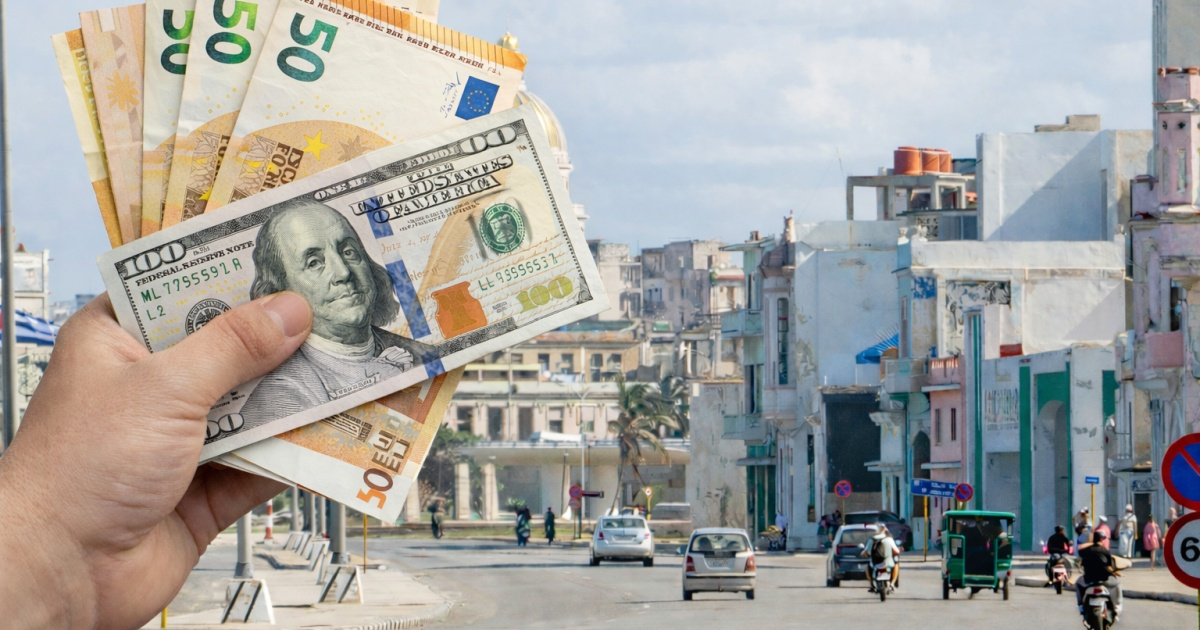
In a day of fluctuations in Cuba's informal currency market, the dollar has seen an increase while the euro has declined.
As of 7:00 a.m. on February 3, the dollar has risen to 490 CUP, marking an increase of five pesos compared to its value since January 26, as reported by the independent outlet elTOQUE.
Conversely, the euro has decreased for the second consecutive day, dropping from 438 to 435 CUP, a three-peso descent compared to this past Monday.
Meanwhile, the Freely Convertible Currency (MLC), the virtual currency used by the Cuban regime, remains steady at 400 CUP, a consistent value over recent weeks.
These numbers underscore the widespread lack of trust in the national currency and the increasing dollarization of the informal economy, where access to foreign currencies determines the actual purchasing power of the people.
On the streets and social media, the dollar and euro are viewed as safe havens against inflation and the persistent erosion of the CUP's buying power.
Exchange rates on February 3, 2026, at 7:15 a.m. in Cuba, according to elTOQUE, are as follows:
- USD to CUP: 490 CUP
- EUR to CUP: 535 CUP
- MLC to CUP: 400 CUP
The unofficial exchange rate in Cuba continues to reflect the country's true economic condition, far surpassing the official rates maintained by the government.
Furthermore, the "floating rate" system for the dollar and euro, introduced in mid-December 2025, has failed to impact or alter the trajectory of the informal currency market.
The weakness of the Cuban peso stems directly from several structural issues: an inefficient state-run economy, a collapsed national production system, a lack of foreign investment, and repression of the private sector.
Moreover, the dual currency system and exchange restrictions have distorted prices and widened inequalities.
The most visible outcome is the rapid impoverishment of the population: salaries in pesos barely cover a fraction of basic needs, while essential goods—such as food, medicine, and fuel—are sold in foreign currencies or at prohibitive prices.
This disparity between the peso and stronger currencies not only highlights the economic crisis but also reflects the complete loss of credibility in the Cuban financial system.
Conversion rates for U.S. Dollar (USD) to Cuban Peso (CUP) as of February 3:
- 1 USD = 490 CUP
- 2 USD = 980 CUP
- 5 USD = 2,450 CUP
- 10 USD = 4,900 CUP
- 20 USD = 9,800 CUP
- 50 USD = 24,500 CUP
- 100 USD = 49,000 CUP
Conversion rates for Euros (EUR) to Cuban Peso (CUP):
- 1 EUR = 535 CUP
- 5 EUR = 2,675 CUP
- 10 EUR = 5,350 CUP
- 20 EUR = 10,700 CUP
- 50 EUR = 26,750 CUP
- 100 EUR = 53,500 CUP
Understanding Cuba's Currency Challenges
Why is the dollar gaining value in Cuba's informal market?
The dollar is gaining value due to widespread distrust in the Cuban peso and the increasing tendency towards dollarization of the informal economy, which is seen as a more stable and reliable store of value.
What impact does the currency fluctuation have on Cuban citizens?
Currency fluctuations significantly impact Cubans by decreasing their purchasing power, as essential goods are often priced in foreign currencies, making them less affordable.
How does the "floating rate" system affect the informal market?
The "floating rate" system has not affected the informal market as it was intended to, with unofficial rates continuing to dictate economic realities over government-set rates.