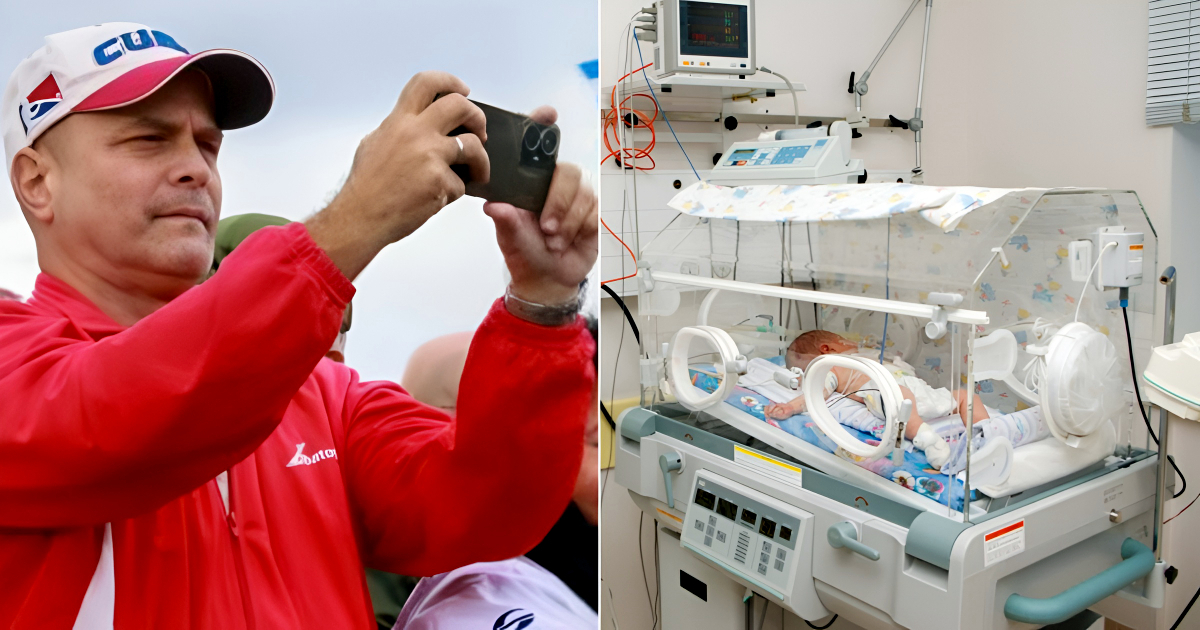
Once again, Gerardo Hernández Nordelo, the former spy and current coordinator of Cuba's Committees for the Defense of the Revolution (CDR), finds himself in the spotlight for all the wrong reasons. Hernández Nordelo recently posted an image, originally taken in an Argentine hospital, to misrepresent the effects of U.S. sanctions on Cuba.
On his Facebook page, the ex-operative shared a photo of a baby inside a medical incubator, accompanied by a message directed at U.S. Senator Marco Rubio, saying: "Explain to him how your 'no oil for Cuba' policy will only hurt 'the regime'!" However, the image did not originate in Cuba. Instead, as highlighted by user @pues__soy__Clau and journalist Mario J. Pentón, it belongs to Materna Argentina's photo bank and is commonly used in Argentinian media discussing neonatology.
Pentón criticized Hernández on his X account, stating, "Gerardo Hernández, a former regime spy, is deceptively sharing a photo of a baby in an incubator from an Argentine hospital, falsely presenting it as if it were from Cuba, clearly aiming to manipulate public opinion."
@pues__soy__Clau confirmed the photo's origin by sharing a reverse Google search screenshot that clearly identifies its Argentine source. Outraged by the deception, she added, "These communists are a joke."
This incident adds to a history of fake news propagated by the communist leader, who had been previously condemned in 2025 for spreading another manipulated image involving a Cuban singer and a detained woman in Miami.
Hernández's Strategy of Emotional Manipulation
Hernández Nordelo's tactics follow a familiar pattern: appealing to emotions to fabricate false narratives that bolster the official Cuban discourse and blame the U.S. embargo for the country's woes, even when the images used have no connection to the island.
Despite the regime's claims of a "media war," Hernández's actions underscore that misinformation is a fundamental part of this conflict, with the truth being its primary casualty.
Real Health Crisis in Cuba
Hernández's use of misleading imagery coincides with a very real health crisis in Cuba, marked by alarming rates of chikungunya and dengue infections, particularly among children.
In November, Dr. Francisco Durán García, National Director of Epidemiology, highlighted that chikungunya severely impacts young people. Among the 95 patients in intensive care, 63 were minors, with 16 in critical condition. The virus remained active in 14 provinces, including Santiago de Cuba and Havana, with a high Aedes aegypti mosquito infestation index.
Dr. Durán warned, "Pay close attention to children and young people, as they are more vulnerable," acknowledging the complexity of the situation nationwide.
By December, the Ministry of Public Health (MINSAP) confirmed at least 44 official deaths from dengue and chikungunya, mostly children and teenagers, although medical sources cited much higher numbers and systematic underreporting. During one week alone, eight pediatric deaths were confirmed, with nine more minors in critical condition, according to Vice Minister Carilda Peña García.
In Sancti Spíritus, the crisis's epicenter, seven newborns were treated in neonatal intensive care for chikungunya, and one infant succumbed to the illness, as confirmed by Carlos Ruiz Santos, the provincial director of Hygiene and Epidemiology. MINSAP admitted that 71 patients, including neonates and pregnant women, remained in serious or critical condition.
Dr. María Eugenia Toledo Romaní from the Institute of Tropical Medicine Pedro Kourí warned that this is Cuba's first major chikungunya outbreak, and the country is not yet equipped to predict long-term control outcomes.
As hospitals struggle with outdated equipment, oxygen shortages, frequent blackouts, and a complete lack of medications, infant mortality in Havana has surged to 14 per 1,000 live births, the highest in three decades.
In this context, Hernández's propaganda not only trivializes the real suffering of countless Cuban families but also attempts to fabricate empathy through deception, when the grim reality of a sick, overwhelmed, and neglected Cuba is already devastating enough.
The Impact of Disinformation on Cuba's Health Crisis
What was Gerardo Hernández accused of regarding the baby photo?
Gerardo Hernández was accused of using a misleading photo of a baby from an Argentine hospital to falsely represent it as being from Cuba, aiming to manipulate public perception about U.S. sanctions.
How is the health crisis in Cuba affecting children?
The health crisis in Cuba, particularly involving chikungunya and dengue, is severely affecting children, with many requiring intensive care and a significant number of fatalities reported.
What are the challenges faced by Cuban hospitals during the health crisis?
Cuban hospitals are dealing with outdated equipment, oxygen shortages, frequent power outages, and a complete lack of essential medications, exacerbating the health crisis.